Hong Kong incorporation fee & Aspire
 cashback.


Table of Contents
Understanding how dividend declared works is essential for Singapore companies seeking transparent profit distribution and proper statutory compliance.
In Singapore, dividends can only be paid out of profits, never out of share capital, and once shareholders formally declare a final dividend it becomes a debt owed by the company and is recorded as a liability.
For company owners, CFOs, and investors, knowing the correct procedures for declaring dividends, from resolutions to payment, helps prevent compliance risks and ensures smooth corporate governance.
This guide explores every key aspect of dividend declared in Singapore, including declaration rules, calculation methods, tax treatment, and accounting entries.
Key Takeaways
- Under section 403 of the Companies Act 1967, a Singapore company may pay dividends only out of profits — never out of share capital.
- A final dividend is declared by shareholders in a general meeting by ordinary resolution, capped at the amount the directors recommend. An interim dividend is paid on a directors’ resolution alone.
- Once a final dividend is validly declared it becomes a debt owed to shareholders. An interim dividend can generally still be rescinded by the board before payment.
- Dividends from a Singapore tax-resident company under the one-tier system are exempt in shareholders’ hands. The exceptions are narrow: co-operatives, certain foreign dividends received through a Singapore partnership, and certain REIT distributions.
- A director who wilfully pays a dividend otherwise than out of profits commits an offence under s.403(2) and is liable to the company’s creditors for the excess.
What are dividends declared?
Dividends declared refer to the amount of profits that a company has formally approved for distribution but has not yet paid to shareholders. Once approved, these dividends are no longer part of retained earnings. Instead, they are reclassified as a liability because the company becomes legally obligated to settle the amount.
Under Section 403 of the Companies Act 1967 — headed “Dividends payable from profits only” — a company may pay dividends only out of profits, not out of share capital. Note that “profits” is not defined in the Act, so it is not simply equal to retained earnings.
In Singapore financial reporting, dividends declared are typically presented as a current liability, unless the payment will occur more than twelve months after the reporting date. The amount is usually disclosed in the balance sheet or in the notes to the financial statements as part of the company’s distribution commitments.
What is a dividend declaration?
Generally, a dividend declaration is an event where you announce the dividend payment to shareholders.
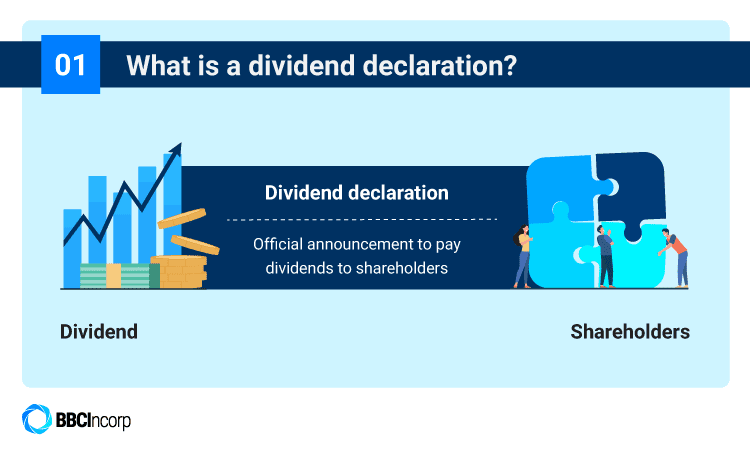
While dividends declared refer to the amount already approved for distribution, a dividend declaration describes the process that leads to this approval. It is the formal corporate action through which a company authorizes the payment of dividends.
A dividend declaration requires a resolution, passed by the board of directors for interim dividends, and the directors must satisfy themselves that the company has profits available. Section 403 of the Companies Act 1967 provides that dividends are payable only out of profits, so a company cannot fund a distribution from share capital. The test is applied to the company’s own position, not to that of any group it belongs to.
The declaration also establishes key details such as the dividend amount, entitlement date, and payment timeline. Once a final dividend has been validly declared by shareholders it becomes a debt owed by the company and cannot be cancelled or reduced unilaterally.
An interim dividend works differently: because it is paid on the directors’ authority and does not create a debt until payment is made, the board can generally rescind or vary it before it is paid.
Types of dividends in Singapore
There are several types of dividends you can choose to pay out to your shareholders.
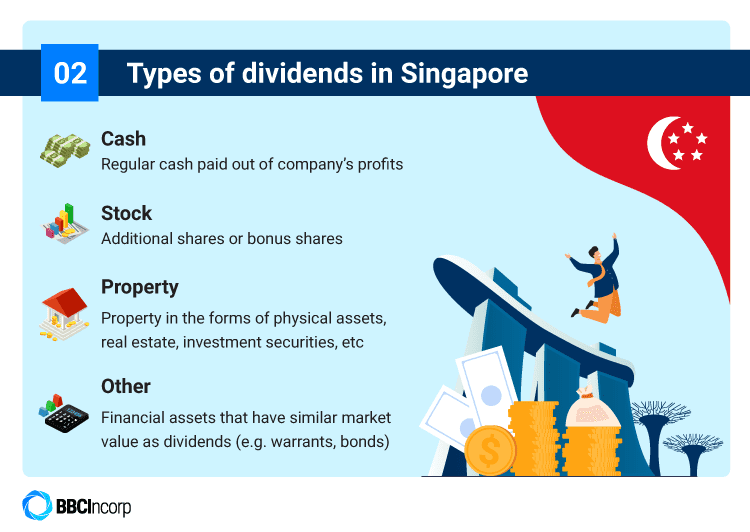
Singapore companies may issue several types of dividends depending on their structure, profits, and shareholder arrangements. While public-listed companies may offer more complex dividend instruments, most private limited companies in Singapore typically use straightforward forms of profit distribution.
Not every form below is open to every company, so they are grouped by who can actually use them:
Available to private limited companies
Declare cash dividend
A cash dividend is the standard form of distribution where profits are paid directly to shareholders’ bank accounts. It is the simplest and most widely used dividend type among Singapore private limited companies.
Special Dividend
A one-off dividend paid outside of the company’s usual distribution schedule, typically arising from exceptional profits, asset disposals, or surplus cash.
Dividend in specie (asset dividend)
Instead of cash, the company distributes specific assets — for example shares in another company, debentures, or property. Under regulation 109 of the Model Constitution, a general meeting declaring a dividend may resolve to satisfy it wholly or partly by distributing specific assets, and the directors must give effect to that resolution.
Listed companies only
Stock Dividend
Instead of cash, shareholders receive additional shares. A scrip dividend — a related but distinct arrangement, in which shareholders elect to take new shares in place of a cash dividend — is used by SGX-listed issuers and is governed by the SGX Listing Rules. Where new securities are offered, the Securities and Futures Act 2001, administered by MAS, also applies.
Dividend Reinvestment Plans (DRIPs)
A DRIP allows shareholders to reinvest their dividends into newly issued shares. DRIPs are used by listed companies, not by private limited companies.
How to declare dividends in Singapore
Normally, declaring final dividends and interim dividends will require different rules.
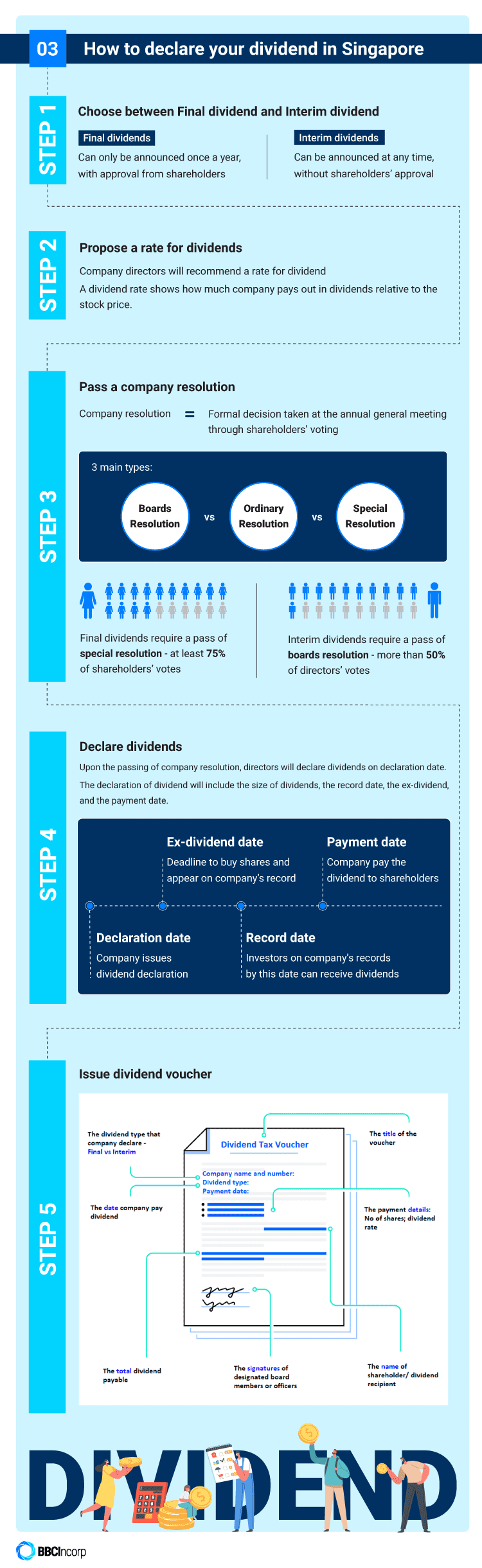
To summarize, you can wrap up the declaration in five simple steps as follow:
Step 1: Final dividends vs Interim dividends
Declaring your dividend will involve choosing between a final dividend and an interim dividend.
Final dividends can only be announced once a year, with approval from shareholders.
You can pay out final dividends after publishing your company’s financial statement and confirming your profits for the year.
Interim dividends, on the other hand, can be announced at any time, without shareholders’ approval.
You can payout interim dividends before the annual general meeting (AGM) and the confirmation of your annual profits.
Step 2: Propose dividend rate
As a company director, you’ll need to recommend a rate for your dividend.
Generally, a dividend rate shows how much your company pays out in dividends relative to the stock price.
Step 3: Pass special resolutions
Once you propose your dividend rate, you’ll need to pass a company resolution to declare dividends.
Put simply, a company resolution is a formal decision taken at the annual general meeting by voting.
The shareholders can vote on the resolution either by hand or by poll.
There are certain types of resolutions you need to take notice of:
- Board resolutions
This type of resolution requires a simple majority of votes to pass (i.e. more than 50%), or approval by all of the directors of your company. Under the Model Constitution, questions at a board meeting are decided by a majority of votes (reg 84), while a resolution in writing must be signed by all the directors entitled to notice of a board meeting (reg 93).
Typically, you’ll need to pass a board resolution to declare interim dividends.
You can find an example of board resolutions for dividend declaration in Singapore here.
- Shareholder’s resolution
The shareholder’s resolution can take the form of an ordinary resolution or a special resolution.
An ordinary resolution needs a simple majority at a meeting to pass whereas a special resolution requires at least a 75% majority of votes.
To declare final dividends, you’ll need a pass of special resolution.
For your reference, a special resolution in Singapore will look like this.
Step 4: Declare dividend singapore company
Upon the passing of the company resolution, you can officially declare your dividend on declaration date.
Specifically, your declaration will include the size of dividends and dividend dates such as the record date, the ex-dividend, and the payment date.

List of dividend dates
- Record date is the date by which the investor must be on the company’s records in order to receive a dividend.
- Ex-dividend date is the deadline by which investors must buy shares to qualify for the dividend payment, usually 1-2 days before the record date.
- Payment date is the date on which company pay the dividend to shareholders
For example, your company declared a dividend on November 10th, 2021 (declaration date) of US$0.40 per share (size of dividend) payable on December 20, 2021 (payment date) to shareholders of record as of November 30, 2020 (record date).
If you choose to declare final dividends, you cannot revoke or cancel them in any way. But if you declare interim dividends, you can cancel or modify them without legal entanglement.
However, it is always recommended that you stick to the approved declaration to not upset your shareholders.
Step 5: Issue dividend voucher
After the declaration of the dividend, make sure you issue dividend vouchers to your shareholders.
Essentially, it is a dividend receipt that records all details of dividend payment, including the name of shareholders, date of issue, number of shares, total dividend paid, and more.
Your company’s dividend voucher will look something like this.
How to calculate dividends declared
Calculating dividends declared starts with establishing how much the company can lawfully distribute. Section 403 of the Companies Act 1967 allows dividends to be paid only out of profits, so accumulated profits — not cash at bank, and not share capital — set the ceiling.
There is no statutory formula for the amount itself: under regulation 103 of the Model Constitution the directors recommend a figure and the shareholders declare it in general meeting, and they cannot declare more than the directors recommended.
In practice, companies work from a per-share figure. Regulation 107 requires dividends to be declared and paid by reference to the amounts paid or credited as paid on the shares, so the total is:
Run this for each class of shares that carries a dividend right, add the results, and check the total against distributable profits before the resolution is passed. Where the company has more than one class with different rights, confirm the priority and rate for each class in the constitution or terms of issue before calculating.
For per-share analysis, companies may also calculate dividends on a per-share basis. This mirrors the method used in global accounting and investment standards, including IFRS-aligned frameworks and investor guides:
This dual approach allows companies to calculate both the total dividend amount and the per-share allocation, ensuring transparency and proportional distribution for all shareholders.
How to find dividends declared
Dividends declared can be identified by reviewing a combination of a company’s financial statements and its statutory corporate records. Once dividends are formally approved, they reduce retained earnings and create a liability that remains outstanding until the payment is made.
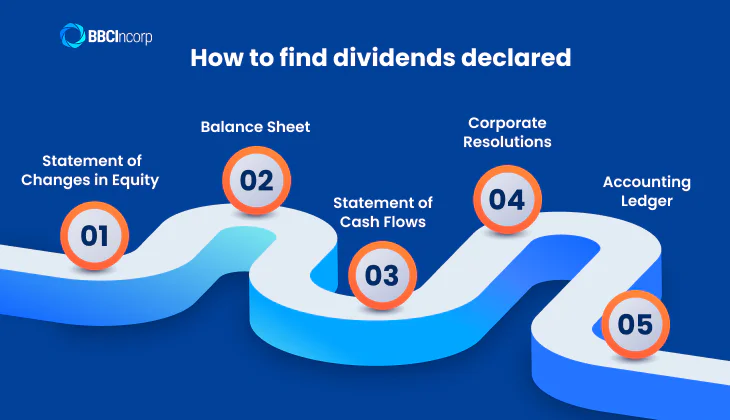
Several documents together provide a complete and reliable picture of dividends declared:
Statement of Changes in Equity
This statement captures movements within the equity accounts. A deduction in retained earnings recorded here is one of the clearest financial indicators that dividends have been declared for the period.
Balance Sheet
Declared but unpaid dividends appear as a current liability under “Dividends Payable.” This reflects the company’s legal obligation to distribute the approved amount to shareholders.
Statement of Cash Flows
Although this statement does not record dividends declared, it reports dividends paid under financing activities. Reviewing this section helps distinguish between what has merely been declared and what has already been disbursed.
Corporate Resolutions
A directors’ resolution (for interim dividends) or a shareholders’ resolution (for final dividends) serves as the formal authorisation for the declaration. These documents specify the amount approved, the declaration date, and the intended payment timeline.
Accounting Ledger
The ledger entry to “Dividends Payable” provides transactional evidence of the liability created at the point of declaration, supporting both internal reporting and external audit requirements.
Taken together, these records form a coherent and auditable trail of dividends declared within any Singapore private limited company.
Dividend tax treatment in Singapore
Overall, the dividend distributions by a Singapore resident company are tax-free. This means that neither your company nor the shareholders will have to pay tax on the dividend payments.
However, there are some cases where special tax treatments are applied.
Typically, non-taxable dividends include:
- Dividends paid by Singapore resident companies under the one-tier tax system
- Foreign dividends received by Singapore resident individuals
- Income distributed from Real Estate Investment Trusts (REITs)
On the flip note, taxable Singapore dividends include:
- Dividends paid by co-operatives
- Foreign dividends received by residents through Singapore-based partnerships. Nevertheless, there is tax exemption available for these dividends if certain conditions are met. More details are here.
- Income distribution from REITs derived by individuals through partnerships in Singapore
Dividend reflection in Singapore company’s account
Once you declare your dividend payment, it will appear on your liability account. In other words, you are owning debt to your shareholders until the payment.
The amount of your liability will depend mostly on the value of declared dividends.
After you pay out dividends to shareholders, your liability account will disappear, and the cash account will be credited by a similar amount.
The two entries are:
- On declaration: debit Retained Earnings, credit Dividends Payable.
- On payment: debit Dividends Payable, credit Cash.
How BBCIncorp Supports Your Business
Singapore’s regulatory environment demands accuracy, timely filings, and proper documentation, especially when it comes to dividends, corporate governance, and annual compliance. BBCIncorp combines deep cross-border expertise, technology-driven processes, and a multidisciplinary professional team to support businesses throughout their entire corporate journey.
What Makes BBCIncorp Different:
End-to-end compliance management with a technology-first model
Our Client Portal, digital onboarding workflows, automated reminders, and secure document management ensure that compliance is seamless, transparent, and always up to date. Businesses stay compliant without administrative burdens or missed deadlines.
Expertise in foreign-owned and cross-border businesses
For international founders and multi-entity groups, BBCIncorp provides clear guidance on Singapore structuring, tax residency, cross-border reporting, and regulatory filings—making expansion and long-term operation smoother and more predictable.
Professional accounting and tax execution
Our accounting and tax specialists deliver accurate bookkeeping, management reports, tax computation, and IRAS submissions. This ensures your financial data is reliable, audit-ready, and aligned with both Singapore FRS and your group-level consolidation requirements.
Scalable corporate secretarial support
Whether you are running a lean startup or a multi-entity Singapore structure, our corporate secretarial service covers resolutions, AGM filings, share allotments, officer updates, constitution amendments, and all statutory records required by ACRA.
Dividend and capital structure documentation done right
BBCIncorp prepares directors’ and shareholders’ resolutions, dividend vouchers, share registers, and related documents with precision, ensuring that every dividend declaration complies with the Companies Act and is fully audit-ready.
By combining regulatory expertise, technology-enabled processes, and practical, execution-driven support, BBCIncorp helps businesses operate with clarity and confidence in Singapore. From dividend declarations to ongoing compliance and governance, our team ensures your company remains compliant, well-structured, and ready for sustainable growth.
Conclusion
Understanding how dividends are declared, recorded, and managed is essential for maintaining strong governance and financial clarity within a Singapore company. From determining available profits to approving resolutions, issuing vouchers, and reflecting dividends accurately in financial statements, each step carries legal and accounting implications under the Companies Act and Singapore’s one-tier corporate tax system.
With clear processes, proper documentation, and timely compliance, dividend distribution becomes a strategic tool rather than an administrative burden, supporting shareholder confidence and long-term corporate stability.
If you want to learn more about running a business in Singapore, get in touch with one of our friendly consultants via service@bbcincorp.com and we’ll help you with any concerns you may have.
Frequently Asked Questions
Do dividends create a tax shield for my company?
No, a dividend is not an expense for tax purposes, but a distribution of your company’s retained earnings.
As such, your company does not receive a tax deduction or tax shield from the dividend payment.
Can I pay myself dividends instead of salary and save on taxes?
Not straightforwardly, and the two are taxed on different bases. Salary and director’s fees are deductible against the company’s chargeable income but are taxable in your hands at personal rates, and salary paid to a Singapore Citizen or Permanent Resident employee attracts CPF contributions.
Dividends are the opposite: they are paid out of profits that have already borne corporate income tax, so they are not deductible to the company, but they are exempt in your hands under the one-tier system. If you are a director or an employee of the company, you should still draw a salary for the work you do — relying on dividends alone leaves you with no income in a year the company makes no profit, and a dividend can only be paid out of profits in the first place.
What additional documents do I need to declare dividends in Singapore?
You will need the resolution that authorises the dividend — a directors’ resolution for an interim dividend, or a shareholders’ resolution for a final dividend — together with the minutes of the meeting under section 188, or the signed written resolution recorded under section 184F if it was passed without a meeting.
Beyond that, most companies also keep a dividend voucher for each shareholder and an internal dividend register, and pay by cheque or warrant under regulation 110 of the Model Constitution. These records are standard practice and useful audit evidence, but a dividend register is not a statutory register under the Companies Act.
If I reinvest my dividends, are they taxable?
Reinvesting a dividend does not change its tax treatment — you are treated as having received it, and the normal rules then decide whether it is taxable. If the dividend came from a Singapore tax-resident company under the one-tier system, it stays exempt even when you put it straight back into new shares.
If it came from a taxable source, such as a co-operative or certain foreign dividends received through a Singapore partnership, it remains taxable and must be declared under “Other Income”.
How often should I pay dividends?
There is no statutory frequency. Your constitution and the availability of profits decide. In practice, most Singapore private limited companies declare a final dividend after the financial year end, once profits are confirmed, and pay interim dividends during the year as cash flow allows.
Quarterly payouts are a listed-company convention rather than the norm for private companies. Whatever cadence you choose, each dividend still needs its own resolution and must be supported by available profits under section 403.
Disclaimer: While BBCIncorp strives to make the information on this website as timely and accurate as possible, the information itself is for reference purposes only. You should not substitute the information provided in this article for competent legal advice. Feel free to contact BBCIncorp’s customer services for advice on your specific cases.
Industry News & Insights
Get helpful tips and info from our newsletter!
Stay in the know and be empowered with our strategic how-tos, resources, and guidelines.