Hong Kong incorporation fee & Aspire
 cashback.


Table of Contents
In Singapore, capital gains tax is often a source of confusion. While the country is widely recognized for having no formal capital gains tax, the rules have important nuances depending on the type of transaction.
The Inland Revenue Authority of Singapore (IRAS) distinguishes carefully between “capital” gains and “income” gains. Many profits from property sales, shares, or investments are treated as non-taxable capital gains, but certain transactions, especially those considered trading or business-related, may be taxed as income.
For investors, property owners, and business sellers, understanding when gains become taxable is crucial. In this guide, we’ll break down what is capital gains tax Singapore, explore taxable situations, and explain compliance requirements in Singapore.
What is capital gains tax and how it works in Singapore
What is capital gains tax? It is a tax on profits earned from selling an asset such as shares, property, or business interests. While many countries impose this tax, capital gains tax Singapore generally does not. The focus is on taxing income rather than wealth accumulation, which encourages investment, business growth, and capital inflow.
Definition and purpose of capital gains tax
Capital gains tax is a tax imposed on the profit earned from selling an asset such as shares, property, or business interests. In many countries, this tax ensures that individuals and companies contribute to public revenue when they benefit financially from the appreciation of their investments.
In Singapore, however, there is generally no capital gains tax. Profits from long-term investment in property, shares, or other capital assets are usually not taxed, which makes the country highly attractive to investors and business owners alike. Understanding this distinction is essential for anyone navigating Singapore’s tax system and planning their investments strategically.
Distinction between capital and income gains
Although Singapore does not have a general capital gains tax, the Inland Revenue Authority of Singapore (IRAS) distinguishes between capital gains, which are generally non-taxable, and income gains, which are taxable.
To determine whether a gain is capital or income in nature, IRAS applies the “badges of trade” test. This test considers factors such as the frequency of transactions, the intent behind acquiring and selling the asset, financing arrangements, and other relevant circumstances.
If a sale is deemed to be part of a trading activity rather than an investment, the profit may be taxed as income. This careful distinction ensures that genuine investments remain untaxed while business activities generating profits are appropriately captured.
Why does Singapore not impose a capital gains tax?
Singapore’s policy of not taxing capital gains is driven by economic considerations. The approach encourages investment, business growth, and capital inflow, supporting the country’s position as a global financial hub.
By focusing on taxing income rather than wealth accumulation, the system incentivizes long-term investments and entrepreneurship. This policy allows investors and businesses to retain more capital for reinvestment, fueling growth across various sectors.
While IRAS ensures that profits from trading activities are captured, ordinary capital gains are largely free from tax, making Singapore an attractive destination for both local and international investors.
When capital gains become taxable in Singapore?
Profits from selling properties, shares, or financial instruments are usually treated as capital gains, which fall outside the scope of taxable income in Singapore. However, gains can become taxable if the Inland Revenue Authority of Singapore (IRAS) determines that the activity amounts to trading rather than genuine investment. This distinction is important for investors, property owners, and businesses who need to understand when a sale may be considered income and therefore taxable.
The ‘badges of trade’ principle explained
IRAS relies on the Badges of Trade to assess whether a profit should be classified as capital or income. This framework is not a strict checklist but a collection of indicators that collectively reveal the intention behind the transaction.
The first factor is the type of asset involved. Some assets are more likely to be held for investment, while others are more commonly associated with trading activity. The holding period also matters. When an asset is owned for only a short time before being sold, IRAS may conclude that the intent was to make a profit rather than to invest long term.
Frequency of transactions is another key indicator. Repeated buying and selling of assets within short intervals often suggests trading behaviour rather than investment management. The reason for selling is also evaluated. A disposal made because of market opportunity or to realise quick gains may indicate profit-making intent, while a sale due to personal circumstances is less likely to be seen as trading.
IRAS also considers how the purchase was financed. Assets acquired through high leverage or short-term loans often point toward trading activity. In contrast, long-term financing supports the argument that the asset was acquired as an investment.
Gains from sale of shares and properties in Singapore
Profits from selling shares or properties in Singapore are typically non-taxable when the assets are held for long-term investment. For example, if an individual buys shares in 2023 for 5 SGD and sells them in 2025 for 10 SGD, the gain is not taxable because it is considered a capital gain. Similarly, a property owner who disposes of a residential unit after several years of ownership generally does not incur tax on the profit.
However, gains become taxable when the circumstances indicate trading intent. Frequent buying and selling of properties, renovating a property mainly to increase its resale value, or disposing of multiple units within short periods may cause IRAS to classify the activity as property trading. In such cases, the profit forms part of taxable income.
The same approach applies to shares. Occasional long-term share disposals are normally tax exempt, but regular speculative trading, short holding periods, and systematic attempts to profit from price movements may fall under the Badges of Trade. When this happens, the gains are considered trading income and become taxable.
Ultimately, whether capital gains become taxable in Singapore depends on intention and behaviour. Long-term investment is generally safe from tax, while activity that resembles trading is more likely to be treated as taxable income.
Penalty for not paying capital gains tax in applicable cases
Even though Singapore does not impose a broad capital gains tax, taxpayers who misclassify taxable gains as capital gains may face significant consequences. When the Inland Revenue Authority of Singapore (IRAS) determines that profits from the sale of assets should have been treated as taxable income but were not declared, penalties apply immediately.
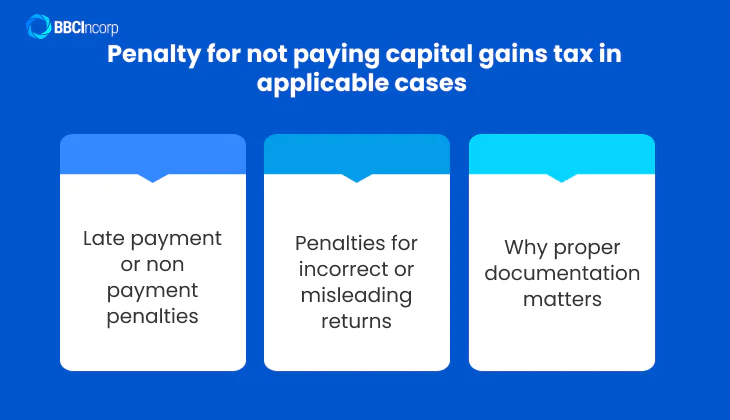
Late payment or non payment penalties
If taxable gains are underreported and the corresponding tax is not paid by the deadline, IRAS will impose a 5% late payment penalty on the outstanding tax amount.
If the tax continues to remain unpaid, IRAS may add an additional 1% penalty for every month the amount remains outstanding. These monthly penalties can accumulate quickly and may continue until payment is made, subject to caps that apply in many cases.
In addition to financial penalties, IRAS has the authority to appoint agents such as banks, employers, tenants, or lawyers to recover unpaid taxes. Travel restrictions may also be imposed, preventing a taxpayer from leaving Singapore until all liabilities are fully settled.
Penalties for incorrect or misleading returns
When IRAS reclassifies gains as taxable income and concludes that a tax return was incorrect due to negligence or omission, penalties can reach up to 200% of the undercharged tax. In more serious cases, taxpayers may also face fines of up to S$5,000 or imprisonment for up to three years.
For deliberate tax evasion or intentional misclassification, the consequences are far more severe. Penalties can include fines of up to S$50,000, imprisonment for up to five years, and up to 400% of the tax undercharged.
Why proper documentation matters
These enforcement measures highlight the need for accurate reporting and proper documentation when disposing of properties, shares, or business interests. Record keeping should include purchase and sale dates, holding periods, original intention at acquisition, financing details, and any work performed on the asset.
Clear documentation helps establish whether a transaction is an investment activity or a trading activity. Without this evidence, taxpayers risk costly underpayment penalties, heavy fines, or even criminal exposure, making proper compliance essential.
How Singapore’s approach compares to other countries
Singapore’s approach to capital gains tax is notably investor-friendly, providing clarity and relief for individuals and businesses engaging in long-term investments. While gains from the sale of properties, shares, or other financial instruments are generally not taxable, IRAS focuses on taxing profits arising from trading activities.
This zero general capital gains tax Singapore rate contrasts sharply with the policies in many other countries, where capital gains are actively taxed and can significantly affect investment returns.
In the United States, capital gains tax depends on whether the gain is short-term or long-term. Short-term gains are taxed at ordinary income rates, which can reach 37%, while long-term gains are taxed at rates from 0% to 20%, depending on income.
In the United Kingdom, capital gains are subject to income tax rates ranging from 24% to 28%, depending on the type of asset and the holding period.
Thailand applies a 15% tax on gains from the sale of stocks, and other countries in the region maintain similar rates on both property and investment gains.
These differences make Singapore an attractive location for investors seeking to maximize net returns. Business owners planning to sell companies or divest from assets can benefit from the absence of a broad capital gains tax, avoiding the significant costs that may arise in high-tax jurisdictions.
For international investors, knowing how capital gains tax Singapore compares to other countries is essential for global tax planning, optimizing exit strategies, and ensuring compliance with local regulations while minimizing overall tax liabilities.
BBCIncorp’s expertise in Singapore tax compliance and structuring
Navigating Singapore’s tax landscape can be complex, especially when distinguishing between capital gains and taxable income. BBCIncorp, a trusted corporate service provider, offers expert guidance to help businesses comply with IRAS regulations and make informed decisions. With extensive experience in tax advisory Singapore, our team ensures that clients correctly classify gains, understand applicable exemptions, and meet reporting obligations efficiently.

Expert guidance on tax classification and compliance
BBCIncorp helps businesses interpret IRAS guidelines to determine whether profits from asset disposals are capital in nature or taxable income. Our experts provide thorough assessments for property, shares, and other financial instruments, ensuring accurate reporting and compliance with Singapore’s tax laws.
By identifying potential risks and applying best practices, we help clients minimize tax liabilities while maintaining full compliance. Our services include preparation of financial statements, review of asset transactions, and tailored advice for complex cases to align with regulatory standards.
Support for business structuring and international expansion
Beyond compliance, BBCIncorp assists companies with business structuring in Singapore to enhance tax efficiency and support growth. We provide end-to-end solutions, including company registration, corporate secretarial services, and strategic planning for cross-border investments.
Our advisory services guide investors in structuring operations and transactions to optimize returns while ensuring adherence to Singapore laws. By combining local expertise with international insight, BBCIncorp enables businesses to expand confidently and manage risks effectively.
With our comprehensive approach, BBCIncorp delivers professional corporate services, helping clients navigate the nuances of Singapore tax regulations, achieve sustainable growth, and focus on strategic business objectives without the uncertainty of non-compliance.
Conclusion
Singapore’s capital gains tax system is designed to encourage investment and reward long-term asset holding. While there is no general capital gains tax, being aware of when profits may be classified as taxable income is critical. The Inland Revenue Authority of Singapore applies the Badges of Trade principle to determine whether gains from property, shares, or other financial instruments are taxable, making proper classification essential for both individuals and businesses.
Compliance with IRAS rules ensures that investors and business owners avoid penalties and maintain smooth operations. Proper documentation of transactions, intentions, holding periods, and financing helps demonstrate that a sale is part of a genuine investment rather than a trading activity.
Consulting experts like BBCIncorp provide invaluable support in navigating these rules. Our team offers comprehensive tax advisory Singapore and business structuring Singapore services, helping clients optimize tax efficiency, achieve compliance, and structure transactions strategically. By leveraging professional guidance, investors can confidently focus on growth while adhering to all regulatory requirements related to capital gains tax Singapore.
Frequently Asked Questions
Is there capital gains tax in Singapore?
No. Singapore does not impose a general capital gains tax. Profits from the sale of assets such as property, shares, or financial instruments are generally treated as capital gains — and capital gains are not taxed under normal circumstances.
However, when a disposal is judged to be part of a trade or business rather than a genuine investment, IRAS may treat the gain as income. In those exceptional cases, the profit becomes taxable under income tax rules rather than as a capital gain.
How does IRAS determine if gains are taxable?
IRAS applies the Badges of Trade principle to determine whether a profit is capital or taxable income. The evaluation considers several factors including the frequency of transactions, the holding period of the asset, and the intention at the time of purchase.
Assets acquired primarily for resale rather than long-term investment may be taxed. IRAS also considers any work performed to enhance the asset, such as renovations, and the source of financing. If the overall facts suggest the disposal is a business-like trading activity, the gain may be reclassified as taxable income.
Do foreigners pay capital gains tax in Singapore?
Foreigners are treated the same as residents regarding capital gains tax. Gains from the disposal of capital assets are generally not taxable, provided the transaction is a genuine investment. If a foreigner’s sale of property, shares, or other assets is deemed trading activity by IRAS, the resulting gain may be subject to income tax, just like for Singapore residents.
What is the penalty for not paying capital gains tax?
Since Singapore does not have a general capital gains tax, penalties only apply when gains are taxable and incorrectly reported. Failing to declare taxable gains or under-reporting them can result in late payment penalties, additional charges, or reassessments by IRAS. In serious cases of deliberate misclassification or under-reporting, substantial fines and even criminal prosecution may apply.
Disclaimer: While BBCIncorp strives to make the information on this website as timely and accurate as possible, the information itself is for reference purposes only. You should not substitute the information provided in this article for competent legal advice. Feel free to contact BBCIncorp’s customer services for advice on your specific cases.
Industry News & Insights
Get helpful tips and info from our newsletter!
Stay in the know and be empowered with our strategic how-tos, resources, and guidelines.