Hong Kong incorporation fee & Aspire
 cashback.


Table of Contents
A GST registration check in Singapore is an essential step for businesses to determine whether they are required to register under the regulations of the Inland Revenue Authority of Singapore (IRAS). It allows you to assess if your business has exceeded the prescribed taxable turnover threshold or if voluntary registration may be beneficial based on your operations and growth plans.
Understanding your GST obligations early helps minimize compliance risks, avoid penalties, and ensure accurate tax handling. In this guide, we will walk you through the key criteria set by IRAS and outline the step-by-step process to help you evaluate your GST registration requirements with confidence.
Key Takeaways
- GST registration check Singapore is essential to assess registration obligations and verify GST status under the Inland Revenue Authority of Singapore (IRAS).
- Businesses must evaluate the S$1 million threshold using both retrospective and prospective basis.
- The retrospective basis is tested against the past calendar year (1 Jan – 31 Dec); the prospective basis is tested against a reasonable forecast for the next 12 months.
- Incorrect assessment can lead to penalties, backdated GST, and cash flow disruption.
GST registration check and its importance
A GST registration check refers to the process of assessing whether a business is required to register for GST under the guidelines of the Inland Revenue Authority of Singapore (IRAS). This involves reviewing your taxable turnover, business activities, and future revenue projections to determine if you meet the mandatory registration threshold or if voluntary registration would be advantageous.
In Singapore, businesses must register when their taxable turnover exceeds the prescribed limit of S$1 million, while others may opt in voluntarily to claim input tax and enhance business credibility. This requirement applies not only to local companies but also to certain overseas vendors supplying remote services (digital and non-digital) and low-value goods supplied to non-GST-registered customers in Singapore.
Importantly, businesses are expected to continuously monitor their turnover and reassess their obligations on an ongoing basis, especially during periods of rapid growth or operational changes. Failing to conduct this assessment accurately can lead to serious consequences, including financial penalties, backdated GST liabilities, and disruptions to pricing strategies.
In addition, non-compliance may affect your ability to claim input tax and damage trust with clients or partners. Regularly performing a GST registration check ensures your business remains compliant, financially efficient, and well-positioned for sustainable growth.
Key criteria for GST registration
To determine if GST registration is mandatory in Singapore, businesses must check if taxable turnover exceeds the S$1 million threshold on a retrospective (past calendar year) or prospective basis (next 12 months counting from the forecast date). Specific exemptions and special rules like Reverse Charge also apply.
Core criteria and special cases
Businesses must evaluate the following main criteria set by the Inland Revenue Authority of Singapore (IRAS) to confirm their registration liability:
- S$1 million threshold: GST registration is required when taxable turnover exceeds S$1 million, tested on either the retrospective or the prospective basis
- Taxable turnover scope: Includes standard-rated and zero-rated supplies; excludes exempt supplies, out-of-scope supplies, and sale of capital assets
- Retrospective basis: Applies when taxable turnover for the past calendar year (1 Jan to 31 Dec) exceeds S$1 million. Apply between 1 and 30 January of the following year; registration takes effect from 1 March.
- Prospective basis: Triggered when there is a reasonable expectation to exceed S$1 million in the next 12 months, supported by objective evidence. Apply within 30 days after the date of your forecast for forecasts dated on or after 1 July 2025, registration takes effect two months from the forecast date.
-
- Documents IRAS accepts as evidence of the forecast: signed contracts or agreements, accepted tenders or quotations, confirmed purchase orders, invoices already being issued for a fixed monthly fee, or income statements showing turnover for the past 12 months already close to S$1 million on a rising trend.
- Not sufficient on its own: market assessments, business plans, or sales targets without confirmed income.
- Voluntary registration: Available to businesses that qualify (they make, or firmly intend to make, taxable, only out-of-scope, or certain exempt supplies), subject to a minimum 2-year commitment. From 1 April 2026, all new voluntary registrants must also be onboarded on GST InvoiceNow before applying.
- Your business procures services from overseas service providers or imports low-value goods and you would not be entitled to full input tax credit even if you were GST-registered.
- Special cases: Includes Overseas Vendor Registration (OVR) for remote services (digital and non-digital) and low-value goods supplied to Singapore customers, where the overseas business’ global turnover exceeds S$1 million and its B2C supplies to Singapore exceed S$100,000
- Conversely, Reverse Charge requires Singapore businesses not entitled to full input tax credit to self-account for GST on imported services and low-value goods, and may itself trigger compulsory registration if their combined value plus taxable turnover exceeds S$1 million over 12 months
Exceptions to GST Registration
You will not be required to register for GST if:
- Your business’s taxable turnover comes wholly or mainly from zero-rated supplies, and you have applied for exemption from registration.
- You are liable to register under the retrospective basis, but not under the prospective basis, and all of the following conditions are met:
- You can state with certainty that your taxable turnover for the coming 12 months will not exceed S$1 million.
- This lower turnover results from a specific cause, such as a large-scale downsizing of the business.
- You hold documentation supporting this projection.
- Even where this exception applies, you remain obligated to keep monitoring your taxable turnover, and must reassess your position at the end of the following calendar year.
Understanding and applying these criteria correctly through a GST registration search helps businesses stay compliant, avoid penalties, and plan their tax obligations more effectively.
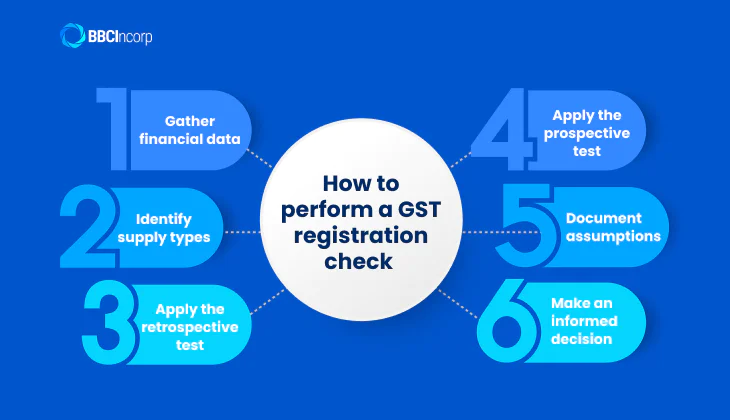
How to perform a GST registration check
Conducting a GST registration check requires a structured review of your financial data and business activities to ensure alignment with the requirements. This process involves evaluating both historical performance and future projections to determine your registration obligations.
- Gather financial data: Compile accurate revenue records, invoices, and accounting reports to establish your total turnover.
- Identify supply types: Distinguish between taxable supplies (standard-rated, zero-rated) and items excluded from taxable turnover for GST registration purposes, such as exempt supplies, out-of-scope supplies and proceeds from the sale of capital assets.
- Apply the retrospective test: Review whether taxable turnover for the past calendar year (1 Jan 31 Dec) exceeded S$1 million.
- Apply the prospective test: Assess if your business is expected to exceed the threshold in the next counting from the date of your forecast, supported by objective evidence (e.g. signed contracts, confirmed accepted quotations or confirmed purchase orders).
- Keep supporting documents: Retain your taxable turnover computation and the documents behind any forecast, such as signed contracts or confirmed purchase orders. IRAS may ask for these when you apply for GST registration, and you must keep them if you rely on the retrospective-view exception.
- Check other registration triggers: If your business imports services or low-value goods and would not be entitled to full input tax credit, include their value when testing the S$1 million threshold under the reverse charge rules. Overseas suppliers should test the OVR thresholds instead.
- Assess voluntary registration: If you are not liable under either basis, check whether you qualify for voluntary registration and whether the benefits outweigh the 2-year commitment, the GST InvoiceNow Requirement and ongoing compliance costs.
- Determine the required action: Apply for registration where compulsory, consider voluntary registration where eligible, or continue monitoring where no liability arises.
By following this step-by-step approach, businesses can ensure accurate assessment, reduce compliance risks, and make well-informed decisions regarding GST registration.
Deadlines, penalties, and compliance risks
Meeting GST registration timelines is essential to remain compliant with the Inland Revenue Authority of Singapore (IRAS).
Under the retrospective basis, businesses must apply between 1 and 30 January of the year following the calendar year in which the S$1 million threshold was exceeded, with registration effective 1 March.
Under the prospective basis, businesses must apply within 30 days after the date of the forecast showing that taxable turnover will exceed S$1 million in the next 12 months; for forecasts dated on or after 1 July 2025, registration takes effect two months from the forecast date.
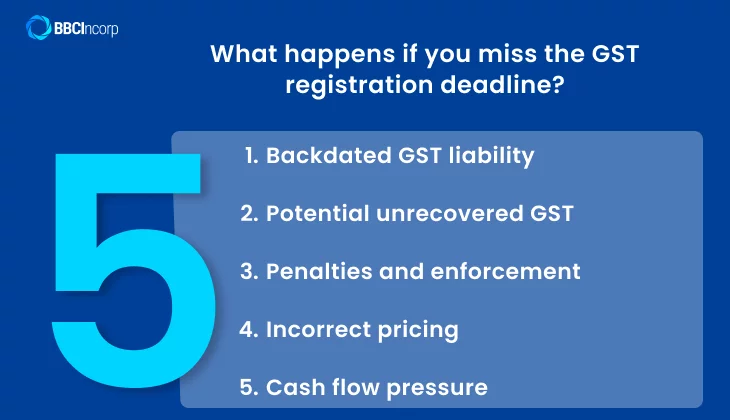
Failing to check GST status and meet this deadline increases the cost of non-compliance and exposes the business to enforcement actions.
- Backdated GST liability: GST at the prevailing rate (currently 9%) may be imposed retrospectively from the date registration should have occurred.
- Potential unrecovered GST: Businesses must pay GST to IRAS even if it was not charged to customers.
- Penalties and enforcement: Failure to notify IRAS of the liability to register is an offence; IRAS may impose a penalty of 10% of the GST due and a fine of up to S$10,000, with possible prosecution in serious cases.
- Incorrect pricing: Failure to account for GST may result in underpricing or margin erosion.
- Cash flow pressure: Unexpected GST liabilities can strain working capital and disrupt financial planning.
Voluntary disclosure of a past registration error is treated by IRAS as a mitigating factor when determining penalties.
By monitoring GST obligations proactively and registering within the required timeframe, businesses can avoid penalties, maintain pricing stability, and protect overall financial health.
Practical considerations and best practices
Maintaining ongoing compliance with GST requirements goes beyond a one-time assessment. Businesses should monitor taxable turnover and keep GST records in line with the requirements of the Inland Revenue Authority of Singapore (IRAS) to support accurate and timely decisions.
- Regular monitoring: Continuously track taxable turnover to identify when thresholds are approaching or exceeded.
- Accurate record-keeping: Maintain clear, up-to-date accounting records to support calculations and compliance reviews.
- Managing growth: Pay close attention during periods of rapid expansion, as turnover may exceed the threshold sooner than expected.
- Evaluate voluntary registration: Consider both benefits (e.g., input tax claims, credibility) and obligations (e.g., compliance, 2-year commitment, GST InvoiceNow onboarding from 1 April 2026) before opting in
One of the most common pitfalls businesses face is overlooking the prospective test, where future revenue is expected to exceed the threshold but not properly assessed or documented. In addition, misclassifying supplies, particularly confusing taxable and exempt transactions, can lead to incorrect turnover calculations and flawed registration decisions.
Another frequent issue is delayed registration, even after meeting the criteria, which may result in backdated GST liabilities and penalties imposed by the IRAS.
Common red flags in a GST registration check and what to do next
A GST check is not only about verifying status, it also helps identify potential risks in your transactions. Knowing how to check if a company is registered can protect your business from compliance issues and financial loss, especially when dealing with third parties.
This can be done using IRAS’ GST Registered Business Search on myTax Portal, by UEN, GST registration number or business name.
Common warning signs in a GST check
It often relates to inconsistencies in business information and tax treatment. For example:
- Mismatched business details between invoices and official records under the Inland Revenue Authority of Singapore (IRAS).
- Suppliers charging GST despite not appearing as registered entities in the IRAS search.
- The IRAS search shows the supplier’s GST registration as suspended or deregistered, while GST is still being billed.
- Tax invoices missing required particulars, such as the supplier’s name, address or GST registration number (for supplies of S$1,000 or less including GST, a simplified tax invoice with fewer particulars may be issued).
- Unreliable or unclear contact information that raises concerns about business legitimacy.
When such issues arise, businesses should take a cautious and structured approach rather than proceeding with transactions as usual.
What to do if you spot issues during a GST registration check
If you notice any of these issues, respond in this order rather than acting on the first step alone.
- Contact the supplier to clarify discrepancies and request corrected documentation.
- If the supplier is not GST-registered, request a revised invoice without GST it should not be charging GST at all.
- Do not claim input tax until the supplier’s GST status and a valid supporting tax invoice have been satisfactorily verified.
- Reassess the business relationship if transparency or cooperation is lacking.
- Escalate serious concerns by reporting suspected non-compliance to IRAS.
By acting promptly on these red flags, businesses can safeguard their compliance position, avoid invalid tax claims, and maintain stronger financial controls.
Need help with your GST registration? Here’s how BBCIncorp can support you
Working out whether you need to register for GST is one thing. Getting the application right is another. If your taxable turnover has exceeded S$1 million, or you expect it to within the next 12 months, BBCIncorp can take the registration off your plate.
At BBCIncorp, we help businesses check whether they need to register for GST and take care of the registration for them. Our team will confirm which basis applies to your business (retrospective or prospective), prepare the supporting documents and handle the submission to IRAS, so you can register on time and avoid backdated GST or penalties.
Once you are registered, our accounting and bookkeeping services team can also support your ongoing accounting and auditing work.
If you would like help reviewing your position or preparing your GST registration, chat with us.
References:
- (1) Inland Revenue Authority of Singapore – Factors to consider before registering voluntarily for GST: https://www.iras.gov.sg/taxes/goods-services-tax-(gst)/gst-registration-deregistration/factors-to-consider-before-registering-voluntarily-for-gst
- (2) Inland Revenue Authority of Singapore – GST Registered Business Search (myTax Portal): https://mytax.iras.gov.sg/ESVWeb/default.aspx?target=GSTListingSearch
- (3) Inland Revenue Authority of Singapore – Checking if a business is GST-registered: https://www.iras.gov.sg/taxes/goods-services-tax-(gst)/consumers/checking-if-a-business-is-gst-registered
- (4) Inland Revenue Authority of Singapore Current GST Rates: https://www.iras.gov.sg/taxes/goods-services-tax-(gst)/basics-of-gst/current-gst-rates
- (5) Inland Revenue Authority of Singapore – Overseas businesses supplying remote services and low-value goods to Singapore: https://www.iras.gov.sg/taxes/goods-services-tax-(gst)/gst-and-digital-economy/overseas-businesses
- (6) Inland Revenue Authority of Singapore – Committee of Supply 2026: Extension of GST InvoiceNow Requirement: https://www.iras.gov.sg/news-events/newsroom/committee-of-supply-2026–extension-of-gst-invoicenow-requirement-to-all-gst-registered-businesses-by-april-2031
- (7) Inland Revenue Authority of Singapore – Do I need to register for GST: https://www.iras.gov.sg/taxes/goods-services-tax-(gst)/gst-registration-deregistration/do-i-need-to-register-for-gst
Frequently Asked Questions
What is the GST registration threshold in Singapore?
S$1 million of taxable turnover. Registration becomes compulsory once this is exceeded on either the retrospective basis (the calendar year just ended) or the prospective basis (a reasonable forecast for the next 12 months).
How do I check if a business is GST-registered?
Use IRAS’ GST Registered Business Search on myTax Portal. No login is required to search by UEN, GST registration number or business name, or by up to four tax reference numbers at once.
What is the difference between the retrospective and prospective basis?
Retrospective looks backward at the calendar year just closed (1 Jan 31 Dec): if turnover exceeded S$1 million, apply between 1-30 January of the next year, effective 1 March. Prospective looks forward: if you reasonably expect to exceed S$1 million in the next 12 months, you must apply within 30 days of that forecast, effective two months later for forecasts dated on or after 1 July 2025.
What happens if I register for GST late?
IRAS backdates your GST liability to the date you should have been registered, and GST at the prevailing 9% rate is payable on taxable supplies from that date, even if it was never collected from customers.
Failing to notify IRAS of your liability to register is an offence, which may lead to a penalty of 10% of the GST due, a fine of up to S$10,000 and prosecution. If you voluntarily disclose the late registration when applying, IRAS may waive the fine and penalty.
Should I register for GST voluntarily?
It can be worthwhile if most of your customers are GST-registered or your supplies are mainly zero-rated exports, as you can then claim GST on business purchases.
However, partially exempt businesses and organisations with non-business activities cannot claim their input tax in full. Weigh this against the 2 year minimum registration period and, for applications from 1 April 2026, the GST InvoiceNow Requirement.
Does a Singapore business have a GSTIN?
No. GSTIN is Indian terminology. In Singapore the equivalent is the GST registration number. For some Singapore entities, the GST registration number is the same as the UEN, but the two numbers can also be different.
Do overseas businesses need to register for GST in Singapore?
They may, under the Overseas Vendor Registration (OVR) regime if annual global turnover exceeds S$1 million and B2C supplies of remote services or low-value goods to Singapore exceed S$100,000 a year. Both thresholds must be met.
Disclaimer: While BBCIncorp strives to make the information on this website as timely and accurate as possible, the information itself is for reference purposes only. You should not substitute the information provided in this article for competent legal advice. Feel free to contact BBCIncorp’s customer services for advice on your specific cases.
Industry News & Insights
Get helpful tips and info from our newsletter!
Stay in the know and be empowered with our strategic how-tos, resources, and guidelines.