Hong Kong incorporation fee & Aspire
 cashback.


Table of Contents
Singapore GDP reflects the country’s position as a leading global hub for trade, finance, and logistics. The economy is highly open, with total trade exceeding 300% of GDP, making it closely tied to global economic conditions. According to the Ministry of Trade and Industry, Singapore GDP growth reached 1.1% in 2023 amid a global slowdown, before rebounding to around 3.6% in 2024 and accelerating to approximately 5.0% in 2025.
This stronger-than-expected performance was driven by manufacturing, particularly AI-related electronics, alongside wholesale trade and financial services. With a nominal GDP projected at about USD 574 billion, the Singapore economy continues to demonstrate resilience. Understanding GDP Singapore trends is therefore essential for businesses evaluating expansion opportunities in Southeast Asia’s dynamic and interconnected markets.

Key takeaways
- Singapore GDP remains strong and resilient, growing from 1.1% (2023) to ~5.0% (2025), highlighting recovery in manufacturing, trade, and financial services.
- Singapore GDP growth is driven by core sectors, including manufacturing (20–21%), financial services (14–15%), and wholesale trade (~17%), ensuring a diversified economy of Singapore.
- Singapore economic growth is supported by structural advantages, such as its role as a global trade hub, strong FDI inflows, and leadership in fintech and AI innovation.
- The Singapore economy faces external risks, including global demand fluctuations, geopolitical tensions, and aging demographics, which may impact long-term GDP growth Singapore.
- Outlook remains stable, with 2–4% Singapore GDP growth forecast for 2026, supported by the digital economy, sustainable finance, and regional trade integration.
Singapore GDP Growth Trends (2023–2026)
Recent data highlights the resilience of the Singapore economy, with Singapore GDP growth continuing to recover despite global uncertainties. As a highly open economy, GDP Singapore is strongly influenced by external demand, global trade cycles, and technological developments.
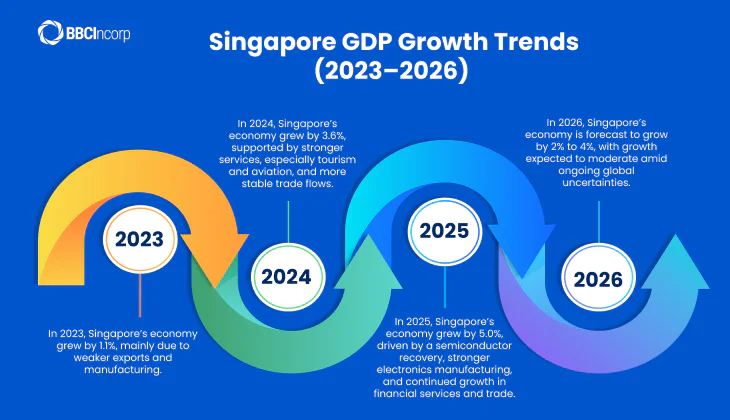
GDP growth timeline
Singapore’s economic performance in recent years reflects both external challenges and internal strengths:
- 2023: 1.1% growth
The economy experienced a slowdown due to weak global electronics demand and softer international trade. As exports declined, manufacturing activity weakened, which in turn affected overall SG GDP performance.
- 2024: 3.6% growth
The economy rebounded as global conditions improved. The recovery was supported by stronger services sectors, particularly tourism and aviation, alongside stabilizing trade flows.
- 2025: 5.0% growth
Growth accelerated beyond expectations, driven by several key factors:
- A recovery in the semiconductor cycle.
- Strong expansion in manufacturing output, especially in electronics.
- Continued growth in financial services and trade-related activities.
- 2026 forecast: 2%–4% growth
The Ministry of Trade and Industry projects a more moderate growth range amid ongoing global uncertainties. Although expansion is expected to continue, the pace is likely to normalize following the strong performance in 2025.
Additional economic indicators
According to the International Monetary Fund (IMF):
- Singapore’s GDP exceeded USD 540 billion in 2024.
- GDP per capita remains among the highest in the world.
These figures show that GDP Singapore remains stable and competitive. Overall, Singapore GDP growth demonstrates the country’s ability to adapt to global changes while maintaining a strong economic foundation.
Singapore GDP by Sector
The economy of Singapore is highly diversified, with strong contributions from both services and manufacturing. According to data from the Singapore Department of Statistics and the Ministry of Trade and Industry (MTI), the services sector accounts for over 70% of output, while manufacturing remains a key pillar of Singapore GDP by sector.
Manufacturing
Manufacturing is one of the most important contributors to Singapore GDP. It accounts for approximately 20–21% of total output, based on official statistics.
Key industries include:
- Semiconductors and electronics (driven by AI-related demand).
- Biomedical manufacturing (including pharmaceuticals).
- Precision engineering.
In 2025, the sector recorded strong growth, supported by global demand for electronics and semiconductors. According to MTI, manufacturing expanded significantly in Q4 2025, making Singapore a major global exporter of high-value electronics.
Financial services
The financial services sector contributes around 14–15% of SG GDP, making Singapore one of Asia’s leading financial hubs.
The sector is regulated by the Monetary Authority of Singapore (MAS) and includes:
- Banking and capital markets.
- Wealth management.
- Fintech and digital financial services.
Growth in 2025 was supported by strong performance across banking and insurance segments.
Wholesale trade
Wholesale trade contributes approximately 17% of Singapore GDP, reflecting the country’s role as a global trading hub.
This sector is closely linked to:
- Global supply chains.
- Re-export activities.
- Trade in electronics and industrial components.
MTI reports that wholesale trade growth in 2025 was driven by strong sales of electronic components amid the AI boom.
Transport and logistics
Singapore’s transport and logistics sector is a critical enabler of trade. The country operates one of the world’s busiest ports through PSA International, handling over 37 million TEUs annually.
The sector includes:
- Maritime shipping.
- Air cargo logistics.
- Warehousing and distribution.
Tourism and services
Tourism and related services have recovered strongly following the pandemic. According to the Singapore Tourism Board, international visitor arrivals exceeded 13 million in 2023, supporting growth in hospitality, retail, and food services.
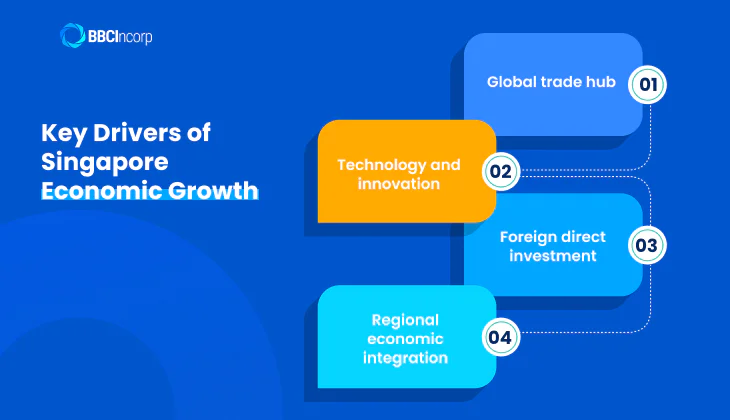
Key Drivers of Singapore Economic Growth
Several structural factors continue to support Singapore economic growth, enabling the country to maintain resilience despite global uncertainties. As a highly open and innovation-driven economy, the economic growth of Singapore is shaped by its strategic position in global trade, strong investment environment, and focus on technology.
Global trade hub
Singapore’s role as a global trading hub remains a core growth driver. Located along major international shipping routes, the country serves as a key gateway between Asia and global markets.
Key strengths include:
- Total trade value consistently exceeding 300% of GDP (source: MTI, Singapore Department of Statistics).
- Strong connectivity to global supply chains and re-export markets.
- World-class port and logistics infrastructure supporting trade flows.
This positioning allows Singapore to benefit directly from global demand, particularly in electronics and industrial goods.
Technology and innovation
Technology is increasingly central to Singapore economic growth. The country has developed into a regional hub for fintech, artificial intelligence (AI), and digital services.
Key drivers include:
- Strong demand for AI-related electronics and semiconductors, boosting manufacturing output (source: MTI).
- Government-led initiatives such as the Smart Nation program promote digital transformation across industries.
- Rapid adoption of AI, data analytics, and automation by businesses.
These developments are strengthening Singapore’s competitiveness in high-value industries.
Foreign direct investment
Singapore consistently attracts high levels of foreign direct investment due to its stable political environment, transparent regulations, and competitive tax policies.
According to the United Nations Conference on Trade and Development (UNCTAD):
- Singapore is often the largest FDI recipient in Southeast Asia
- Strong inflows support sectors such as finance, manufacturing, and technology
FDI plays a critical role in expanding industrial capabilities and creating high-value jobs.
Regional economic integration
Singapore also benefits from strong regional trade integration. Agreements such as the Regional Comprehensive Economic Partnership (RCEP) enhance connectivity with major Asian economies.
These frameworks help:
- Reduce trade barriers.
- Facilitate cross-border investment.
- Strengthen supply chain resilience across the region.
Challenges Facing the Singapore Economy
Despite its strong fundamentals, the Singapore economy faces several structural risks that may affect future GDP growth in Singapore. As a highly open and trade-dependent economy, Singapore is particularly sensitive to global developments and external shocks.
Global economic uncertainty
Singapore’s export-driven model means that economic performance is closely tied to global demand. Slowdowns in major economies such as the United States, China, or the European Union can directly impact trade, manufacturing output, and overall GDP growth Singapore.
Technology cycle fluctuations
The electronics sector, especially semiconductors, is a key driver of the Singapore economy. However, this sector is highly cyclical. Periods of strong demand, such as those driven by artificial intelligence, can be followed by downturns, leading to volatility in exports and industrial production.
Geopolitical tensions
Ongoing geopolitical tensions and trade conflicts can disrupt global supply chains and shipping routes. For Singapore, which depends heavily on international trade flows, such disruptions may increase costs, delay logistics, and reduce trade efficiency.
Demographic pressures
Singapore also faces long-term demographic challenges. An aging population may lead to a tighter labor market, potentially affecting productivity and increasing reliance on foreign workforce policies and automation.
To manage these risks, Singapore adopts a proactive and disciplined policy approach. The Monetary Authority of Singapore plays a central role in maintaining macroeconomic stability through exchange-rate management and financial regulation.
By balancing growth with stability, Singapore continues to strengthen its economic resilience while navigating an increasingly complex global environment.
Singapore GDP Outlook and Predictions
Forecasts suggest that Singapore GDP growth will remain moderate but stable in the coming years, supported by strong fundamentals and structural advantages of the SG economy.
According to the Ministry of Trade and Industry, GDP growth is projected to reach 2–4% in 2026. This reflects a normalization after the strong rebound in 2025, as global trade conditions stabilize and external demand becomes more balanced.
Similarly, the International Monetary Fund expects Singapore’s economy to grow at around 2–3% in the medium term, indicating steady and sustainable expansion despite global uncertainties.
Looking ahead, several long-term drivers will continue to support Singapore GDP growth:
- Financial services expansion: Singapore remains a leading financial hub in Asia, with continued growth in wealth management and cross-border finance.
- Digital economy and fintech: Rapid adoption of digital technologies, including artificial intelligence and blockchain, is accelerating productivity and innovation.
- Regional trade integration: Strong participation in regional agreements enhances trade flows and economic connectivity.
- Sustainable finance development: Singapore is positioning itself as a hub for green finance and ESG investments, attracting global capital.
Overall, these factors reinforce the resilience of the SG economy. By focusing on innovation, connectivity, and sustainability, Singapore continues to strengthen its position as a leading global economic hub.
With Singapore GDP expected to remain stable and supported by strong fundamentals such as financial services growth, digital innovation, regional trade integration, and sustainable finance development, now is a strategic time for entrepreneurs and investors to establish a business in Singapore.
For those looking to enter this resilient and forward-looking market, BBCIncorp’s Company Incorporation in Singapore provide practical support throughout the setup process, from incorporation and regulatory guidance to post-registration compliance. With the right foundation in place, businesses can position themselves to benefit from Singapore’s long-term economic strength and its role as a leading hub for regional and global expansion.
Conclusion: The Future of Singapore GDP
The Singapore GDP reflects the strength of a highly diversified and globally connected economy. Key sectors such as manufacturing, financial services, and trade continue to drive Singapore GDP growth, while recent performance, highlighted by 5% growth in 2025, demonstrates the resilience of the SG economy.
Although external risks remain, Singapore benefits from stable institutions, forward-looking innovation policies, and strong regional trade integration. These factors support the long-term economic growth of Singapore.
As global conditions evolve, Singapore is well-positioned to maintain steady growth and remain one of Asia’s most competitive economies. For further insights, contact BBCIncorp at service@bbcincorp.com.
Disclaimer: While BBCIncorp strives to make the information on this website as timely and accurate as possible, the information itself is for reference purposes only. You should not substitute the information provided in this article for competent legal advice. Feel free to contact BBCIncorp’s customer services for advice on your specific cases.
Industry News & Insights
Get helpful tips and info from our newsletter!
Stay in the know and be empowered with our strategic how-tos, resources, and guidelines.