Hong Kong incorporation fee & Aspire
 cashback.


Table of Contents
The XBRL filing deadline is a key part of annual compliance for companies in Singapore. Under ACRA requirements, eligible businesses must submit their financial statements in XBRL format together with their Annual Return. Missing this deadline can result in penalties, compliance risks, and unnecessary delays in regulatory filings.
Understanding the XBRL requirement is essential, especially for companies unfamiliar with what XBRL is and how it works in practice. From formatting financial data correctly to aligning with ACRA’s filing framework, each step plays a role in ensuring accurate and timely submission.
This guide explains the XBRL filing deadline in Singapore, outlines ACRA requirements, and provides practical insights on timelines, rules, and key considerations to help businesses stay compliant with confidence.
Key Takeaways:
- XBRL filing deadline = Annual Return deadline: both must be submitted together via BizFile+ to stay compliant.
- Know your timeline: 5 months (listed) and 7 months (non-listed) after FYE are the key deadlines.
- Prepare early to avoid penalties: late filing can cost up to S$600 and create compliance risks.
- Accuracy matters in XBRL format: incorrect tagging or mismatched data can lead to rejection and delays.
- Align reporting with compliance: structured planning helps ensure smooth XBRL filing in Singapore and avoids last-minute issues.
What is XBRL filing in Singapore?
XBRL filing in Singapore refers to the submission of financial statements in eXtensible Business Reporting Language (XBRL) format to the Accounting and Corporate Regulatory Authority (ACRA). Instead of uploading a standard PDF, companies must convert their financial data into a structured, machine-readable format that aligns with ACRA’s prescribed templates.
In practice, XBRL filing is submitted together with the Annual Return via ACRA BizFile+. This means it is not a standalone requirement, but part of the broader annual compliance process for Singapore-incorporated companies.
The XBRL filing deadline is not based on the calendar year. Instead, it depends on the company’s financial year-end (FYE). Each company will have a specific filing timeline calculated from its FYE, making it important to track deadlines accurately.
A key principle to understand is that the XBRL filing deadline is aligned with the Annual Return deadline. Missing one typically means non-compliance with both, which may lead to penalties or enforcement actions.
XBRL filing applies to companies that are required to submit financial statements in XBRL format under ACRA regulations. While there are limited exemptions, most companies in Singapore are subject to this requirement.
It is also important to note that filing obligations may still apply even if a company is dormant, unless it qualifies for a specific exemption under the Companies Act. As such, businesses should not assume that inactivity exempts them from compliance responsibilities.
Overall, XBRL enhances transparency, standardisation, and regulatory efficiency, but it also requires careful preparation to ensure accurate and timely submission.
Official XBRL filing deadlines by company type
In Singapore, the XBRL filing deadline is directly tied to a company’s Annual Return timeline, which is determined based on its financial year end (FYE). Understanding the applicable deadline is essential to avoid late filing penalties and ensure compliance with ACRA requirements.
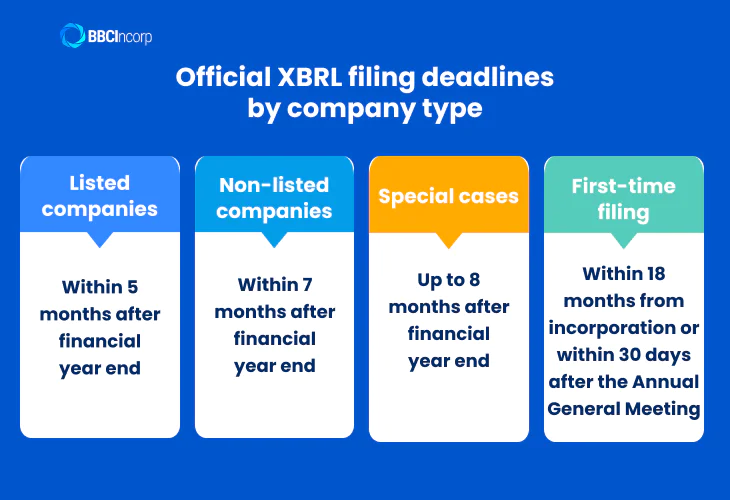
Listed companies
Listed companies are required to file their Annual Return, including XBRL financial statements, within 5 months after their FYE. These companies typically have stricter reporting obligations and are expected to meet shorter timelines.
Non-listed companies
For most private companies in Singapore, the deadline is within 7 months after FYE. This applies to the majority of small and medium-sized businesses, including exempt private companies that are required to file financial statements.
Special cases
Certain companies may qualify for extended deadlines. For example, companies with overseas branch registers may be granted additional time, with deadlines extending up to 8 months after FYE, subject to ACRA’s conditions and approval.
First-time filing
For newly incorporated companies, the timeline differs slightly. The first filing must be completed within 18 months from incorporation or within 30 days after the Annual General Meeting (AGM), whichever is earlier. This ensures that even new businesses enter the compliance cycle promptly.
Example: XBRL filing timeline for 2026
Let’s assume your company’s financial year end (FYE) is 31 December 2026.
For a non-listed company, your XBRL filing deadline (together with the Annual Return) will be 31 July 2027 (i.e., 7 months after FYE).

Key point to remember:
A critical rule is that XBRL filing must be submitted together with the Annual Return via BizFile+. It is not a separate submission process. Missing the Annual Return deadline means the XBRL filing is also considered late.
Failure to meet these deadlines may result in late filing penalties ranging from S$300 to S$500, along with potential compliance risks for directors. As such, businesses should track their FYE carefully and plan to meet their filing obligations on time.
Timeline breakdown from FYE to filing
Managing the XBRL filing deadline becomes much easier when businesses break the process into clear stages. Since all deadlines are based on the financial year end (FYE), planning early is key to avoiding last-minute pressure or errors.
Month 1–2: Close accounts and finalize bookkeeping
Shortly after the FYE, companies should begin closing their books. This includes reconciling accounts, verifying transactions, and ensuring all financial records are complete and accurate. A clean bookkeeping process sets the foundation for the entire filing.
Month 3–4: Prepare financial statements (SFRS compliant)
Once accounts are finalized, businesses prepare their financial statements in accordance with Singapore Financial Reporting Standards (SFRS). This step may involve coordination with accountants or auditors, especially for companies requiring audited reports.
Month 4–5: Convert financials into XBRL format
After the financial statements are ready, they must be converted into the required XBRL format using ACRA-approved templates (e.g., Full or Simplified XBRL). This stage often requires technical accuracy, as validation errors can delay submission.
Final stage: Submit with Annual Return
The final step is to submit the XBRL file together with the Annual Return via BizFile+ before the applicable deadline (5 or 7 months after FYE). Both components must be filed together to complete the compliance requirement.
Practical insight
Early preparation significantly reduces the risk of rejection, validation errors, or resubmission delays. Many companies face issues not because of complexity, but due to time constraints near the deadline.
It is also important to remember that deadlines vary depending on each company’s FYE, not the calendar year. Businesses should track their own timeline carefully and plan each stage to ensure a smooth and compliant filing process.
What is the penalty for late filing of XBRL?
In Singapore, late XBRL filing is treated as part of a late Annual Return submission, since XBRL financial statements must be filed together with the Annual Return via ACRA BizFile+. As a result, missing the XBRL deadline directly triggers statutory penalties.
Under ACRA’s current framework:
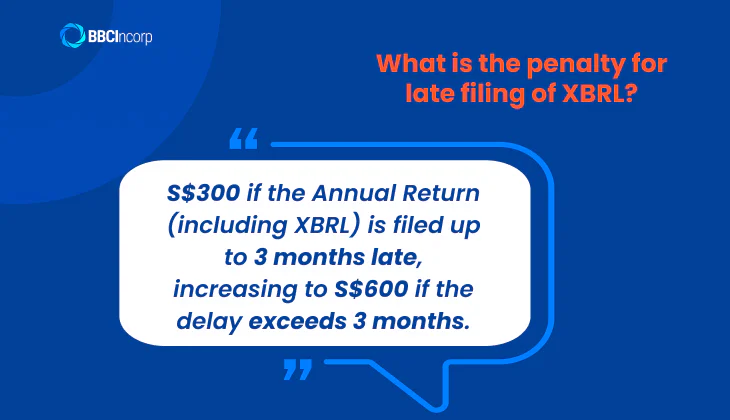
- A S$300 penalty applies if the Annual Return (including XBRL) is filed within 3 months after the deadline.
- The penalty increases to S$600 if the delay exceeds 3 months.
The longer the delay, the higher the compliance risk and financial impact.
It is also important to note that if the XBRL file is missing or invalid, the filing is considered incomplete. Even if the Annual Return is submitted, it may still be treated as non-compliant, which can result in penalties.
Beyond monetary fines, repeated non-compliance can lead to more serious consequences, including:
- Regulatory enforcement actions by ACRA.
- Disqualification of directors for persistent filing breaches.
- Potential company strike-off in severe cases.
Operationally, late or incomplete filings can also create business disruptions. Companies may face delays in securing financing, completing audits, or executing corporate transactions, as up-to-date filings are often required for due diligence.
A common issue arises when XBRL preparation is left too close to the deadline. If the file fails validation or contains errors, there may not be enough time to correct and resubmit, resulting in late filing penalties.
For this reason, timely preparation and submission are critical to maintaining compliance and avoiding unnecessary risks.
Compliance strategies
Staying compliant with XBRL filing requirements requires a structured and proactive approach. Since deadlines are tied to the financial year end (FYE), companies should closely monitor their timelines from the start of each financial cycle.
One of the most effective strategies is to avoid last-minute filing. XBRL preparation involves technical steps such as tagging and validation, which can lead to errors if rushed. Early preparation allows sufficient time to identify and resolve issues before submission.
Businesses should also ensure they are using the correct XBRL format, whether Full XBRL or Simplified XBRL, based on ACRA requirements. Selecting the wrong template is a common cause of rejection and delays.
Another key consideration is maintaining consistency between financial statements and XBRL data. Any mismatch, such as figures not aligning across statements, can trigger validation errors and require resubmission.
To reduce risk, companies may implement internal reviews or engage professional support to verify the accuracy of their XBRL files before submission.
Common mistakes to avoid:
- Assuming the deadline is tied to the AGM instead of FYE.
- Delaying preparation of financial statements.
- Errors in XBRL tagging that cause validation failures.
Best practice:
Plan to complete and submit your XBRL filing at least 1–2 months before the deadline. This buffer helps manage unexpected issues and ensures a smoother filing process.
By adopting these strategies, businesses can minimize compliance risks, avoid penalties, and maintain a strong regulatory standing with ACRA.
Conclusion
The XBRL filing deadline in Singapore is directly tied to your Annual Return timeline, making it a critical part of corporate compliance. Understanding the 5-month (listed) and 7-month (non-listed) benchmarks is essential to ensure timely submission and avoid penalties.
Beyond deadlines, effective XBRL filing requires proper planning, from preparing financial statements to converting them into the correct format. Businesses that align their financial reporting processes with filing schedules are better positioned to minimize errors, avoid last-minute issues, and stay compliant with ACRA requirements.
With increasing regulatory expectations, timely and accurate XBRL submission is not just a requirement, but a key part of maintaining strong corporate governance. BBCIncorp supports businesses with XBRL preparation and filing, ensuring a smooth, compliant process.
Need help with XBRL filing? Contact service@bbcincorp.com to ensure your submission is accurate and on time.
Disclaimer: While BBCIncorp strives to make the information on this website as timely and accurate as possible, the information itself is for reference purposes only. You should not substitute the information provided in this article for competent legal advice. Feel free to contact BBCIncorp’s customer services for advice on your specific cases.
Industry News & Insights
Get helpful tips and info from our newsletter!
Stay in the know and be empowered with our strategic how-tos, resources, and guidelines.