Hong Kong incorporation fee & Aspire
 cashback.


Table of Contents
Accounting entries form the foundation of bookkeeping in Hong Kong, and every global business operating here relies on accurate records to meet compliance requirements and maintain financial clarity.
The Inland Revenue Department highlights that proper books and records are essential for audits and tax filings, and companies must retain them for at least seven years under the Inland Revenue Ordinance.
Clear and consistent accounting entries support reliable reporting, strengthen internal control, and help management understand real performance in a competitive market.
In this article, let’s look into the core principles of double-entry accounting and how journal entries create a complete picture of business activities. We outline key definitions, common types, practical examples, frequent errors, and recommended tools to improve accuracy for your enterprise.
What are accounting entries?
Accounting entries record every business transaction in a structured and traceable way, giving companies a reliable foundation for financial reporting and statutory compliance.
In Hong Kong, each entry captures the financial impact of an activity, from revenue and expenses to assets and liabilities. This aligns with the Inland Revenue Department requirement that businesses maintain ongoing books and records that clearly reflect their operations.
Basics of journal entries
An accounting entry is also known as a journal entry. It uses the principles of double entry to show how one transaction affects at least two accounts.
The approach prevents imbalance and creates a transparent audit trail that supports audits, tax filings, and internal management reviews. Authorities in Hong Kong rely on these records to confirm that a company’s financial information is complete and consistent during regulatory checks.
Flow from journals to ledgers
The flow of accounting entries begins with identifying a transaction and recording it in a journal using a clear debit and credit structure. These journals then post to ledgers, which organize account information and form the basis of financial statements.
When businesses apply journal entries basics correctly, they create a dependable system that helps management interpret performance, manage risks, and meet reporting obligations.
Structure and components of an accounting entry
A structured accounting entry captures every transaction in a clear format for accurate reporting and regulatory compliance in Hong Kong.
Core elements of an entry
An accounting entry records a transaction in a clear and organized format. Every entry includes specific components that allow businesses in Hong Kong to meet documentation standards set by the Inland Revenue Department, which requires companies to keep records supported by proper evidence.
These elements form the basis of reliable bookkeeping and create a consistent trail for review.
Accounts, debits, and credits
An entry starts by identifying the accounts affected. At least two accounts appear in every record because the double-entry format reflects movement across the business.
The debit-credit format shows the direction of that movement. Debits raise certain accounts while credits raise others, and the total values must match.
Amounts, narration, and reference
The amount shows the value of the transaction. Businesses use invoices, contracts, payment slips, or receipts to confirm these figures. Adding a document reference links the entry to the source record, giving auditors and regulators a direct path to verification.
A concise narration states the purpose of the transaction. It guides reviewers, supports management checks, and keeps the entry meaningful even when viewed months later.
Value of a structured format
The components of journal entries work together to create clarity and prevent confusion. Accounts show what changed, debits and credits show how it changed, amounts show scale, and references show evidence.
When combined, these elements enable accurate reporting and strengthen the audit trail required in Hong Kong’s regulatory environment.
The double-entry accounting system explained
Double-entry accounting records every transaction in a systematic way so that financial statements are correct, balanced, and fully verifiable for businesses operating in Hong Kong.
The core principle of double-entry accounting
The core principle of double-entry accounting is that every transaction affects at least two accounts. This dual impact ensures the accounting equation: Assets equals Liabilities plus Equity, remains balanced at all times.
For example, when a business purchases office equipment with cash, one asset account increases (equipment) while another decreases (cash). Similarly, earning revenue on credit increases accounts receivable while simultaneously increasing equity through retained earnings.
By capturing both sides of the transaction, the system provides a complete financial view, supports compliance with the Inland Revenue Department’s record-keeping requirements, and allows management to track the real impact of operations.
Comparison with single-entry accounting
Single-entry accounting records only one side of a transaction, such as cash received or paid. While simpler, it lacks the internal checks necessary for identifying discrepancies, making it less reliable for audits, statutory reporting, or accurate financial analysis.
By using double-entry accounting, businesses are able to reduce errors, ensure a clear audit trail, and strengthen governance in Hong Kong.
Debit and credit rules across accounts
Debits and credits follow specific rules depending on the account type.
| Account type | Normal balance | Increase | Decrease |
|---|---|---|---|
| Assets | Debit | Debit | Credit |
| Liabilities | Credit | Credit | Debit |
| Equity | Credit | Credit | Debit |
| Revenue | Credit | Credit | Debit |
| Expenses | Debit | Debit | Credit |
Practical examples of transactions
- Purchasing inventory for cash
- Inventory (Asset) → Debit
- Cash (Asset) → Credit
- Receiving customer payment on account
- Cash (Asset) → Debit
- Accounts Receivable (Asset) → Credit
- Paying salaries
- Salary Expense (Expense) → Debit
- Cash (Asset) → Credit
- Taking a bank loan
- Cash (Asset) → Debit
- Bank Loan Payable (Liability) → Credit
- Recording service revenue earned
- Accounts Receivable (Asset) → Debit
- Service Revenue (Revenue) → Credit
Recognizing normal balances and their importance
Every account has a normal balance, debit for assets and expenses, credit for liabilities, equity, and revenue. For instance, recording revenue as a debit would misstate profit, while crediting an expense would understate costs. Observing normal balances protects accuracy and supports the preparation of reliable financial statements.
By combining account types, debit-credit rules, normal balances, and consistent recording, double-entry accounting maintains equilibrium across all financial records.
Main types of accounting entries used in business
Accounting entries take various forms, each designed to capture different aspects of business transactions and maintain records for companies doing business in Hong Kong.
Regular journal entries
Regular journal entries record routine daily transactions that reflect the company’s ongoing operations. They include sales, purchases, cash receipts, and payments.
For example, when a business sells products on credit, the entry increases accounts receivable (debit) and records revenue (credit). Similarly, purchasing office supplies for cash increases supplies (debit) and decreases cash (credit).
These entries form the backbone of bookkeeping, ensuring every transaction is documented and ready for posting to ledgers.
Adjusting entries
Adjusting entries occur at period-end so that financial statements accurately reflect the company’s financial position. They account for accruals, amortization, and depreciation, aligning revenues and expenses with the period in which they occur.
For instance, accrued salaries increase salary expense (debit) and create a liability (credit) even if payment occurs later. Depreciation spreads the cost of fixed assets over their useful life, decreasing asset value (credit) while recording expense (debit).
Adjusting entries support compliance with the accrual accounting principle, which is widely required for businesses in Hong Kong.
Closing entries
Closing entries reset temporary accounts at the end of a fiscal period, transferring balances from revenue and expense accounts to retained earnings. This process prepares the accounts for the next accounting period and provides a clean slate for measuring future performance.
To exemplify, the balance in a sales revenue account is credited to retained earnings, and expense accounts are debited to offset retained earnings.
Closing entries are essential for accurate year-end reporting and financial analysis.
Correcting entries
Errors in recording transactions are inevitable. Correcting entries rectifies mistakes such as misposted amounts, wrong accounts, or duplicated entries. They may involve reversals or adjustments. If a payment to a supplier was recorded as $500 instead of $50, a correcting entry debits the correct amount and adjusts the overstatement.
These entries maintain integrity, prevent misstatements, and ensure that ledgers and financial statements remain accurate.
Compound entries
Compound entries involve multiple debits and/or credits affecting more than two accounts. They are used when a single transaction has multiple financial impacts. When you purchase inventory and pay shipping costs in one payment, you will need to debit inventory and freight-in accounts while crediting cash.
Compound entries reduce the number of separate journal entries needed and provide a clearer view of complex transactions.
You can also see the summary table below for easier navigation:
| Entry type | Purpose | Typical accounts affected | Example |
|---|---|---|---|
| Regular journal entries | Record routine daily transactions | Sales, purchases, cash receipts, cash payments | Selling goods on credit: Accounts Receivable (debit), Sales Revenue (credit) |
| Adjusting entries | Maintain period-end accuracy | Accruals, depreciation, amortization, prepaid expenses | Accrued salaries: Salary Expense (debit), Salaries Payable (credit) |
| Closing entries | Reset temporary accounts for year-end reporting | Revenue and expense accounts transferred to Retained Earnings | Transfer sales revenue to retained earnings: Sales Revenue (credit), Retained Earnings (debit) |
| Correcting entries | Rectify errors or mispostings | Any accounts impacted by the original error | Payment recorded as $500 instead of $50: Accounts Payable adjustment |
| Compound entries | Record transactions affecting multiple accounts simultaneously | Multiple debit and credit accounts | Purchasing inventory and paying shipping: Inventory (debit), Freight-in (debit), Cash (credit) |
Thus, proper use of these types of journal entries enhances transparency, audit readiness, and strengthens financial governance for global businesses in Hong Kong.
Practical journal entry examples for key business activities
Practical accounting journal entry examples demonstrate how transactions are recorded in real business scenarios.
Revenue and receivable entries
Revenue transactions are recorded based on the nature of the sale. For cash sales, the entry increases cash and records sales revenue:
- Cash (debit)
- Sales Revenue (credit)
For credit sales, accounts receivable is debited while revenue is credited, reflecting income earned but not yet received:
- Accounts Receivable (debit)
- Sales Revenue (credit)
In case of sales returns, the company records a reduction in revenue and adjusts receivables or cash accordingly:
- Sales Returns (debit)
- Accounts Receivable or Cash (credit)
Expense and payable entries
Expenses are recorded as they are incurred, even if payment occurs later. For example, utility bills received at month-end:
- Utility Expense (debit)
- Accounts Payable (credit)
Monthly rent is recorded similarly:
- Rent Expense (debit)
- Accounts Payable (credit)
Salaries and wages entries
Salary payments or accruals follow the same principle:
- Salary Expense (debit)
- Cash or Salaries Payable (credit)
Treasury stock accounting entries
When a company repurchases its own shares, it records a treasury stock accounting entry to reduce equity:
- Treasury Stock (debit)
- Cash (credit)
If treasury shares are later reissued at a different price, the difference between cost and proceeds affects additional paid-in capital or retained earnings:
- Cash (debit)
- Treasury Stock (credit)
- Additional Paid-in Capital (credit or debit, depending on price)
These accounting journal entry examples illustrate practical applications for revenue, expenses, and treasury stock transactions.
Creating accurate accounting entries step-by-step
Here are the steps to create accurate accounting entries for Hong Kong businesses.
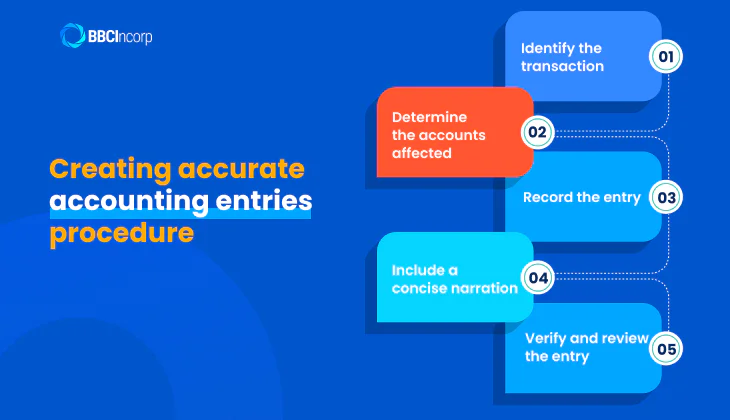
Step 1: Identify the transaction
The first step is to recognize the financial event that requires recording. Transactions can include sales, purchases, payments, receipts, payroll, or asset acquisitions.
Identifying the transaction makes certain that all business activities are captured and none are omitted from the accounting system.
Step 2: Determine the accounts affected
Each transaction impacts at least two accounts under the double-entry accounting system. Determine which accounts increase or decrease, considering their normal balances.
For example, purchasing office supplies with cash increases supplies (debit) and reduces cash (credit). Proper account selection is critical to maintaining accurate records.
Step 3: Record the entry
Once accounts are identified, record the transaction using the correct debit and credit format. Include the precise amount, and reference supporting documents such as invoices, receipts, or contracts.
These references provide verifiable evidence for each entry, supporting audits and regulatory reviews.
Step 4: Include a narration
A concise narration explains the purpose of the transaction, summarizing its nature in one or two sentences.
Narrations improve clarity for management, auditors, and other stakeholders, making it easier to understand the context of each entry without reviewing supporting documents in detail.
Step 5: Verify and review
After recording, review the entry for accuracy. Check that debits equal credits, amounts match source documents, and account classifications are correct. Verification prevents errors, misstatements, and fosters compliance with Hong Kong accounting standards.
Frequent errors in accounting entries and how to prevent them
Here are the most common accounting entry errors and practical steps to prevent them.
Frequent errors in accounting entries
- Misclassification of accounts: Posting transactions to the wrong account type, such as treating an expense as an asset or misclassifying a liability as equity, can distort financial statements and affect tax reporting.
- Incorrect debit and credit direction: Reversing debits and credits or ignoring normal balances causes ledger imbalances and inaccurate trial balances.
- Missing or duplicated entries: Oversights or manual errors can leave transactions unrecorded or recorded multiple times, affecting totals in journals, ledgers, and financial statements.
- Incorrect amounts: Typographical errors, rounding mistakes, or currency conversion inaccuracies result in misreported balances.
- Unclear or missing narrations: Transactions without descriptive explanations make audits, reviews, and reconciliations time-consuming and error-prone.
Best practices to maintain clean records
- Regular reconciliations: Compare bank statements, supplier statements, and ledgers to detect discrepancies and verify cash, receivables, and payables.
- Periodic internal reviews: Conduct scheduled checks of journal and ledger entries to identify anomalies or unusual transactions.
- Standardized chart of accounts: Maintain consistent account coding and categories to prevent misclassification and improve reporting accuracy.
- Document attachment: Link invoices, receipts, contracts, and payment proofs to each journal entry to provide verifiable evidence.
- Accounting software and automation: Use reliable tools to enforce proper debit-credit rules, reduce manual data entry, and flag inconsistencies automatically.
Importance of documentation and audit readiness
Attaching invoices, receipts, contracts, and other source documents creates an organized paper trail, allowing auditors and management to trace financial activity quickly.
Proper documentation reduces errors, strengthens internal controls, and demonstrates compliance with Hong Kong accounting standards. It also simplifies reconciliations, resolves disputes efficiently, and provides evidence for tax reporting or regulatory reviews.
Technology and automation in modern accounting entry processing
Modern accounting relies on technology to simplify workflows, reduce errors, and deliver accurate records for companies operating in Hong Kong.
Cloud bookkeeping platforms
Cloud-based systems store journals, ledgers, and supporting documents in a single secure environment, giving teams instant access to updated data. Continuous syncing keeps information current while automated backups reduce the risk of data loss.
Automated accounting entries
Automation links bank feeds, invoices, and payment data directly to the accounting platform. Predefined rules classify transactions correctly and help prevent misposted accounts or debit-credit mistakes. Optical character recognition captures information from receipts and invoices with strong accuracy, removing manual entry steps.
A practical example is the integrated Client Portal of BBCIncorp. On this platform, clients upload files for storage, download records whenever needed, and complete online sign procedures easily. This digital workflow supports fast document handling and creates a clear audit trail for every entry.
Benefits for growing businesses
Automation reduces repetitive tasks, giving finance teams more time for review and planning. It produces audit-ready records with source documents attached and supports cash flow tracking and compliance with Hong Kong Financial Reporting Standards.
Expanding companies gain precise records, faster processing, and organised documentation that supports both operational efficiency and regulatory needs in Hong Kong.
For expanding businesses, these tools offer precise records, faster processing, and reliable documentation, supporting both operational efficiency and compliance in Hong Kong.
When businesses should seek expert support for accounting entries
Handling complex accounting entries alone can be time-consuming and error-prone, but with expert support, even the most complicated transactions become manageable and precise.
Scenarios requiring expert involvement
Certain transactions demand specialist expertise. Consolidating financial statements across multiple subsidiaries requires precise elimination entries and intercompany adjustments.
Foreign currency adjustments involve exchange rate calculations, revaluations, and translation impacts that can affect profitability if recorded incorrectly.
Equity transactions, such as share issuance, buybacks, and stock-based compensation, touch multiple accounts and must be accurately documented to reflect ownership changes and retained earnings.
Professional involvement ensures these high-stakes transactions are recorded correctly, avoiding costly mistakes, compliance issues, or misstatements.
Benefits of outsourcing to certified experts
Outsourced bookkeeping with certified professionals provides accurate handling of complex accounting entries while delivering timely, audit-ready records.
Experts apply Hong Kong and international accounting standards, reducing risk and providing clarity for stakeholders. This allows internal teams to focus on growth and strategic initiatives rather than wrestling with intricate transactions.
An expert team also provides guidance on regulatory updates and solutions for multi-jurisdictional operations, giving businesses a competitive advantage through reliable, compliant financial management.
Businesses navigating consolidation, foreign exchange adjustments, or equity transactions gain confidence and precision by leveraging outsourced services and expert guidance.
Partnering with certified professionals transforms accounting from a source of risk into a strategic tool, enabling companies to enhance financial integrity and drive sustainable growth in Hong Kong’s dynamic business environment.
BBCIncorp’s end-to-end support for accounting and compliance
Complex financial transactions can create stress for businesses, and BBCIncorp provides the tools and expertise to simplify them.
Journal entry management and cloud accounting setup
We provide bookkeeping services for both routine and journal entries, simplifying daily financial management. Using cloud-based platforms, we record transactions in real time, automatically categorize them, and integrate with bank feeds to reduce errors.
This approach keeps financial data organized, accessible, and easy to interpret for business owners and managers.
Reporting assistance and compliance support
We handle complex accounting entries, including equity transactions, consolidation, and multi-currency adjustments.
We prepare financial statements in line with HKFRS and SME-FRS standards, ensuring timely submission to the Inland Revenue Department. Accurate reporting helps businesses remain compliant while providing insights that support informed decisions.
Value for international businesses, startups, and SMEs
Our services are designed for startups, SMEs, and international businesses. Startups receive structured bookkeeping that saves time, SMEs gain consistent financial oversight, and international companies benefit from expertise across multiple jurisdictions.
From cloud-accounting setup to journal entry management and reporting, we provide end-to-end bookkeeping services and accounting compliance support. Our expert approach reduces errors, making financial management simple, reliable, and stress-free.
To learn more or start improving your accounting operations, contact us or visit our website on accounting in Hong Kong compliance services today.
Conclusion
Accurate accounting entries form the foundation of reliable financial records and effective business management. Following the principles of double-entry accounting and ensuring proper classification of accounts is essential for maintaining balance, transparency, and audit readiness.
Errors in entries can quickly cascade, affecting financial statements, compliance, and strategic decision-making. Leveraging automation tools, such as cloud bookkeeping and bank feed integration, reduces manual mistakes and accelerates data processing.
At the same time, with professional company services, complex transactions, like equity adjustments, foreign currency revaluations, and consolidation, are recorded precisely.
Get in touch with BBCIncorp at service@bbcincorp.com for timely assistance and streamlined procedures for Hong Kong accounting entries today.
Disclaimer: While BBCIncorp strives to make the information on this website as timely and accurate as possible, the information itself is for reference purposes only. You should not substitute the information provided in this article for competent legal advice. Feel free to contact BBCIncorp’s customer services for advice on your specific cases.
Industry News & Insights
Get helpful tips and info from our newsletter!
Stay in the know and be empowered with our strategic how-tos, resources, and guidelines.