Hong Kong incorporation fee & Aspire
 cashback.


Table of Contents
Rising global concern over climate change has accelerated demand for sustainable investment channels. Financial markets are increasingly prioritizing environmental responsibility, driving the expansion of green finance initiatives across major economies. Within Asia, Hong Kong has positioned itself as a strategic center for sustainable capital flows.
The growing green bond Hong Kong market plays a crucial role in funding environmentally focused infrastructure and climate-related projects. Policy support from the Hong Kong Monetary Authority and collaboration within the financial ecosystem, including the Hong Kong Green Finance Association, have strengthened market development.
Through these efforts, green bonds are becoming an important mechanism supporting long-term sustainability goals and responsible economic growth in the region.
Key Takeaways
- Green bond HK drives sustainable capital flows and climate-focused investment across Asia
- Hong Kong strengthens its position as a leading green finance hub through policy support and global connectivity
- Green bonds enable transparent funding for environmental projects aligned with ESG standards
- Growing investor demand and regulatory frameworks accelerate sustainability HK development
What are green bonds and why do they matter for green finance
Green bonds are fixed-income instruments issued to raise capital for projects that generate measurable environmental benefits.
As an essential component of green finance, these instruments enable governments, corporations, and financial institutions to mobilize funding for initiatives that address climate risks and support sustainable development.
Unlike conventional bonds, which can be used for general funding purposes, green bonds require that proceeds be allocated exclusively to environmentally responsible projects. Common categories of eligible projects include:
- Renewable energy initiatives such as solar, wind, and clean power infrastructure
- Sustainable transportation systems and low-carbon mobility solutions
- Energy-efficient buildings and industrial efficiency improvements
- Water resource management and pollution reduction projects
- Environmental protection and ecosystem restoration programs
To maintain transparency and market credibility, international guidelines have been developed by the International Capital Market Association through the Green Bond Principles. These principles outline key practices for issuers, including:
- Clear criteria for selecting and evaluating eligible green projects
- Transparent management and allocation of bond proceeds
- Ongoing disclosure and reporting on environmental impact
Across Asia, Hong Kong has emerged as a major center for sustainable capital markets. The continued development of the green bond Hong Kong market helps direct investment toward climate-focused infrastructure and environmental initiatives.
In doing so, these instruments play a meaningful role in advancing broader sustainability Hong Kong objectives while supporting the global transition to a low-carbon economy.
How the Hong Kong green bond market has developed
Driven by rising global demand for sustainable investment, Hong Kong has established a policy framework and financial infrastructure that support the growth of environmentally focused capital markets.
These efforts have helped build a credible ecosystem for sustainable bond issuance while attracting international investors seeking ESG-aligned assets.
Key developments shaping the green bond Hong Kong ecosystem include:
- Government commitment to green finance development: The Hong Kong government has prioritized sustainable finance as part of its long-term economic strategy, positioning the city as a regional platform for green investment and climate-related financing.
- Launch of the Government Green Bond Programme: This initiative enables the government to issue green bonds to fund projects such as sustainable infrastructure, renewable energy, and environmental protection, while establishing benchmarks for transparency and market standards.
- Policy and infrastructure support from the Hong Kong Monetary Authority: The authority promotes sustainable finance initiatives, strengthens regulatory frameworks, and supports market practices that facilitate green bond issuance and reporting.
- Increasing green bond issuance in Hong Kong: Beyond government issuances, financial institutions and corporate entities have increasingly adopted green bonds as a financing tool for sustainability-related projects.
- Growing participation from global institutional investors: International investors are actively participating in Hong Kong’s sustainable capital markets, attracted by the city’s regulatory transparency and strong financial infrastructure.
As a global financial center, Hong Kong also plays a strategic role in connecting international capital with sustainability projects across Asia.
By facilitating cross-border investment flows, the green bond Hong Kong market contributes to regional climate financing while supporting long-term sustainability Hong Kong policies and environmental development.
Sustainable finance initiatives shaping Hong Kong’s green economy
The development of sustainability is supported by a comprehensive policy framework designed to strengthen green finance and promote responsible capital allocation.
As Hong Kong positions itself as a leading sustainable finance hub in Asia, government agencies, regulators, and industry organizations have introduced initiatives that encourage transparency, investment, and market participation.
Several key policy mechanisms are shaping the city’s sustainable finance ecosystem:
- Policy coordination through the Green and Sustainable Finance Cross-Agency Steering Group: Established to align regulatory priorities across financial authorities, this group coordinates climate-related financial policies, promotes sustainable investment practices, and supports the development of a regional green finance center.
- Development of ESG disclosure frameworks and reporting standards: Regulators have introduced guidelines that strengthen environmental, social, and governance (ESG) transparency. These frameworks improve comparability of sustainability data and help investors evaluate environmental performance more effectively.
- Government incentives encouraging green bond issuance: Financial incentives and grant schemes have been introduced to support issuers in launching sustainable financial instruments, including the green bond Hong Kong market. These incentives help reduce issuance costs and encourage wider adoption among corporate and financial institutions.
- Industry collaboration with the Hong Kong Green Finance Association: The association promotes industry engagement, supports knowledge sharing, and facilitates collaboration between financial institutions, investors, and policymakers to advance sustainable finance initiatives.
- Expansion of sustainable investment infrastructure: Regulatory frameworks, sustainable finance taxonomies, and market standards are being continuously developed to improve capital allocation toward environmentally responsible projects.
Benefits of issuing green bonds in Hong Kong for companies and investors
The green bond market offers strategic advantages for both issuers and investors seeking to participate in green finance and sustainable investment opportunities.
As Hong Kong continues to strengthen its role as an international financial center, its green bond ecosystem provides access to global capital while supporting long-term sustainability objectives.
For companies and financial institutions, issuing green bonds in Hong Kong offers several key benefits:
- Access to global ESG-focused investors: The city hosts a deep pool of institutional investors actively seeking environmental, social, and governance (ESG) aligned assets, helping issuers attract diversified international capital.
- Strong financial infrastructure and regulatory credibility: Hong Kong’s transparent legal framework, mature capital markets, and established sustainable finance policies provide credibility and confidence for issuers entering the green bond market.
- Gateway to Asian sustainable investment markets: As a regional financial hub, Hong Kong enables companies to raise capital for environmental projects across Asia while expanding their presence in growing sustainability-focused markets.
For investors, the green bond Hong Kong market also presents attractive opportunities:
- Transparent environmental financing: Green bonds require a clear allocation of proceeds to environmentally beneficial projects, improving transparency and accountability in sustainable investment.
- Exposure to sustainability projects across Asia: Investors gain access to a broad range of climate-related initiatives, including renewable energy, green infrastructure, and environmental innovation across the region.
- Participation in a growing green finance ecosystem: Hong Kong’s expanding sustainable finance framework allows investors to engage in a dynamic market that continues to develop alongside global ESG investment trends.
In addition, cross-border market connectivity enhances investor access through Bond Connect, which links Hong Kong’s financial markets with mainland China’s bond market. This connectivity strengthens Hong Kong’s role as a bridge between international capital and Asian sustainability projects.
How companies can issue a green bond in Hong Kong
Issuing a green bond Hong Kong typically involves a structured process designed to ensure transparency, environmental credibility, and alignment with global green finance standards. Companies seeking to raise capital for sustainability-focused projects in Hong Kong generally follow several key steps.
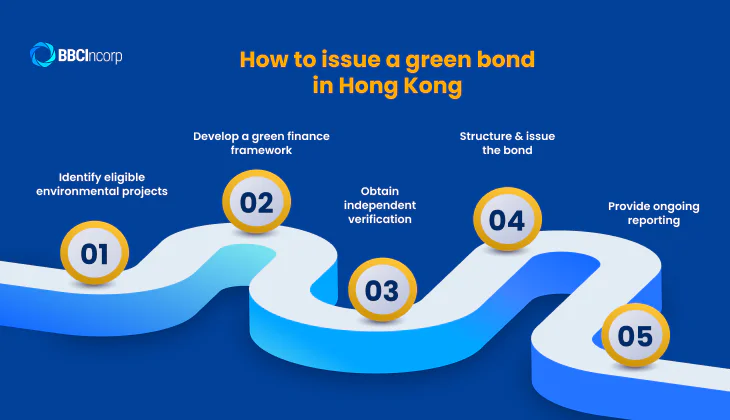
Step 1: Identify eligible environmental projects
Issuers first determine which projects qualify for green financing. These may include renewable energy development, sustainable infrastructure, energy efficiency improvements, or environmental protection initiatives that contribute to broader sustainability objectives.
Step 2: Develop a green finance framework
Companies establish a green finance framework outlining project eligibility, fund management, and reporting practices. This framework is typically aligned with international guidelines developed by the International Capital Market Association.
Step 3: Obtain independent verification
An external reviewer or certification body assesses whether the framework and projects meet recognized green bond standards, strengthening investor confidence.
Step 4: Structure and issue the bond
The bond is then structured and issued through Hong Kong’s capital markets, allowing issuers to access regional and global investors.
Step 5: Provide ongoing reporting
After issuance, companies are expected to report regularly on the allocation of proceeds and the environmental impact of funded projects, ensuring transparency and accountability within the green bond Hong Kong market.
The green bond Hong Kong market is expected to play an increasingly important role as Hong Kong continues to strengthen its position in global green finance. Supported by proactive government policies and a well-established financial infrastructure, the city is well placed to facilitate sustainable investment flows across the region.
As demand for climate-focused capital rises throughout Asia, green bonds will remain a key driver of sustainability Hong Kong initiatives and environmental development.
With its strong international connectivity, Hong Kong will continue to serve as a strategic gateway linking global capital with sustainable projects in Asia. BBCIncorp provides helpful information on doing business in Hong Kong. Contact us for inquiries or if you are interested in Hong Kong incorporation.
Disclaimer: While BBCIncorp strives to make the information on this website as timely and accurate as possible, the information itself is for reference purposes only. You should not substitute the information provided in this article for competent legal advice. Feel free to contact BBCIncorp’s customer services for advice on your specific cases.
Industry News & Insights
Get helpful tips and info from our newsletter!
Stay in the know and be empowered with our strategic how-tos, resources, and guidelines.