Hong Kong incorporation fee & Aspire
 cashback.


Table of Contents
As one of the world’s leading international financial centers, Hong Kong attracts multinational corporations, investors, and entrepreneurs seeking access to global capital and the Asia-Pacific market.
In such a highly regulated and competitive environment, transparent and reliable financial reporting is essential for maintaining investor confidence and ensuring regulatory compliance.
HKICPA issues the accounting standards applicable to financial reporting in Hong Kong. Depending on an entity’s circumstances and eligibility, financial statements may be prepared under Hong Kong Financial Reporting Standards (HKFRS), HKFRS for Private Entities, or the SME-FRF & SME-FRS.
Closely aligned with international accounting practices, HKFRS reporting supports transparency and strengthens the credibility of financial information. For companies operating or planning to establish a presence in Hong Kong, understanding HKFRS is a critical component of effective financial governance and compliance.
Key Takeaways
- Hong Kong Financial Reporting Standards provides a standardized framework for transparent and consistent financial reporting in Hong Kong.
- HKFRS reporting aligns closely with international standards, enhancing comparability and investor confidence.
- Proper application of HKFRS accounting standards helps businesses ensure compliance and reduce regulatory risks.
- Strong HKFRS practices support effective financial governance and sustainable business growth.
What are Hong Kong Financial Reporting Standards?
Hong Kong Financial Reporting Standards are a set of accounting standards that regulate how companies prepare and present financial statements in Hong Kong. These standards provide a structured framework for financial reporting, ensuring that financial information is disclosed in a consistent, transparent, and comparable manner.
Accounting standards establish clear rules for recording and reporting financial transactions, including areas such as revenue recognition, asset valuation, and liabilities. Through standardized reporting practices, HKFRS allows investors, regulators, and other stakeholders to better interpret financial information and evaluate company performance.
The HKFRS accounting standards framework encompasses the following standards and interpretations that guide the preparation and presentation of financial statements:
- Standards: HKFRSs and HKASs, which set requirements for financial reporting and accounting treatments.
- Interpretations: HK(IFRIC)-Ints, HK(SIC)-Ints, and HK-Ints, which provide guidance on applying the relevant standards.
Beyond structure, Hong Kong Financial Reporting Standards are designed to achieve several important objectives in financial reporting:
- Enhancing financial transparency by requiring companies to disclose relevant and accurate financial information.
- Improving comparability so stakeholders can evaluate financial performance across different companies and industries.
- Supporting informed decision-making for investors, regulators, and business partners.
The development and continuous updates of HKFRS are managed by the Hong Kong Institute of Certified Public Accountants, ensuring the standards remain aligned with international accounting practices and evolving market conditions.
How HKFRS aligns with International Financial Reporting standards (IFRS)
The HKFRS accounting standards are designed to maintain close convergence with the International Financial Reporting Standards, issued by the International Accounting Standards Board.
Through this alignment, the Hong Kong Financial Reporting Standards support consistent and transparent financial reporting within the global marketplace while addressing the specific regulatory context of Hong Kong.
This alignment is reflected in several key aspects:
- Convergence with IFRS Accounting Standards: HKFRS accounting standards have been fully converged with IFRS Accounting Standards since 1 January 2005, subject to Hong Kong-specific interpretations and local implementation considerations.
- Continuous convergence with international updates: Hong Kong standard setters monitor developments issued by the IASB and incorporate relevant updates to maintain alignment with global standards.
- Targeted local interpretations: Limited guidance may be introduced to address regulatory or market-specific considerations within Hong Kong.
- Enhanced international comparability: Financial statements prepared under HKFRS can be readily compared with IFRS-based reports used in other jurisdictions.
This close alignment strengthens Hong Kong’s credibility as an international financial centre and facilitates cross-border investment and capital market participation.
Key components of HKFRS reporting requirements
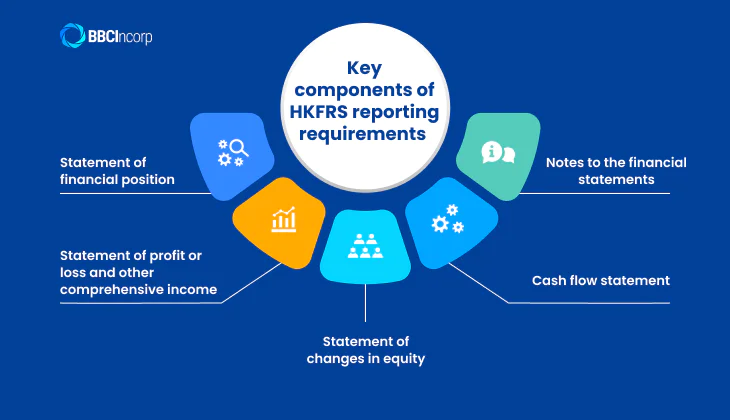
Under HKFRS reporting, companies are required to prepare the primary statements and notes that present a clear and consistent view of their financial position and performance. The framework established by the Hong Kong Financial Reporting Standards ensures that financial reports are transparent, comparable, and aligned with international reporting practices.
A typical HKFRS reporting package includes several core financial statements:
- Statement of financial position: This statement provides a snapshot of a company’s financial standing at the end of a reporting period, presenting assets, liabilities, and equity. It helps stakeholders assess the organization’s financial stability and capital structure.
- Statement of profit or loss and other comprehensive income: This report outlines a company’s financial performance during a specific period by detailing revenue, expenses, and overall profitability. It also includes other comprehensive income items that affect total equity but are not recorded in the standard profit or loss calculation.
- Statement of changes in equity: This statement tracks movements in shareholders’ equity over time. It reflects factors such as net profit, dividend distributions, and any additional capital contributions or withdrawals.
- Statement of cash flows: The cash flow statement presents cash inflows and outflows from operating, investing, and financing activities. It helps users understand how a company generates and uses cash throughout the reporting period.
- Notes to the financial statements: These notes provide detailed explanations supporting the financial statements. They include disclosures about accounting policies, key assumptions, and significant judgments applied in preparing the reports.
In addition to these core components, HKFRS reporting requires companies to provide sufficient disclosures to ensure transparency. Businesses must clearly explain their accounting policies and any material estimates or risks that could affect financial results.
The development and oversight of HKFRS accounting standards are managed by the Hong Kong Institute of Certified Public Accountants, which ensures that the standards remain consistent with global reporting practices and relevant to Hong Kong’s financial environment.
Which companies must follow HKFRS in Hong Kong
The HKFRS framework forms the foundation of financial reporting for many businesses operating in Hong Kong. The Hong Kong Financial Reporting Standards establish consistent principles for preparing financial statements that meet regulatory and investor expectations.
In practice, HKFRS reporting is required or commonly adopted by several categories of companies, depending on their legal obligations and reporting needs.
The following types of companies typically follow HKFRS in Hong Kong:
- Companies incorporated in Hong Kong preparing statutory financial statements: Local companies must prepare annual financial statements for shareholders and regulators, and these statements are generally prepared in accordance with HKFRS accounting standards.
- Listed companies on the Hong Kong Stock Exchange: Hong Kong-listed issuers generally prepare their annual financial statements under HKFRS or IFRS, or other financial reporting standards permitted under HKEX requirements.
- Subsidiaries of multinational companies operating in Hong Kong: Many international groups require their Hong Kong subsidiaries to prepare financial reports based on HKFRS so that the data can be consolidated with global financial statements.
However, not all companies must apply the full HKFRS framework. Certain private companies without public accountability may qualify to use HKFRS for Private Entities, a simplified reporting standard focused on entities without public accountability.
The revised HKFRS for Private Entities was issued in 2025 and is effective for annual periods beginning on or after 1 January 2027, with early application permitted. It streamlines reporting requirements while remaining aligned with international accounting principles.
Eligible entities may also apply the SME-FRF & SME-FRS (SME-FRS), a simpler financial reporting framework.
Benefits of HKFRS for companies and investors
Established under the Hong Kong Financial Reporting Standards, these standards help ensure that financial statements reflect a company’s financial position and performance in a clear and reliable manner. As a result, HKFRS delivers important strategic benefits for both businesses and investors operating in Hong Kong’s financial ecosystem.
For companies, HKFRS accounting standards offer several advantages:
- Increased credibility in financial reporting: Financial statements prepared under recognized standards strengthen the reliability of corporate disclosures.
- Improved investor confidence: Transparent and consistent reporting helps build trust among shareholders, lenders, and business partners.
- Alignment with international accounting practices: Close convergence with International Financial Reporting Standards allows companies to operate more easily across global markets.
For investors, HKFRS reporting also delivers significant value:
- Comparable financial information across jurisdictions: Investors can evaluate companies using consistent financial metrics across international markets.
- Transparent financial performance and risk disclosure: Clear reporting standards make it easier to assess profitability, financial stability, and potential risks.
By promoting reliable financial reporting and international comparability, HKFRS accounting standards reinforce Hong Kong’s reputation as a trusted global financial center and an important gateway connecting international investors with Asian markets.
Managing HKFRS compliance with BBCIncorp services
Ensuring accurate HKFRS reporting can be a complex and resource-intensive process, particularly for companies operating in a highly regulated environment like Hong Kong. Many businesses face challenges in correctly applying Hong Kong Financial Reporting Standards, maintaining proper financial records, and keeping up with evolving compliance requirements.
From preparing financial statements to meeting tax filing obligations, even minor errors can lead to regulatory risks and impact business credibility.
This is where professional support becomes essential. Partnering with an experienced service provider such as BBCIncorp allows companies to streamline compliance processes and focus on core business operations.
BBCIncorp supports businesses in managing HKFRS reporting through a comprehensive range of services:
- Business accounting services in Hong Kong: Maintain accurate and up-to-date financial records in line with HKFRS requirements.
- Tax filing and compliance management: Handle corporate tax filings while ensuring alignment between financial statements and tax obligations.
- Audit coordination with licensed auditors: Facilitate smooth audit processes and help prepare all documentation that meets regulatory expectations.
- Ongoing corporate compliance support: Provide continuous guidance to help businesses stay compliant with changing regulations.
By leveraging expert support, companies can reduce compliance risks, improve reporting accuracy, and strengthen their financial governance. With the right partner, HKFRS reporting becomes a streamlined and reliable process, enabling businesses to operate confidently and sustainably in Hong Kong’s competitive market.
Conclusion
HKFRS provide a reliable framework for transparent financial reporting, regulatory compliance, and investor confidence. Choosing the appropriate reporting framework and maintaining accurate financial records are essential for businesses operating in Hong Kong.
BBCIncorp helps simplify accounting and compliance obligations, allowing businesses to focus on growth. Chat with our team to find the right support for your business.
Disclaimer: While BBCIncorp strives to make the information on this website as timely and accurate as possible, the information itself is for reference purposes only. You should not substitute the information provided in this article for competent legal advice. Feel free to contact BBCIncorp’s customer services for advice on your specific cases.
Industry News & Insights
Get helpful tips and info from our newsletter!
Stay in the know and be empowered with our strategic how-tos, resources, and guidelines.