Hong Kong incorporation fee & Aspire
 cashback.


Table of Contents
Severance payment in Hong Kong provides essential statutory support for employees who lose their jobs due to redundancy or layoffs. Governed by the Employment Ordinance, this entitlement comes with clear rules on eligibility, calculation, and payment obligations.
For both employers and employees, understanding how it works is critical to ensure compliance and avoid disputes or missed entitlements.
With upcoming changes to the MPF offsetting mechanism taking effect from 2025, the topic has become even more relevant for businesses operating in Hong Kong. This guide breaks down the key requirements and highlights practical considerations to help you navigate the process with clarity and confidence.
Key Takeaways:
- Severance payment in Hong Kong is a statutory entitlement for redundancy, governed by the Employment Ordinance
- Calculated based on wages multiplied by two-thirds multiplied by years of service, subject to caps (HKD 22,500/month; HKD 390,000 total)
- From 1 May 2025, MPF offsetting is removed for post-transition service, increasing employer costs
- Strict deadlines, accurate calculation, and proper documentation are essential to avoid disputes and penalties
What is a severance payment in Hong Kong?
Severance payment in Hong Kong is a form of statutory compensation provided under the Employment Ordinance to employees whose roles are terminated due to redundancy or layoff. It is designed to offer financial support when a position is no longer required, rather than as a reward for long-term service or performance.
In practice, this means the payment is triggered by business-driven decisions, such as restructuring, downsizing, or closure rather than employee-related reasons.
It is important to distinguish severance payment from long service payment, as the two are mutually exclusive under Hong Kong law. Severance payment specifically applies to redundancy situations, while long service payment is generally linked to other forms of termination after extended employment.
In both cases, the amount payable is calculated based on the employee’s years of service and wages, following a statutory formula.
Legal framework under the Employment Ordinance
Severance payment in Hong Kong is governed by the Employment Ordinance (Cap. 57), which establishes the legal framework for employee entitlements in cases of redundancy or layoff.
It sets out minimum statutory requirements that all employers must follow, regardless of internal policies or contractual arrangements. This ensures a consistent baseline of protection for employees across different industries and business sizes.
A key concept under the Ordinance is the “continuous contract”, which generally refers to employees who have been employed for at least 4 weeks, working 18 hours or more per week.
Only employees under such contracts are eligible for statutory severance payment, provided they meet other qualifying conditions. This distinction is important, as it determines whether the legal entitlement applies in the first place.
From a compliance perspective, employers must understand that statutory obligations override contractual terms. Even if an employment contract is silent on severance payment or attempts to offer less than the statutory minimum, the provisions of the Employment Ordinance will still apply.
Employers may choose to offer contractual severance packages that are more generous, but they cannot provide less than what is legally required.
Severance payment calculator and statutory caps
The calculation of severance payment in Hong Kong follows a statutory formula under the Employment Ordinance, with defined caps to ensure consistency and prevent excessive liabilities. For monthly-paid employees, the entitlement is determined based on the employee’s relevant monthly wages, multiplied by two-thirds, and then by the years of service.
Notably, “relevant monthly wages” must be the higher of the last month’s wages or the average wages over the preceding 12 months, ensuring the employee receives the more favourable outcome.
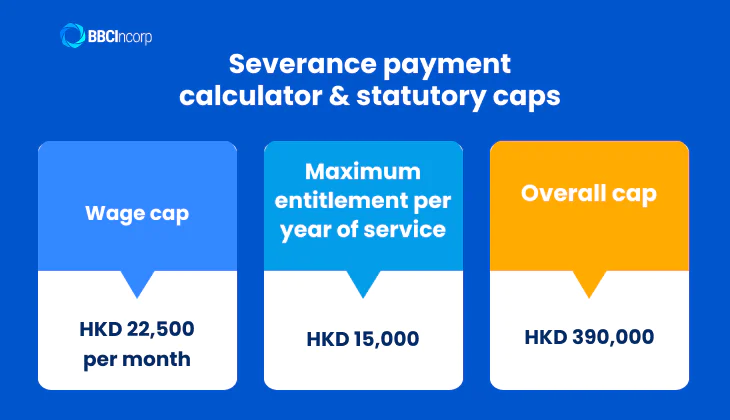
To standardise calculations, the law imposes several key limits:
- Wage cap: HKD 22,500 per month
- Maximum entitlement per year of service: HKD 15,000
- Overall cap: HKD 390,000
For daily-rated or piece-rated employees, the approach differs slightly. The entitlement is calculated based on 18 days’ wages, selected from any 18 days within the last 30 normal working days, and then multiplied by the years of service.
Where the service period is not a whole number of years, a pro-rata calculation applies to reflect the exact duration of employment. The definition of “wages” is also critical to ensure accuracy in calculation. In general:
- Included: regular salary, commissions, and fixed allowances
- Excluded: discretionary bonuses and irregular or non-recurring payments

For example:
An employee with six years of service has a last monthly salary of HKD 24,000 and a 12-month average of HKD 21,000. After applying the statutory wage cap, the relevant monthly wage is adjusted to HKD 22,500, which is higher than the average.
The severance payment is therefore calculated as HKD 22,500 multiplied by two-thirds, and then multiplied by six, resulting in a total entitlement of HKD 90,000.
MPF offsetting changes and financial impact
A significant development in Hong Kong’s employment landscape is the reform of the MPF offsetting mechanism, which takes effect on 1 May 2025.
From this date, employers will no longer be allowed to offset severance payment against their mandatory MPF contributions for the portion of service accrued after the transition.
This change does not alter the employee’s entitlement to severance payment itself, but it fundamentally reshapes how the payment is funded.
To apply the new rules correctly, severance payment must be divided into two distinct portions based on the employee’s service period:
- Pre-1 May 2025 service portion: Employers may continue to offset severance payment against their mandatory MPF contributions, in line with the existing mechanism
- Post-1 May 2025 service portion: No offset is permitted, meaning employers must bear the full cost of severance payment for this period
This reform has clear financial and operational implications. Employers will face higher termination costs over time, particularly for employees with long post-2025 service periods. As a result, workforce planning and cost forecasting will require more careful consideration.
At the same time, employees benefit from stronger financial protection, as their MPF savings will no longer be used to reduce severance entitlements, leading to higher net payouts.
The changes also place greater emphasis on accurate record-keeping. Employers must clearly track and distinguish between pre- and post-transition service periods to ensure correct calculation and compliance.
It is also important to clarify that the reform applies specifically to mandatory MPF contributions made by employers. It does not universally apply to voluntary contributions in all cases.
Payment process, deadlines, and tax treatment
Managing severance payment in Hong Kong requires attention not only to calculation, but also to the proper process and timelines set out under the Employment Ordinance. In practice, the process begins with the employee, who must formally initiate the claim.
Employees are required to submit a claim for severance payment, and it is strongly recommended that this is done in writing to ensure clarity and maintain proper records for both parties. This helps avoid disputes and provides a clear reference point for statutory deadlines.
The Ordinance also prescribes strict timelines:
- The claim must be made within 3 months after the date of termination
- The employer is required to make payment within 2 months after receiving the claim
Failure to comply with these requirements may expose the employer to legal consequences, including prosecution and financial penalties.
From a tax perspective, severance payment is treated favourably. Statutory severance payment is not subject to salaries tax in Hong Kong, providing employees with full access to the entitled amount. However, where an employer offers a payment exceeding the statutory entitlement, the excess portion may be considered taxable.
It is also important to distinguish severance payment from other termination-related payments, such as notice pay or payment in lieu of unused annual leave. These are separate entitlements with different legal bases and do not replace or offset severance payment.
Practical considerations and common risks
Severance payment in Hong Kong often gives rise to disputes not because of the law itself, but due to misapplication or oversight. Both employers and employees need to approach the process carefully to avoid unnecessary risks.
From an employer’s perspective, if the underlying reason does not meet the legal definition, the company may face claims or disputes. Errors in wage calculation are also frequent, particularly when failing to apply the correct wage basis or statutory caps.
In addition, inadequate documentation, such as unclear records of termination rationale or payroll data, can weaken the employer’s position in the event of a challenge.
Following the 2025 reform, failure to properly separate pre- and post-transition service periods may further lead to incorrect calculations and compliance exposure.
Employees, on the other hand, missing the 3-month deadline to submit a claim can result in the loss of entitlement. There is also a tendency to misunderstand eligibility criteria or assume entitlement without verifying the legal conditions.
In some cases, employees may not review how the payment is calculated, which could lead to receiving less than they are entitled to.
To minimise these risks, several best practices should be considered:
- Maintain clear and accurate employment and payroll records
- Use official Labour Department calculation tools where appropriate
- Ensure redundancy decisions are properly documented and justified
- Seek professional advice in complex or high-value cases
A structured and well-documented approach supports compliance and helps both parties manage termination processes more confidently and transparently.
Streamline payroll and termination compliance with BBCIncorp
Navigating severance payment and termination requirements in Hong Kong can quickly become complex, especially with regulatory updates like the 2025 MPF offsetting changes.
Rather than managing these challenges internally, many businesses choose to work with experienced partners to ensure accuracy, consistency, and compliance at every stage.
BBCIncorp supports companies by simplifying payroll and termination processes while keeping them fully aligned with statutory requirements. In practice, this means businesses can rely on:
- Precise severance calculations, with the correct application of wage bases, statutory caps, and service periods
- Up-to-date compliance handling, including alignment with the latest MPF offsetting rules
- Well-maintained payroll and employment records, reducing risk in audits or disputes
- Structured termination processes, from classification to final settlement
- Stronger risk control, supported by clear documentation and regulatory understanding
- Reduced administrative burden, allowing internal teams to focus on core operations
- Practical guidance in complex cases, such as long-serving employees or mixed pre- and post-2025 service periods
With the right systems and expertise in place, businesses can approach termination with greater confidence, ensuring that every step is handled in a professional, transparent, and compliant manner.
Severance payment in Hong Kong is a statutory entitlement governed by clear legal rules, requiring both employers and employees to understand their rights and obligations.
With the 2025 MPF offsetting reform, employer responsibility has increased while employee protection is further strengthened. In practice, accurate calculation, proper documentation, and strict adherence to timelines are essential to ensure compliance and avoid disputes.
Businesses that fail to manage these elements effectively may face legal and financial risks. By adopting a structured approach, BBCIncorp streamlines payroll and termination processes while maintaining full compliance with Hong Kong regulations.
Disclaimer: While BBCIncorp strives to make the information on this website as timely and accurate as possible, the information itself is for reference purposes only. You should not substitute the information provided in this article for competent legal advice. Feel free to contact BBCIncorp’s customer services for advice on your specific cases.
Industry News & Insights
Get helpful tips and info from our newsletter!
Stay in the know and be empowered with our strategic how-tos, resources, and guidelines.