Hong Kong incorporation fee & Aspire
 cashback.


Table of Contents
Hong Kong has long been recognized as one of the world’s most important international trading hubs. Its strategic location in Asia, efficient logistics infrastructure, transparent legal system, and low-tax environment continue to support its strong role in global commerce. Hong Kong remains one of the world’s leading merchandise trading economies, ranking 7th among global trading entities in 2024, according to data from the World Trade Organization and the Hong Kong Trade Development Council.
Within this ecosystem, a textile trading company plays an important role in connecting international buyers with manufacturers across Asia. Many Hong Kong textile trading companies operate as intermediaries, managing sourcing, supplier coordination, quality control, and cross-border logistics. By overseeing these processes, textile trading companies help global fashion brands and retailers access Asia’s manufacturing networks while maintaining efficiency and consistent product standards across their supply chains.
Key takeaways
- A textile trading company plays a vital role in global supply chains, connecting buyers with manufacturers across China, Vietnam, Bangladesh, and India, while managing sourcing, quality control, and logistics.
- Hong Kong textile trading companies benefit from strong advantages, including a strategic Asia location, world-class logistics via Port of Hong Kong and Hong Kong International Airport, and a transparent, low-tax business environment.
- The textile trading company business model is highly operational, covering supplier management, contract negotiation, inspections, and export coordination, often supported by trade finance from banks like HSBC and Standard Chartered.
- Setting up a textile trading company in Hong Kong is efficient and scalable, with a clear process, strong legal framework, and access to global buyers through trade events like Hong Kong Fashion Week.
- Despite strong opportunities, textile trading companies face challenges, including supply chain disruptions, sustainability requirements, and increasing demand for transparency and compliance in global sourcing.
The role of textile trading companies in global supply chains
A textile trading company plays a central role in the global textile supply chain by connecting manufacturers, suppliers, and international buyers. In a highly fragmented industry where production stages often span multiple countries, trading companies help coordinate sourcing, manufacturing, and distribution so that products reach global markets efficiently.
The global textile supply chain typically involves several interconnected stages, including raw material sourcing, production, distribution, and retail. For example, cotton grown in India may be spun into yarn in China, woven into fabric in Bangladesh, and eventually manufactured into garments exported to Europe or North America. This complex structure allows brands to benefit from specialized production capabilities and cost advantages across different regions.
Within this system, textile trading companies act as intermediaries that simplify supply chain management for global brands and retailers. Their key functions often include:
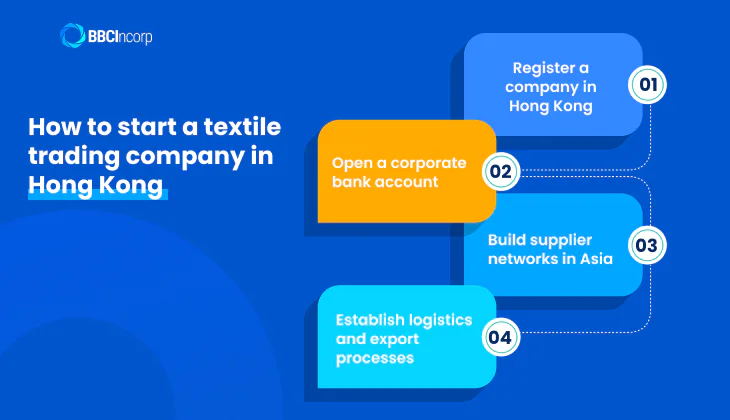
- Supplier sourcing: Identifying reliable manufacturers and raw material suppliers across major textile-producing countries.
- Price negotiation: Facilitating competitive pricing between buyers and factories while managing cost structures.
- Quality control: Ensuring that textile products meet required specifications, safety standards, and brand guidelines.
- Shipping coordination: Organizing international logistics, documentation, and delivery schedules.
Many Hong Kong textile trading companies source fabrics and garment components from leading manufacturing countries such as China, Vietnam, Bangladesh, and India. These markets offer established production ecosystems and large-scale manufacturing capabilities.
By managing supplier relationships and coordinating cross-border logistics, a textile trading company helps international brands navigate supply chain complexity. At the same time, these firms play a growing role in monitoring compliance, improving traceability, and ensuring that production timelines and quality expectations are met. As global sourcing networks continue to expand, trading companies remain essential partners in maintaining efficiency and reliability across the textile value chain.
Why Hong Kong is a hub for textile trading companies
Hong Kong has long been recognized as one of the world’s leading international trading centers. Many Hong Kong textile trading companies choose to establish their headquarters in the city because it offers a combination of strategic geography, advanced logistics infrastructure, and a highly transparent business environment. These advantages allow trading firms to efficiently coordinate sourcing, manufacturing, and global distribution.
Several structural factors explain why Hong Kong continues to serve as a major base for international textile trading companies.
Strategic location in Asia
Hong Kong sits at the center of Asia’s manufacturing network, close to key textile production markets such as China, Vietnam, Bangladesh, and India. This proximity allows trading firms to:
- Coordinate sourcing and production more efficiently.
- Maintain frequent communication with suppliers and factories.
- Reduce lead times across complex regional supply chains.
As a result, many Hong Kong textile trading companies use the city as a regional coordination hub for their supplier networks.
Highly efficient logistics infrastructure
Hong Kong’s global logistics network supports fast and reliable international trade. Two major logistics gateways play a key role:
- Port of Hong Kong – one of the world’s major container ports, enabling large-scale maritime trade across global shipping routes.
- Hong Kong International Airport – the world’s busiest air cargo hub, supporting rapid delivery for time-sensitive textile shipments.
These logistics capabilities allow textile trading firms to move fabrics, materials, and finished garments quickly between Asian manufacturers and overseas markets.
Transparent legal and tax environment
Hong Kong also provides a predictable regulatory framework that supports international commerce. The tax system is simple and business-friendly, administered by the Inland Revenue Department.
Key advantages include:
- Clear corporate regulations
- Transparent legal protections for international trade
- A straightforward tax structure that supports cross-border business activities
Together, these strengths make Hong Kong an ideal base for textile trading companies managing complex global supply chains and international trade operations.
How a Hong Kong textile trading company operates
A textile trading company typically operates as an intermediary that connects international buyers with textile manufacturers across Asia. Rather than producing goods directly, these firms focus on managing sourcing, supplier coordination, quality control, and logistics to ensure that textile products move efficiently from factories to global markets.
Many Hong Kong textile trading companies follow a structured operating model that includes several key business activities.
Supplier sourcing and relationship management
One of the most important responsibilities of a trading company is identifying reliable suppliers. Companies usually build long-term relationships with textile mills, fabric producers, and garment manufacturers in major production markets such as China, Vietnam, Bangladesh, and India.
Typical sourcing activities include:
- Identifying manufacturers that meet quality and capacity requirements
- Evaluating production capabilities and certifications
- Maintaining long-term partnerships with trusted suppliers
- Monitoring supplier performance and compliance standards
Strong supplier networks allow trading companies to offer international buyers flexible sourcing options.
Product quality inspections
Ensuring product quality is another critical function. Since production often occurs in multiple factories across different countries, trading companies usually implement quality control procedures throughout the manufacturing process.
These inspections may include:
- Pre-production material checks
- In-line inspections during manufacturing
- Final product inspections before shipment
- Compliance verification with international safety or brand standards
This oversight helps brands maintain consistent product quality across their supply chains.
Contract negotiation and order management
Trading companies also manage the commercial aspects of textile transactions. They often act as the central point of coordination between buyers and manufacturers.
Key responsibilities include:
- Negotiating product pricing and payment terms
- Managing purchase orders and production schedules
- Coordinating product specifications and order quantities
- Handling revisions or adjustments during production
By managing these details, textile trading companies simplify procurement processes for global buyers.
Logistics coordination and export documentation
Once production is complete, trading companies arrange international shipment and export procedures. This typically involves:
- Booking freight shipments by sea or air
- Preparing export documentation and customs declarations
- Coordinating delivery timelines with logistics providers
- Tracking shipments until final delivery
To support these operations, many Hong Kong textile trading companies rely on trade financing solutions offered by major financial institutions such as HSBC and Standard Chartered. These banking services help companies manage cash flow, working capital, and cross-border payments throughout the trading cycle.
How to start a textile trading company in Hong Kong
Starting a textile trading company in Hong Kong is a relatively straightforward process due to the city’s pro-business environment and efficient company registration system. Many entrepreneurs choose Hong Kong as a base for textile trading because it allows them to manage supplier relationships across Asia while serving international buyers.
Below are the main steps involved in establishing a textile trading business.
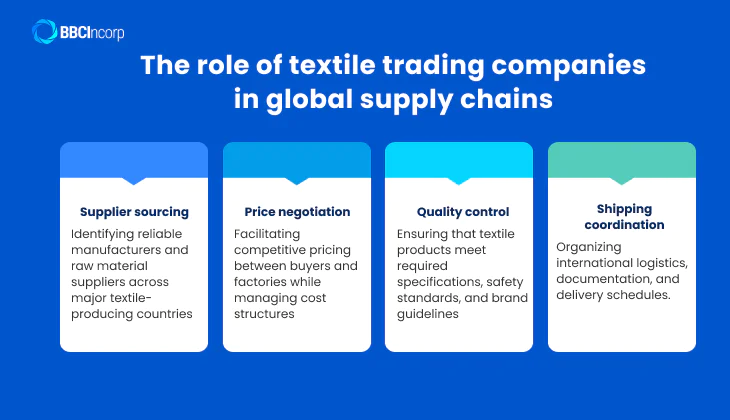
Register a company in Hong Kong
The first step is incorporating a company with the Companies Registry. Most entrepreneurs establish a private limited company, which is the most common corporate structure for trading businesses.
The basic incorporation process usually includes:
- Choosing a company name.
- Appointing at least one director and shareholder.
- Providing a local registered address.
- Filing incorporation documents with the authority.
Once approved, the company receives a Certificate of Incorporation and can begin operating legally.
Open a corporate bank account
After company registration, businesses typically open a corporate bank account to manage international transactions. Hong Kong’s banking sector supports global trade operations with multi-currency accounts and trade finance services.
A business account allows companies to:
- Receive payments from international buyers.
- Pay suppliers and manufacturers across Asia.
- Manage working capital and trade financing.
Build supplier networks in Asia
A successful textile trading company depends heavily on reliable supplier relationships. Many Hong Kong textile trading companies work with manufacturers located in China, Vietnam, Bangladesh, and India.
Key activities include:
- Identifying factories with suitable production capabilities.
- Evaluating product quality and certifications.
- Negotiating pricing and production terms.
- Building long-term partnerships with trusted suppliers.
Establish logistics and export processes
Trading companies must also develop efficient logistics systems to move textile products across international markets. This includes arranging freight services, export documentation, and delivery schedules.
To strengthen industry connections, many businesses participate in global trade exhibitions such as Hong Kong Fashion Week. These events provide opportunities to meet textile manufacturers, buyers, and supply chain partners, helping new companies expand their networks and explore business opportunities in the global textile market.
Challenges facing textile trading companies
Despite strong global demand for apparel and fabrics, textile trading companies today operate in a more complex and demanding environment than in previous decades. Changes in global trade patterns, regulatory expectations, and sustainability requirements are reshaping how textile supply chains are managed.
One major challenge involves supply chain disruptions. Events such as geopolitical tensions, shipping delays, and fluctuations in raw material prices can affect production schedules and delivery timelines. Because many Hong Kong textile trading companies rely on manufacturing networks across multiple countries, disruptions in one part of the chain can quickly affect the entire supply process.
Another growing pressure is the increasing emphasis on sustainability and responsible sourcing. Global fashion brands and retailers are under greater scrutiny from regulators and consumers to reduce environmental impact and improve labor practices within their supply chains.
Key compliance expectations often include:
- Greater traceability of raw materials and production processes.
- Verification of ethical labor practices in manufacturing facilities.
- Compliance with international environmental standards and reporting frameworks.
Organizations such as the International Trade Centre report that buyers increasingly expect transparency across textile supply chains. As a result, textile trading companies must invest more resources in supplier monitoring, compliance verification, and sustainability reporting while continuing to maintain efficiency and competitive pricing.
BBCIncorp supports fast and efficient textile trading company formation in Hong Kong
For entrepreneurs planning to establish a textile trading company in Hong Kong, working with an experienced corporate service provider can significantly simplify the setup process. BBCIncorp supports global founders, startups, and trading businesses with structured company formation services designed for cross-border operations.
Overview of BBCIncorp
BBCIncorp provides corporate services that help entrepreneurs establish and manage companies in major international business hubs. The firm focuses on simplifying the administrative and regulatory requirements involved in company formation, allowing founders to focus on building their business operations.
Through a digital-first platform and an experienced advisory team, BBCIncorp assists clients throughout the entire business setup journey, including incorporation, banking support, and post-registration compliance. The company has supported thousands of entrepreneurs worldwide in establishing companies across multiple jurisdictions.
Advantages of BBCIncorp’s Hong Kong company formation service
BBCIncorp’s Hong Kong incorporation service is designed to make company formation faster and more efficient for international entrepreneurs. Key advantages include:
End-to-end incorporation support
BBCIncorp manages the full setup process for a Hong Kong company, including:
- Company name reservation and registration
- Preparation and submission of incorporation documents
- Provision of a registered address and a company secretary
- Guidance on regulatory and compliance requirements
This structured approach helps ensure the company is formed in accordance with local regulations.
Fully online incorporation process
Entrepreneurs can complete most incorporation procedures remotely through a digital platform. Documents can be uploaded, verified, and signed electronically, allowing founders to establish their Hong Kong company without traveling to the city.
Integrated corporate services
Beyond company formation, BBCIncorp also supports businesses with additional services such as:
- Corporate bank account opening assistance
- Accounting, auditing, and tax filing support
- Corporate secretarial services and compliance management
These integrated services allow founders to manage their business operations and regulatory obligations in one place.
For entrepreneurs looking to launch a textile trading company or other international trading business, Hong Kong remains a strong base for regional operations. With professional guidance from BBCIncorp, businesses can establish their company efficiently and begin building supplier networks across Asia’s textile manufacturing markets.
Conclusion
A textile trading company in Hong Kong remains an essential link in global textile supply chains. With world-class logistics, strong financial connectivity, and a transparent regulatory framework, the city continues to attract international trading operations. As sourcing networks evolve across Asia, Hong Kong textile trading companies play a key role in connecting global buyers with reliable manufacturers.
For assistance with registering your Hong Kong company, contact BBCIncorp at service@bbcincorp.com.
Disclaimer: While BBCIncorp strives to make the information on this website as timely and accurate as possible, the information itself is for reference purposes only. You should not substitute the information provided in this article for competent legal advice. Feel free to contact BBCIncorp’s customer services for advice on your specific cases.
Industry News & Insights
Get helpful tips and info from our newsletter!
Stay in the know and be empowered with our strategic how-tos, resources, and guidelines.