Hong Kong incorporation fee & Aspire
 cashback.


Table of Contents
Hong Kong’s tax system taxes only income sourced in Hong Kong foreign-sourced income is generally exempt where the relevant conditions are met. Four taxes apply: profits tax (8.25% on the first HK$2 million, then 16.5%), salaries tax (2–17% progressive, capped by two-tiered standard rates of 15%/16%), property tax (15% of net assessable value), and stamp duty.
There is no VAT, capital gains tax, dividend tax or estate duty. All four are administered by the Inland Revenue Department. This guide sets out the current rates, filing deadlines and exemptions, with worked examples for each tax.
Key takeaways
- Hong Kong’s tax system is clear, simple, and business-friendly. Only Hong Kong-sourced income is taxable, and offshore earnings may qualify for exemptions.
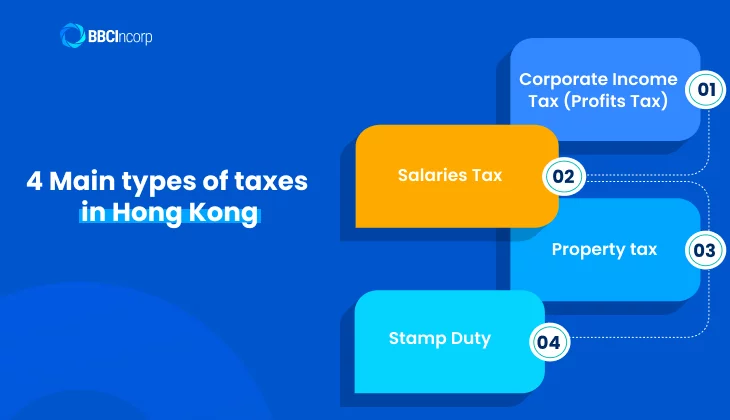
- There are four main taxes: Profits Tax, Salaries Tax, Property Tax, and Stamp Duty.
- Profits tax is charged at two-tiered rates: 8.25% on the first HK$2 million of assessable profits and 16.5% above that for corporations (7.5% and 15% for unincorporated businesses)(1) .
- Salaries tax is charged at progressive rates of 2% to 17%, or at two-tiered standard rates of 15% on the first HK$5 million of net income and 16% on the remainder(2) whichever produces the lower tax.
- Property tax is levied on rental income at a flat 15% of net assessable value, excluding income already taxed under profits tax.
- Stamp duty regulates transactions and ensures legality.
- Hong Kong imposes no VAT or GST, no capital gains tax, no dividend or interest tax for individuals, and no estate duty.
- The tax year runs from April 1 to March 31, with alternative fiscal years possible.
Overview of the Hong Kong tax regime
Hong Kong’s tax regime rests on a territorial source principle administered by a single authority, the Inland Revenue Department, under the Inland Revenue Ordinance (Cap. 112)(3) . First, it is essential for entrepreneurs and business leaders aiming to run a business in Asia to understand Hong Kong’s tax regime. There are four key components:
- The tax authority
- The territorial tax principle
- The tax year, and
- Tax filing obligations.
Together, they define how businesses and individuals interact with the Hong Kong tax system.
Tax authority
The Inland Revenue Department (IRD) is the central government body responsible for administering and enforcing Hong Kong’s tax system. It oversees all tax collection, including profits tax, salaries tax, property tax, and stamp duty, to make sure that individuals, corporations, and other entities meet their obligations.
The IRD also manages matters related to double taxation agreements (DTAs) and mutual agreement procedures (MAPs), helping businesses avoid being taxed twice on the same income when operating internationally. It provides guidance, clarifications, and rulings to taxpayers.
In addition, the IRD audits corporate and individual tax filings, investigates potential tax avoidance, and enforces penalties where necessary. At the same time, it offers electronic filing services, advance rulings, and taxpayer assistance programs.
Filing portals:
The IRD operates two separate online channels: the Individual Tax Portal (ITP) for personal returns and the Business Tax Portal (BTP) for corporate filings. From the year of assessment 2025/26, Hong Kong constituent entities of multinational groups within the scope of BEPS Pillar Two must file their profits tax returns electronically through the BTP.
Territorial tax principle
Hong Kong taxes on a territorial basis: only income arising in or derived from Hong Kong is chargeable. Income from activities carried out outside the territory falls outside the charge. The principle applies to all three income taxes:
The territorial principle applies to the three main types of taxable income in Hong Kong:
- Profits from business activities (profits tax)
- Rental income from properties (property tax), and
- Employment income (salaries tax).
For example, a company selling products both locally and abroad will pay profits tax only on revenue generated from Hong Kong-based sales, whereas income from overseas transactions may qualify for exemption per the offshore claim process.
To determine eligibility for these exemptions, the Inland Revenue Department (IRD) considers factors such as where contracts are executed, where services are performed, and where profits are generated. Companies meeting these criteria can file for offshore tax claims. Two limits apply to how far that exemption goes(4) .
An offshore claim is made annually, not granted once. A Hong Kong company must file a Profits Tax Return every year regardless of whether its profits are claimed as offshore, and the IRD assess es the source of profits on the facts of each year of assessment.
Passive income of multinational groups is treated differently. Under the Foreign-Sourced Income Exemption (FSIE) regime, effective 1 January 2023, four types of foreign-sourced income interest, dividends, disposal gains and IP income received in Hong Kong by a member of a multinational enterprise (MNE) group are regarded as arising in Hong Kong and chargeable to profits tax, unless the applicable economic substance, participation or nexus requirement is met.
The scope of disposal gains widened on 1 January 2024 to cover all assets, not only equity interests. Companies that do not belong to an MNE group are outside the FSIE regime, and trading profits are not covered by it in any case.

Are you eligible for an offshore tax claim?
Hong Kong tax year
The tax year in Hong Kong, or year of assessment, runs from April 1st to March 31st of the following year. This period determines the taxable timeframe for key income types, including profits tax, salaries tax, and property tax, and it is essential for planning financial reporting and cash flow management. The current year of assessment, 2025/26, covers 1 April 2025 to 31 March 2026.
Businesses can opt for an alternative fiscal year if it aligns better with operational or accounting cycles. For instance, a company with seasonal revenue peaks might opt for January 1st to December 31st. The accounting year-end a company chooses determines its filing deadline code (see the table below), so it is a practical decision as much as an accounting one.
Taxpayers must submit tax returns within the deadlines set by the Inland Revenue Department (IRD), and late submissions or payments may incur penalties and interest. Additionally, companies can plan deductions, allowances, and profit recognition around the assessment year.
Tax filing obligation
In Hong Kong, fulfilling tax filing obligations is a key annual compliance requirement for both individuals and businesses. All taxpayers are required to submit the relevant tax return forms to the Inland Revenue Department (IRD) each year, reporting income, deductions, allowances, and tax liabilities accurately. Corporations typically file Profits Tax Returns, and individuals file Salaries Tax Returns.
The general rule is that a return must be filed within one month of the date of issue. Where a tax representative has been appointed, the IRD’s Block Extension Scheme grants longer deadlines based on the company’s accounting year-end:
| Accounting date code | Year-end falls between | Extended due date | Electronic filing extended due date |
| Code N | 1 April – 30 November | No extension | 4 June 2026 |
| Code D | 1 December – 31 December | 17 August 2026 | 17 September 2026 |
| Code M | 1 January – 31 March | 16 November 2026 | 16 December 2026 |
| Code M current year loss cases | 1 January – 31 March | 1 February 2027 | 1 February 2027 |
Profits Tax Return 2025/26(5) (only applicable if a tax representative has filed the application. Source: GovHK, updated April 2026)
Other key points:
- A newly registered business generally receives its first Profits Tax Return about 18 months after the date of commencement of business or the date of incorporation.
- Profits Tax Returns are issued in bulk on the first working day of April each year.
- The IRD does not normally call for an annual return where the business gives rise to no assessable profits, or has not commenced or has ceased. However, once a return is issued, it must be filed including a NIL return.
- Corporations subject to mandatory electronic filing receive a further one-month extension automatically, provided they notify the IRD of their status before March 2026. For voluntary e-filing, the further one-month extension is granted on application, not automatically.
- Further extension beyond the Block Extension Scheme dates is granted only in the most exceptional circumstances, in writing with supporting evidence.
- Failure to file, or filing an incorrect return without reasonable excuse, may result in penalties under the Inland Revenue Ordinance.
Late submission or faulty reporting can trigger penalties, interest charges, and audits.
You can prepare in advance by maintaining organized financial records, proper receipts, and supporting documentation, which simplifies filing and minimizes errors.
4 main types of taxes in Hong Kong
There are 4 fundamental types of taxes and duties applicable in accordance with the Hong Kong tax system, including Corporate Income Tax, Salaries Tax, Property Tax, and Stamp Duty.
| Tax | What it applies to | Rate (2025/26) | Main return form |
| Profits Tax | Profits from a trade, profession or business in Hong Kong | 8.25% on first HK$2m, 16.5% above (corporations) | BIR51 / BIR52 / BIR54 |
| Salaries Tax | Income from office, employment or pension in Hong Kong | 2%–17% progressive, or 15%/16% two-tiered standard rate, whichever is lower | BIR60 |
| Property Tax | Rental income from Hong Kong property | 15% of net assessable value | BIR57 / BIR58 |
| Stamp Duty | Instruments transferring property, leases and Hong Kong stock | Varies by instrument (see section below) | Stamping application |
Summary of the four Hong Kong taxes, year of assessment 2025/26. All amounts in HKD.
Note
Corporate Income Tax (Profits Tax)
Define profits tax
Hong Kong Corporate Income Tax, officially known as Profits Tax, is levied on income arising from trade, profession, or business conducted in Hong Kong. Income derived outside Hong Kong generally qualifies for exemption under the territorial tax system. On the other hand, profits sourced locally are taxable.
Key obligations for businesses include:
- Filing an annual Profits Tax Return with the Inland Revenue Department (IRD)
- Submitting accurate tax computations, and
- Keeping proper records in English or Chinese for at least seven years.
Companies may also need to provide a balance sheet and, if applicable, an auditor’s report, depending on their size and statutory requirements.
Hong Kong applies a two‑tiered tax rate for corporations, as the table below:
| Business type | First HK$2,000,000 | Exceeding HK$2,000,000 |
| Corporations | 8.25% | 16.5% |
| Unincorporated businesses | 7.5% | 15% |
How the two-tier tax system works
The two-tiered regime halves the rate on the first HK$2 million of assessable profits, but it is not automatic. Three conditions apply:
- You must vote for it. The election is made in the Profits Tax Return using Supplementary Form S1. If the box is left blank, the full rate applies to all assessable profits, and the IRD does not allow retroactive elections.
- Only one entity per group. As an anti-fragmentation measure, where an entity has one or more connected entities, only the nominated entity may be charged at two-tiered rates for that year of assessment. An entity is “connected” broadly where one owns or controls more than 50% of the share capital, voting rights, or capital or profits of the other. A different entity may be nominated in a later year.
- No double benefit. A company that has elected into another preferential half-rate regime such as qualifying reinsurance, captive insurance, corporate treasury centre or aircraft leasing does not qualify for the two-tiered rates.
The territory’s network of over 50 comprehensive double taxation agreements significantly reduces or eliminates withholding tax on dividends, interest, and royalties when trading with treaty partners such as mainland China, the UK, and most EU countries.
For an engaging overview of why this makes Hong Kong so attractive, check out Hong Kong Tax Haven: Interesting Facts You Might Not Know.
Tax calculation
The Profits Tax is calculated as follows:
Tax payable = Assessable profits * Tax rate
Where:
Assessable profits = Taxable profit – Deducted expenses/ Amount – Loss (if any)
Additionally, certain sectors like insurance and treasury centres are bound to follow special rules, while passive foreign income may qualify for exemptions.
Example
ABC Electronics is a Hong Kong-incorporated company that earns HK$3,000,000 in assessable profits for the year. The company can deduct HK$500,000 in business expenses, leaving HK$2,500,000 as net assessable profits.
The first HK$2,000,000 is taxed at 8.25% and the remaining HK$500,000 at 16.5%:
- HK$2,000,000 × 8.25% = HK$165,000
- HK$500,000 × 16.5% = HK$82,500
- Total = HK$247,500
Less the 2025/26 one-off reduction (capped at HK$3,000) = HK$244,500
Without a valid election for the two-tiered rates, the tax would be HK$412,500 at the flat 16.5% rate.

Exemptions to the Corporate Income Tax
Under Hong Kong’s profits tax regime, certain corporate income can benefit from significant exemptions or preferential rates:
- First, the Foreign‑Sourced Income Exemption (FSIE) regime states that certain passive income types may be exempt from profits tax, given that companies meet economic substance, participation, or nexus requirements.
- Second, there is a tax concession for eligible intellectual property (IP) income under the “patent box” regime. Profits from these IP derived through R&D‑backed inventions might be taxed at a concessionary rate of 5%.
- Third, qualifying reinsurance or captive insurance businesses can benefit from a reduced profits tax rate of 8.25%.
For more information on how to qualify for these exemption benefits, please read our detailed tax exemption Hong Kong guide.
Salaries Tax
Define salaries tax
Salaries tax is a tax that applies to income arising from employment, office, or pension in Hong Kong, even if that income has already been taxed in another jurisdiction.
The Inland Revenue Department assesses individuals each year based on income earned during the year of assessment, taking into account allowable deductions and personal allowances.
Chargeable income covers a wide range of employment-related payments:
- Salaries
- Wages
- Director’s fees
- Bonuses
- Allowances
- Commissions
- Stock awards
- Share options
- Pensions
- Retirement benefits, and
- Several perquisites.
The system employs a progressive rate structure that ranges from 2% to 17%. At the same time, Hong Kong applies a standard rate cap of 15% on net assessable income after deductions but before personal allowances.
| Net chargeable income (HK$) | Rate | Tax for bracket |
| First 50,000 | 2% | 1,000 |
| Next 50,000 | 6% | 3,000 |
| Next 50,000 | 10% | 5,000 |
| Next 50,000 | 14% | 7,000 |
| Above 200,000 | 17% | 17% of remainder |
Salaries tax rates for the year of assessment 2025/26. Amounts in HKD.
| Net income (HK$) | Rate |
| First 5,000,000 | 15% |
| Remainder | 16% |
Two-tiered standard rates (applicable from the year of assessment 2024/25)
The distinction between the two bases matters: personal allowances are deducted when calculating net chargeable income for progressive rates, but not when calculating net income for the standard rate.
Tax calculation
Salaries tax is calculated twice, and the IRD charges whichever result is lower.
Method 1: Progressive rates
Net chargeable income = Total income – Non-assessable income – Allowable deductions – Personal allowances
Tax = Net chargeable income × Progressive rates (2% to 17%)
Method 2: Standard rates
Net income = Total income – Allowable deductions
Tax = Net income × Standard rates (15% on first HK$5m, 16% on remainder)
Tax payable = the lower of Method 1 and Method 2
Example
Sarah works in Hong Kong and earns HK$420,000 a year. After claiming HK$40,000 in allowable deductions and a single person allowance of HK$132,000, her net chargeable income becomes HK$248,000.
Her salaries tax under progressive rates is calculated as follows:
- First HK$50,000 at 2% gives HK$1,000
- Next HK$50,000 at 6% gives HK$3,000
- Next HK$50,000 at 10% gives HK$5,000
- Next HK$50,000 at 14% gives HK$7,000
- Remaining HK$48,000 at 17% gives HK$8,160
Total under progressive rates: HK$24,160
Under the standard rate, her net income before allowances is HK$380,000. As this is below HK$5 million, the whole amount falls in the first tier: 15% × HK$380,000 = HK$57,000.
Sarah pays the lower amount, HK$24,160, reduced to HK$21,160 after the 2025/26 one-off reduction.
From the year of assessment 2026/27, the basic allowance rises from HK$132,000 to HK$145,000, the married person’s allowance from HK$264,000 to HK$290,000, and the child allowance from HK$130,000 to HK$140,000.
For a more detailed explanation and practical examples, please refer to our Hong Kong Salaries Tax Guide, where you can explore the rules, calculations, exemptions, and strategies for optimizing your salaries tax obligations.
Property tax
Define property tax
Property tax in Hong Kong is levied annually on owners receiving rental income from properties within the territory. Notably, rental income that is already subject to profits tax, such as income earned by companies trading or developing properties, is generally exempt from property tax.
Taxpayers liable for Hong Kong Property Tax must submit the relevant tax return to the Inland Revenue Department (IRD):
- BIR57 – Property jointly owned or co-owned by individuals or by corporations
- BIR58 – Corporations and bodies of persons
Returns are typically issued on the first working day of April and must be filed by May 2. In addition, payment is made in two installments: the first before the end of November and the second in April of the following year.
The tax is calculated using the Net Assessable Value (NAV), which equals the Assessable Value minus a statutory 20% allowance. The Assessable Value includes:
- Gross rent received or receivable, including any upfront payments
- License payments for property use
- Service charges or management fees paid directly by tenants
- Expenditures normally borne by the owner but paid by tenants
- Lump sum premiums received under lease agreements
- Recovered irrecoverable rent previously deducted
Then, the property tax is charged at a flat 15% rate on the NAV.
Only two deductions are available: rates paid by the owner, and irrecoverable rent. Apart from the automatic 20% statutory allowance for repairs and outgoings, no other expenses are deductible not government rent, management fees, decoration, actual repair costs, insurance, or mortgage interest. Mortgage interest can only be claimed by owners who elect for Personal Assessment.
Tax calculation
The IRD applies the deductions in a set order:
Assessable value = Rental income + Recovered irrecoverable rent – Irrecoverable rent
Net assessable value = (Assessable value – Rates paid by owner) – 20% statutory allowance on that balance
Tax payable = Net assessable value × 15%
Note that irrecoverable rent is deducted in the year it is written off, while rent previously written off and later recovered is added back in the year of recovery.
Example
Mr. Lee owns a residential property in Hong Kong and rents it out. Over the year he receives HK$600,000 in gross rent, pays HK$30,000 in rates, and HK$10,000 of previously deducted irrecoverable rent is recovered.
- Assessable value = HK$600,000 + HK$10,000 = HK$610,000
- Less rates = HK$610,000 − HK$30,000 = HK$580,000
- Less 20% statutory allowance (HK$116,000) = HK$464,000 net assessable value
- Property tax = 15% × HK$464,000 = HK$69,600
Property tax returns are generally issued in April each year and must be filed within one month of the date of issue. The IRD also charges provisional property tax based on the preceding year’s rental income, normally payable in two instalments the first typically falling due in November and the second in April of the following year. The exact due dates appear on the notice of assessment.
Stamp Duty
Define stamp duty
Stamp Duty in Hong Kong is a tax imposed on legal instruments that document transactions involving the sale, transfer, or lease of properties and assets. Its purpose is twofold:
- Regulating property transactions: Stamp duties are imposed by the government to regulate the real estate market, preventing property speculation and upholding market stability.
- Fostering the legality of documents: Stamp duty validates certain documents, enabling them to be legally recognized and enforceable in Hong Kong courts.
Key updates
- 28 February 2024: Special Stamp Duty (SSD) and Buyer’s Stamp Duty (BSD) on residential property transactions were abolished. AVD rates under Part 1 of Scale 1 were amended to match Scale 2 rates.
- 26 February 2025: The maximum property value chargeable to the minimum AVD of HK$100 was raised from HK$3 million to HK$4 million, for both residential and non-residential property.
- 26 February 2026: A new Scale 3 was introduced for non-residential property instruments, with rates matching Scale 2 as it stood before the amendment running from HK$100 up to a top rate of 4.25%. For residential property, Part 1 of Scale 1 and Scale 2 continue to apply, with the top rate raised from 4.25% to 6.5% for consideration exceeding HK$100 million. The Stamp Duty (Amendment) Ordinance 2026 was gazetted on 29 May 2026 and applies retrospectively to instruments executed on or after 26 February 2026. Buyers who paid at the former 4.25% rate in the interim must settle the difference within 30 days of the Ordinance taking effect.
Current types of stamp duty
Ad Valorem Stamp Duty (AVD)
AVD applies to instruments for the sale, purchase or transfer of property, calculated on the consideration or the property value, whichever is higher.
AVD rates under Part 1 of Scale 1 and Scale 2, applicable to residential property instruments executed on or after 26 February 2026. Scale 3 applies the same bands to non-residential property, with a top rate of 4.25%(6) .
| Consideration or value | Duty |
| Up to HK$4,000,000 | HK$100 |
| HK$4,000,001 – HK$4,323,780 | HK$100 + 20% of excess over HK$4,000,000 |
| HK$4,323,781 – HK$4,500,000 | 1.5% |
| HK$4,500,001 – HK$4,935,480 | HK$67,500 + 10% of excess over HK$4,500,000 |
| HK$4,935,481 – HK$6,000,000 | 2.25% |
| HK$6,000,001 – HK$6,642,860 | HK$135,000 + 10% of excess over HK$6,000,000 |
| HK$6,642,861 – HK$9,000,000 | 3.00% |
| HK$9,000,001 – HK$10,080,000 | HK$270,000 + 10% of excess over HK$9,000,000 |
| HK$10,080,001 – HK$20,000,000 | 3.75% |
| HK$20,000,001 – HK$21,739,120 | HK$750,000 + 10% of excess over HK$20,000,000 |
| Above HK$21,739,120 | 4.25% |
| Above HK$100,000,000 (residential only) | 6.5% |
Two features of this table are easy to misread. First, the percentage bands apply to the entire consideration, not progressively slice by slice a HK$7 million flat is charged 3.00% on all HK$7 million, not 3.00% on the portion above HK$6,642,860.
Second, the intermediate bands with fixed amounts plus a 10% or 20% add-on are marginal relief bands, which smooth the jump between rates so that duty does not spike at each threshold. Where the calculated duty includes a fraction of a dollar, it is rounded up to the nearest dollar.
Example
Ms. Chan buys a residential flat in Kowloon for HK$8,000,000 in July 2026.
- HK$8,000,000 falls in the HK$6,642,861 – HK$9,000,000 band, charged at a flat 3.00%
- AVD = 3.00% × HK$8,000,000 = HK$240,000
She must stamp the agreement within 30 days of execution. Had the flat been priced at HK$4,000,000 or below, the duty would have been HK$100. At HK$4,200,000 it would fall in a marginal relief band, charged HK$100 plus 20% of the excess over HK$4,000,000 a total of HK$40,100.
Lease Stamp Duty
Duty on a lease or tenancy agreement depends on the length of the term:
| Term | Rate | Charged on |
| Not exceeding 1 year | 0.25% | Total rent payable over the term |
| Over 1 year, up to 3 years | 0.5% | Yearly or average yearly rent |
| Over 3 years | 1% | Yearly or average yearly rent |
A duplicate or counterpart is charged HK$5 each. Any deposit mentioned in the lease is disregarded when assessing duty. A tenancy agreement must generally be stamped within 30 days of execution.
Share Transfer Duty
Transfers of Hong Kong stock are charged at 0.1% on the higher of the contract consideration or market value, levied on each of the bought note and the sold note so 0.2% in total across both parties. A transfer operating as a voluntary disposition inter vivos is charged HK$5 plus 0.2% of the value of the stock.
For more detailed insights, please read our comprehensive guide on Hong Kong Stamp Duty or chat with our team through our chatbox.
Taxes Hong Kong does not impose
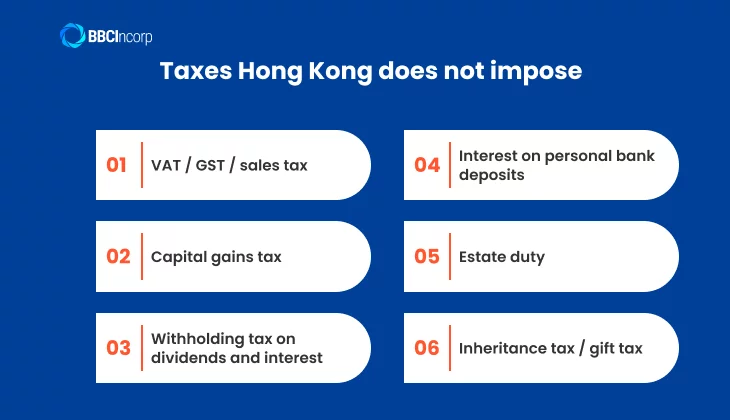
What Hong Kong does not tax is often more decisive for entrepreneurs than the rates it does charge. Income and transactions falling outside the four taxes above are generally not taxed at all.
| Tax common elsewhere | Hong Kong position | Practical note |
| VAT / GST / sales tax | None | No registration threshold and no periodic VAT return to file. |
| Capital gains tax | None | Gains forming part of a trading activity may still be taxed as revenue profits under profits tax. |
| Withholding tax on dividends and interest | None | Dividends and interest paid to non-residents are not subject to withholding. Royalties are the main exception see below. |
| Interest on personal bank deposits | Not chargeable | Salaries tax covers only income from employment, office or pension, so bank interest falls outside it. Interest earned by a business may still be accessible to profits tax. |
| Estate duty | Abolished | Abolished under the Revenue (Abolition of Estate Duty) Ordinance 2005 for deaths occurring on or after 11 February 2006. |
| Inheritance tax / gift tax | None | Hong Kong has never levied a separate inheritance or gift tax. |
One important qualification. “No capital gains tax” is not the same as “no tax on gains.” Where the IRD considers a disposal to be part of a trade rather than a capital transaction assessed through the badges of trade, including holding period, frequency and intention the gain is chargeable to profits tax. Frequent property or share dealing is the most common area where this arises.
Conclusion
The Hong Kong tax system centers on four main types of taxes: Profit Tax, Salaries Tax, Property Tax, and Stamp Duty. Notably, income that falls outside these categories, such as capital gains, interest, dividends, and sales tax, is generally exempt. The system simplifies financial planning and enhances the business environment.
As a result, Hong Kong’s competitive tax framework continues to attract international talent and businesses, further reinforcing its position as a premier destination for entrepreneurship and relocation.
Modern entrepreneurs increasingly pair these accounting services Hong Kong with digital platforms for real-time bookkeeping and e-filing, dramatically reducing errors and late penalties. Discover the latest tools that save time and money in our guide Streamlining Tax Compliance: Essential Digital Solutions For Businesses.
For any questions regarding Hong Kong’s tax regulations or need guidance on managing a business effectively, don’t hesitate to reach out to us at service@bbcincorp.com to receive personalized advice tailored to your circumstances.
References:
- (1) gov.hk – Tax Rates of Profits Tax: https://www.gov.hk/en/residents/taxes/taxfiling/taxrates/profitsrates.htm
- (2) ird.gov.hk – A guide to Salaries Tax: https://www.ird.gov.hk/eng/pdf/pam39e.pdf
- (3) Inland Revenue Ordinance (Cap. 112): https://www.elegislation.gov.hk/hk/cap112
- (4) Foreign – sourced Income Exemption: https://www.ird.gov.hk/eng/tax/bus_fsie.htm
- (5) ird.gov.hk – PROFITS TAX RETURNS: https://www.ird.gov.hk/eng/pdf/bel26e.pdf
- (6) gov.hk – Stamp Duty Rates: https://www.gov.hk/en/residents/taxes/stamp/stamp_duty_rates.htm
Frequently Asked Questions
Does Hong Kong tax foreign income?
Generally no. Hong Kong operates a territorial system, so only income arising in or derived from Hong Kong is chargeable. However, since 1 January 2023 the FSIE regime treats specified foreign-sourced income interest, dividends, disposal gains and IP income received in Hong Kong by a member of a multinational group as chargeable, unless the relevant economic substance, participation or nexus requirement is met.
What is the corporate tax rate in Hong Kong?
For corporations electing the two-tiered regime, profits tax is 8.25% on the first HK$2 million of assessable profits and 16.5% on the balance. Unincorporated businesses pay 7.5% and 15% respectively.
Without a valid election, the flat rates of 16.5% and 15% apply to all assessable profits. These rates are unchanged for the year of assessment 2025/26.
How does the two-tier tax system in Hong Kong work?
It halves the tax rate on the first HK$2 million of assessable profits. Three conditions apply: the entity must elect for it in its Profits Tax Return, only one entity within a group of connected entities may be nominated in any year of assessment, and the entity must not have elected into another preferential half-rate regime. The election cannot be made retroactively.
Is there VAT or capital gains tax in Hong Kong?
No. Hong Kong imposes no VAT, GST or sales tax, and no capital gains tax. That said, if the IRD considers a gain to arise from a trading activity rather than a capital disposal, it can be assessed as revenue profit under profits tax. Frequent dealing in property or securities is the usual trigger for this treatment.
When is the profits tax return due in Hong Kong?
A return is normally due within one month of the date of issue. Where a tax representative is appointed, the Block Extension Scheme applies deadlines based on the accounting year-end code.
For the year of assessment 2025/26, Code D returns are due 17 August 2026 and Code M returns 16 November 2026, with loss cases extendable to 1 February 2027. The IRD announces any further extensions by circular.
What is the salary tax standard rate in Hong Kong?
From the year of assessment 2024/25 the standard rate is two-tiered: 15% on the first HK$5 million of net income and 16% on the remainder. It replaced the previous flat 15% rate.
The standard rate is applied to income after allowable deductions but before personal allowances, and the IRD charges whichever is lower the standard rate result or the progressive calculation.
Do I still need to file if my company made no profit?
Yes. Once the IRD issues a Profits Tax Return, it must be completed and filed even where the company is dormant or loss-making. A NIL return is still a return, and failure to file may result in penalties and an estimated assessment under the Inland Revenue Ordinance.
Disclaimer: While BBCIncorp strives to make the information on this website as timely and accurate as possible, the information itself is for reference purposes only. You should not substitute the information provided in this article for competent legal advice. Feel free to contact BBCIncorp’s customer services for advice on your specific cases.
Industry News & Insights
Get helpful tips and info from our newsletter!
Stay in the know and be empowered with our strategic how-tos, resources, and guidelines.