Hong Kong incorporation fee & Aspire
 cashback.


Table of Contents
Expanding into Mainland China is a significant milestone for any international business, and choosing the right legal structure from the outset can determine how smoothly that expansion unfolds. For foreign investors, a Wholly Foreign-Owned Enterprise (WFOE) offers one of the most direct and controlled routes to operating in China without requiring a local Chinese partner.
Understanding WFOE meaning is particularly relevant for Hong Kong-based investors and holding companies, many of which use their Hong Kong entity as a gateway to the Mainland market. Beyond Hong Kong, international SMEs and global startups increasingly turn to the WFOE structure to establish a fully foreign-owned presence, maintain operational independence, and protect proprietary business interests within China’s regulatory framework.
This guide covers everything you need to know about WFOEs, from definition and structure to the key benefits, step-by-step setup process, and ongoing compliance considerations, giving you a clear foundation to assess whether this structure fits your China expansion strategy.
Key Takeaways:
- A Wholly Foreign-Owned Enterprise (WFOE) is a limited liability company in Mainland China that is 100% owned by foreign investors (no local Chinese partner required), giving full operational control, independent hiring, and direct profit repatriation.
- Hong Kong holding companies are the most common and strategically sound vehicle for establishing a WFOE, offering tax efficiency through the CDTA, international banking access, and a clean cross-border ownership structure.
- There are three types of WFOEs: consulting/service, trading, and manufacturing. Each has a distinct business scope that determines licensing requirements, registered capital expectations, and setup complexity.
- The WFOE registration process typically takes 6 to 8 weeks and involves multiple sequential steps across Chinese government authorities, from AMR filing and tax registration to foreign exchange registration and corporate bank account setup.
- Operating a WFOE comes with ongoing compliance obligations, making professional advisory support essential for maintaining good standing throughout the entity’s life.
What is a wholly foreign-owned enterprise?
A Wholly Foreign-Owned Enterprise is a limited liability company established in Mainland China that is 100% owned by foreign investors, with no Chinese partner required. Under China’s foreign investment law, a WFOE operates as an independent legal entity with the same business rights as local Chinese companies, making it one of the most direct structures for foreign market entry.
Unlike a Joint Venture (JV), where ownership and decision-making are shared with a Chinese partner, a WFOE gives foreign investors complete strategic autonomy. This matters in practice: faster decisions, full profit retention, and stronger intellectual property protection, without the governance complexity that comes with shared ownership.
Three defining characteristics set the WFOE structure apart:
- 100% foreign ownership: no Chinese partner or shareholder is required
- Independent operations: the entity can trade freely, hire staff, generate RMB revenue, issue Chinese tax invoices, and remit profits overseas after fulfilling local tax obligations
- Limited liability: investor exposure is capped at the amount of registered capital contributed
For foreign investors, this combination of control, legal independence, and operational flexibility makes the WFOE the preferred entry structure in most sectors. For Hong Kong-based companies specifically, the path is particularly direct. Hong Kong entities are classified as foreign investors under Mainland Chinese law, making the WFOE the most natural vehicle for establishing a controlled, fully-owned presence across the border.
Why Hong Kong companies use a WFOE to enter China
Using a Hong Kong holding company to establish a WFOE in Mainland China is one of the most proven and widely used structures for cross-border market entry and for good reason.
Hong Kong has long functioned as the primary gateway for international businesses entering China. Its unique position, operating under a separate legal and tax system while maintaining deep economic ties with the Mainland, makes it an effective intermediary layer between a foreign parent company and a China-based operating entity.
The Comprehensive Double Taxation Arrangement (CDTA) between Hong Kong and Mainland China further strengthens this structure by reducing withholding tax on profit repatriation under qualifying conditions.
When a Hong Kong holding company sits above a WFOE, the structure delivers three practical advantages:
- Cross-border investment clarity: a Hong Kong entity provides a clean, internationally recognized ownership layer above the China entity, simplifying reporting and investor relations
- Banking and financial flexibility: Hong Kong’s robust financial infrastructure supports multi-currency accounts, trade finance, and offshore treasury management that Mainland-only structures cannot easily replicate
- Tax efficiency: Hong Kong’s territorial tax system, combined with the CDTA, can meaningfully reduce the effective cost of moving profits from the WFOE back to the overseas parent
For international SMEs and global startups, a Hong Kong holding company above a Mainland WFOE remains the most practical and well-tested model for China expansion. It balances operational control inside China with financial flexibility and credibility outside it.
Types of WFOEs
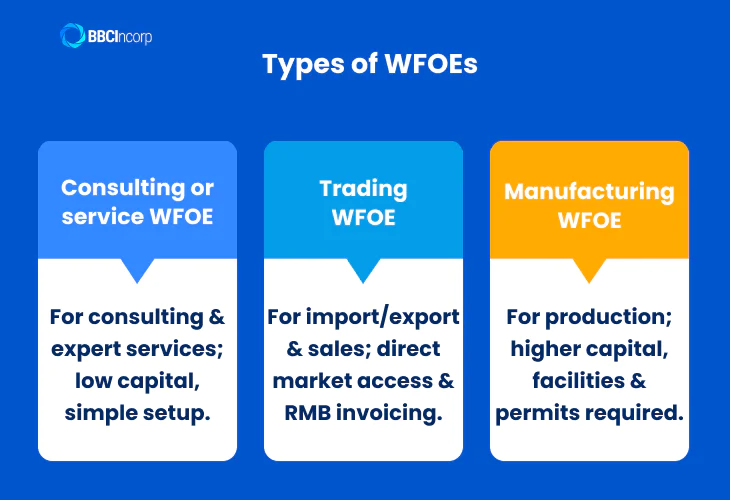
There are three recognized types, each with a distinct business scope. That scope directly determines which licenses and operational permissions your entity will require.
Consulting or service WFOE
The most common entry point for foreign businesses. This structure covers management consulting, IT services, marketing, legal advisory, and other professional services. It’s well-suited for companies that deliver knowledge or expertise rather than physical goods, and typically involves a lower registered capital threshold and simpler setup process.
Trading WFOE
Designed for businesses importing, exporting, distributing, or selling products within China. A trading WFOE can purchase goods locally, sell to Chinese customers, and issue RMB invoices, giving foreign companies direct commercial access to the Mainland market without a local partner.
Manufacturing WFOE
Built for industrial production, assembly, and processing operations. This structure suits foreign companies setting up physical production facilities in China, and generally requires more substantial registered capital and site-specific permits.
Defining your business scope accurately at the registration stage is critical; it shapes your license requirements, tax treatment, and the range of activities your WFOE is legally permitted to conduct.
WFOE structure and ownership
A WFOE is established as a limited liability company (LLC) under Chinese corporate law, owned entirely by one or more foreign investors, whether individuals or overseas legal entities such as a Hong Kong holding company. Shareholder liability is capped at the amount of registered capital contributed, providing a defined boundary of financial exposure.
Within that structure, four key corporate roles are required:
- Shareholder(s): the foreign investor(s) holding 100% ownership; responsible for capital contribution and major corporate decisions
- Legal Representative: the individual authorized to act on behalf of the company in legal and regulatory matters; carries significant personal responsibility under Chinese law
- Executive Director or Board of Directors: responsible for day-to-day management and operational decisions
- Supervisor: an oversight role required under Chinese corporate law to monitor financial and management conduct
On registered capital: while China removed mandatory minimum capital requirements for most WFOEs, the amount declared must be realistic and sufficient to support the proposed business scope. Undercapitalization can create compliance issues and affect the entity’s operational credibility with regulators, banks, and business partners.
Advantages and disadvantages of a WFOE
The WFOE structure offers foreign investors a level of control and operational independence that no other China entry vehicle matches, but that autonomy comes with real compliance obligations and setup complexity. Understanding both sides clearly is essential before committing to the structure.
Advantages
- Full operational control: without a Chinese partner in the ownership structure, foreign investors retain complete authority over strategy, management, and business direction.
- Direct hiring and invoicing: a WFOE can legally employ both local and foreign staff, and issue official RMB invoices (fapiao) directly to Chinese customers, meeting local tax requirements.
- Stronger IP protection: operating as an independent entity allows foreign companies to manage trademarks, patents, and proprietary technology under their own governance, reducing exposure to infringement risks common in shared-ownership structures.
- Profit repatriation: after fulfilling Chinese tax obligations, a WFOE can legally remit profits to its overseas parent company, supporting flexible global cash flow management.
Disadvantages
- Lengthy registration process: setup typically takes two months or more, and may extend further depending on business scope or local administrative requirements.
- Ongoing compliance burden: WFOEs must meet continuous obligations across tax filing, accounting standards, and Chinese labor law, requiring dedicated local expertise.
- Higher entry costs in regulated sectors: industries such as finance and education still carry significant minimum registered capital thresholds, increasing initial investment requirements.
- Limited access to government incentives: compared to Joint Ventures, WFOEs are less likely to qualify for local government subsidies or preferential financing programs.
WFOE registration process for foreign investors
Registering a WFOE in Mainland China involves multiple sequential steps across different government authorities. While the core process is consistent, timelines and specific requirements vary by business type and location, making professional guidance strongly advisable.
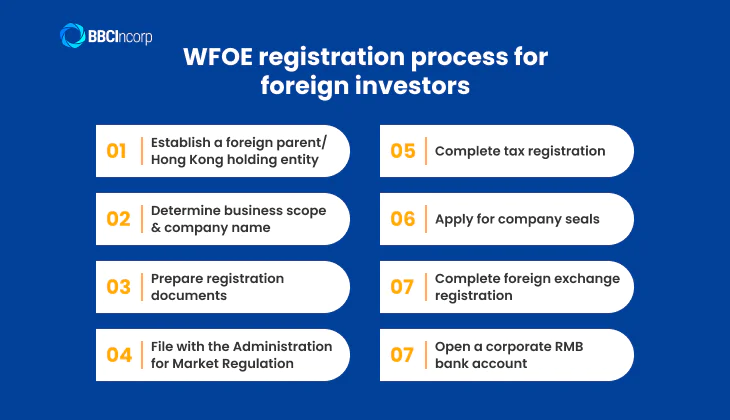
General steps to register a WFOE
- Step 1: Establish a foreign parent or Hong Kong holding entity: the overseas investor entity must be properly constituted before it can hold shares in a Mainland WFOE
- Step 2: Determine business scope and company name: the Chinese company name must follow local naming conventions; the business scope defines permitted activities and directly affects which licenses are required
- Step 3: Prepare registration documents: including articles of association, shareholder and director identification, proof of registered office address, and overseas parent company documents
- Step 4: File with the Administration for Market Regulation (AMR): the primary authority for business license approval
- Step 5: Complete tax registration: with national and local tax authorities to enable compliant invoice issuance and tax filing
- Step 6: Apply for company seals: legally required for binding business activities in China
- Step 7: Complete foreign exchange registration: with the State Administration of Foreign Exchange (SAFE) to enable lawful RMB-to-foreign currency transfers
- Step 8: Open a corporate RMB bank account: for daily operations, payroll, and tax settlements
Typical timeline: A consulting WFOE generally takes 1.5 to 2 months to establish. Manufacturing and trading WFOEs may take longer due to additional licensing, customs procedures, or environmental assessments.
Common required documents
- Articles of association
- Shareholder and director identification documents
- Proof of registered office address
- Business scope declaration
Compliance requirements and operational factors
Establishing a WFOE is not a one-time event; it comes with structured ongoing obligations that must be maintained throughout the life of the entity. Failure to meet these requirements can result in penalties, license suspension, or complications with cross-border fund transfers.
Key compliance obligations include:
- Accounting and bookkeeping: WFOEs must maintain financial records in accordance with Chinese accounting standards, typically requiring a locally qualified accountant or outsourced firm.
- Corporate tax and VAT filings: monthly or quarterly filings are required depending on tax category; late or inaccurate submissions carry financial penalties.
- Annual compliance reporting: annual financial statements and enterprise reporting to relevant authorities are mandatory for maintaining good standing.
- Employment law compliance: WFOEs must adhere to Chinese labor regulations covering employment contracts, minimum wage, social insurance contributions, and visa requirements for foreign staff.
Professional support for Hong Kong and China business expansion with BBCIncorp
Structuring a cross-border expansion into Mainland China requires more than an understanding of the rules; it requires experienced advisors who know how those rules apply to your specific business model, ownership structure, and long-term goals.
For most international businesses, the journey begins in Hong Kong. Establishing a Hong Kong holding company before setting up a Mainland WFOE is a well-proven approach, one that combines Hong Kong’s favorable tax environment, international banking access, and legal transparency with the operational reach of a fully-owned China entity.
BBCIncorp supports businesses at every stage of this process:
- Hong Kong company formation: efficient, fully guided incorporation for foreign investors
- International corporate structuring: designing ownership layers that support cross-border investment and tax efficiency
- Accounting and compliance services: ongoing support to meet both Hong Kong and Mainland reporting obligations
- China market entry advisory: practical guidance on WFOE setup, business scope, and regulatory navigation
Working with experienced advisors reduces setup risk, shortens timelines, and ensures your structure is built for compliance from day one, not retrofitted after problems arise.
Conclusion
A Wholly Foreign-Owned Enterprise gives foreign investors a controlled, independent, and legally recognized presence in Mainland China, without requiring a local partner. Understanding WFOE meaning, structure, and compliance obligations is the foundation of any effective China market entry strategy.
For international businesses, Hong Kong remains the most practical and strategically sound gateway into the Mainland, offering favorable tax treatment, robust banking infrastructure, and a well-established legal framework that supports cross-border investment.
Getting the structure right from the outset matters. Whether you’re evaluating entity type, determining business scope, or navigating ongoing compliance requirements, professional guidance ensures your expansion is both efficient and fully compliant. Reach us out at service@bbcincorp.com to plan your Hong Kong and China market entry with confidence.
Frequently Asked Questions
Can a Hong Kong company own a WFOE in China?
Yes. A Hong Kong company can act as the parent entity of a WFOE in Mainland China. This structure allows the China-based subsidiary to operate locally, hire staff, and sign contracts, while ownership is maintained through the Hong Kong holding company. It is one of the most commonly used cross-border investment structures in Asia.
What is the difference between a WFOE and a joint venture?
A WFOE is 100% owned by foreign investors, giving complete control over operations, strategy, and intellectual property. A joint venture (JV) involves shared ownership with a Chinese partner, which can accelerate market entry through local networks but introduces shared decision-making and potential IP exposure. The right choice depends on your business goals, capital position, and how much operational control matters to your model.
How long does it take to set up a WFOE?
The full WFOE registration process typically takes 6 to 8 weeks, depending on the city, business scope, and how efficiently documents are prepared. Consulting WFOEs are generally faster to establish, while manufacturing and trading WFOEs may take longer due to additional licensing, environmental assessments, or customs procedures. Professional support can help streamline the process and avoid unnecessary delays.
Disclaimer: While BBCIncorp strives to make the information on this website as timely and accurate as possible, the information itself is for reference purposes only. You should not substitute the information provided in this article for competent legal advice. Feel free to contact BBCIncorp’s customer services for advice on your specific cases.
Industry News & Insights
Get helpful tips and info from our newsletter!
Stay in the know and be empowered with our strategic how-tos, resources, and guidelines.