Hong Kong incorporation fee & Aspire
 cashback.


Table of Contents
As businesses grow, managing finances often requires more than one bank account. Instead of relying on a single account, companies tend to open multiple accounts to separate daily operations, tax obligations, savings, and even international transactions. This approach helps improve financial clarity and control, especially for businesses expanding across markets. However, knowing how to manage multiple bank accounts effectively becomes a critical skill as financial structures become more complex.
While having multiple accounts enhances organization, it also creates challenges in tracking cash flow, monitoring expenses, and maintaining accurate balances. Without a proper system, businesses can easily lose visibility over their finances or make costly errors.
Key Takeaways
- Multiple bank accounts help businesses separate funds, improve cash flow clarity, and reduce financial risk.
- Assigning a clear purpose to each account makes money management simpler and more transparent.
- Using accounting tools helps track transactions, reconcile records, and monitor balances in real time.
- Managing bank fees, minimum balances, and provider choices is essential to avoid unnecessary costs.
Why Businesses Use Multiple Bank Accounts
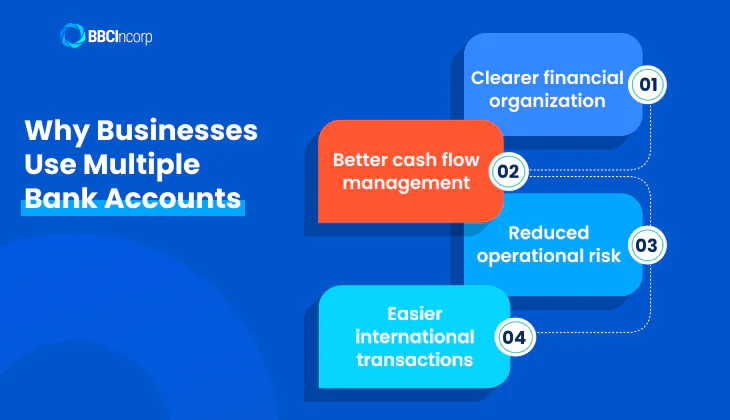
Using multiple bank accounts is a common financial management strategy among startups and SMEs. Instead of pooling all funds into one place, businesses allocate money across different accounts to improve visibility and control. This approach not only enhances financial clarity but also helps manage risks and streamline daily operations—especially as transaction volumes grow or businesses expand internationally.
- Clearer financial organization: Separate accounts for expenses, taxes, and savings make it easier to track and manage funds
- Better cash flow management: Monitor inflows and outflows more accurately across different business functions
- Reduced operational risk: Limit exposure by isolating funds, reducing the impact of errors or fraud
- Easier international transactions: Manage multi-currency payments and cross-border operations more efficiently
How to Open Multiple Bank Accounts for Your Business
Opening multiple bank accounts involves structuring them with clear purposes from the start. After choosing a suitable bank or fintech provider and completing the standard account setup process, businesses can create separate accounts aligned with specific financial functions. This approach ensures each stream of money is easy to track, manage, and optimize as the company grows.
To build an effective system, consider organizing your accounts as follows:
- Income account: Dedicated to receiving payments from clients or customers, helping you track revenue without mixing it with expenses
- Operating account: Used for daily transactions such as paying suppliers, salaries, and routine business costs
- Tax account: Set aside a portion of revenue for tax obligations to avoid last-minute cash shortages
- Savings account: Store surplus funds for long-term goals or emergency reserves, often earning interest over time
- Foreign currency account: Ideal for businesses dealing with international clients or vendors, reducing conversion fees and simplifying cross-border payments
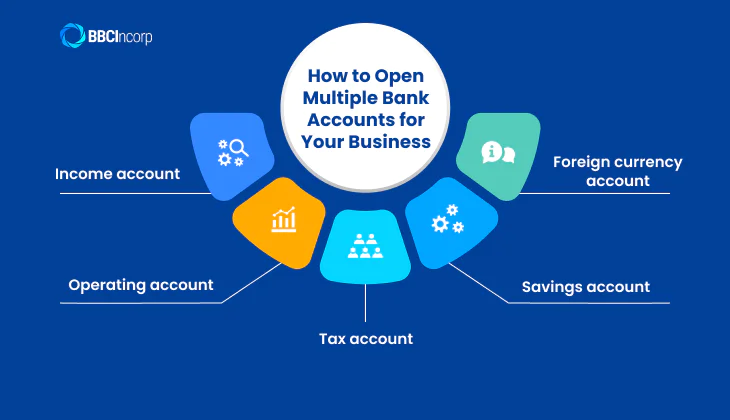
By assigning a clear role to each account, businesses can streamline financial management while maintaining better control over cash flow.
How to Manage Multiple Bank Accounts Effectively
Assign a Clear Purpose to Each Account
A strong foundation for managing multiple accounts starts with clarity. Each account should serve a single, well-defined function, whether it’s collecting revenue, handling operational expenses, paying salaries, or setting aside tax reserves. When every account has a clear role, businesses can avoid mixing transactions and maintain a cleaner financial structure. This not only makes tracking easier but also reduces confusion, prevents overlap, and creates a more transparent view of how money flows through the business.
Use Accounting or Financial Management Tools
As the number of accounts grows, relying on manual tracking can quickly become messy. Accounting software, financial dashboards, and expense management platforms can bring all your account activity into one place, making it easier to follow transactions, reconcile records, and understand your financial position in real time. With the right tools, businesses can save time while gaining a clearer view of daily cash movement.
Monitor Accounts Regularly
Regular review is essential when managing several bank accounts. Checking balances each week, reviewing statements, and watching for unusual transactions can help businesses stay on top of their finances before small issues turn into bigger problems. This habit not only supports more accurate records but also helps detect fraud early and gives decision-makers a better sense of overall financial health.
Control Access and Permissions
When multiple people are involved in financial operations, access should always be carefully managed. Limiting account access to the right team members, assigning clear responsibilities, and reviewing permissions from time to time can reduce the risk of errors or unauthorized transactions. A well-defined access structure makes financial management safer and more controlled.
Keep Financial Documentation Organized
Good documentation is the foundation of smooth financial management. Keeping records organized makes it easier to handle audits, prepare tax filings, and stay compliant with financial regulations. It also saves time later, since important information can be found quickly whenever the business needs to review its accounts or verify past transactions.
How to Reduce Fees When Managing Multiple Bank Accounts
Understand Banking Fees
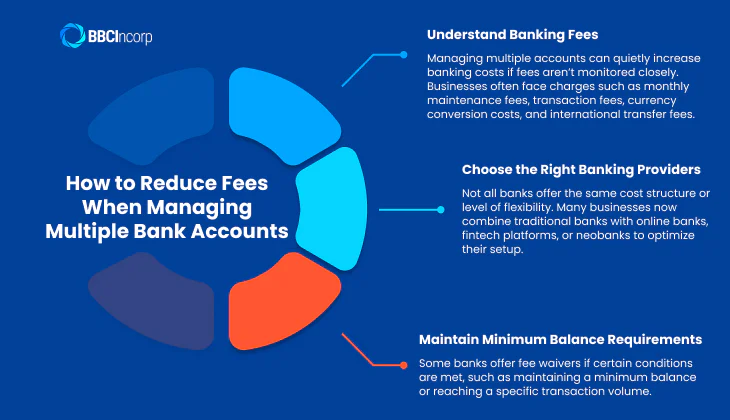
Managing multiple accounts can quietly increase banking costs if fees aren’t monitored closely. Businesses often face charges such as monthly maintenance fees, transaction fees, currency conversion costs, and international transfer fees. While each fee may seem small, they can add up significantly across several accounts. Taking the time to review fee structures, terms, and conditions for each account helps businesses spot unnecessary costs and make more informed financial decisions.
Choose the Right Banking Providers
Not all banks offer the same cost structure or level of flexibility. Many businesses now combine traditional banks with online banks, fintech platforms, or neobanks to optimize their setup. This diversified approach allows companies to take advantage of lower fees, faster onboarding, and more advanced digital tools. Choosing the right mix of providers can significantly reduce operational costs while improving efficiency in managing multiple accounts.
Maintain Minimum Balance Requirements
Some banks offer fee waivers if certain conditions are met, such as maintaining a minimum balance or reaching a specific transaction volume. Without proper planning, it’s easy for one account to fall below the required threshold and trigger avoidable charges. By strategically allocating funds and monitoring balances, businesses can meet these requirements consistently and minimize unnecessary fees over time.
Common Mistakes When Managing Multiple Bank Accounts
Managing multiple accounts can be effective—but only when there’s a clear system in place. Below are some of the most common mistakes businesses make, along with why they can cause problems:
- Opening too many accounts without clear purposes leads to confusion, duplicated functions, and unnecessary complexity in financial management.
- Failing to track transactions consistently may lose control over cash flow, miss important payments, or struggling to reconcile financial records accurately.
- Ignoring bank fees and account requirements can result in avoidable costs that accumulate over time.
- Poor visibility of cash flow makes it difficult to understand the company’s real financial position.
- Weak internal financial controls increase the risk of errors, fraud, or unauthorized transactions.
Manage Multiple Business Bank Accounts with BBCIncorp
Managing multiple bank accounts becomes far more complex when your business operates across different jurisdictions or currencies. Opening and maintaining accounts in multiple countries often involves strict regulatory requirements, extensive documentation, and ongoing compliance processes. For international founders, navigating these layers can be time-consuming and challenging without the right support.
By combining expertise in company incorporation and global banking support, BBCIncorp helps businesses simplify how they set up and manage their financial infrastructure, especially in key hubs like Hong Kong and Singapore.
- Support for opening corporate or multi-currency accounts, including offshore corporate banking solutions, to match your business structure and expansion goals
- Guidance through banking compliance and documentation to reduce delays and avoid common pitfalls
- Access to global-friendly banking solutions designed for international transactions and cross-border operations
With the right banking structure and professional support, businesses can manage multiple bank accounts more efficiently while building a strong foundation for global growth.
Using multiple bank accounts can be a powerful strategy for businesses looking to stay organized, manage financial risks, and improve operational efficiency. As companies grow, learning how to manage multiple bank accounts effectively becomes essential to maintaining clear cash flow visibility and supporting sustainable operations.
With the right approach, businesses can turn complexity into control. If you’re expanding internationally or need expert support to streamline your financial setup, BBCIncorp can help you build a scalable banking structure and manage your accounts with confidence.
Frequently Asked Questions
How many bank accounts should a business have?
A business should have as many bank accounts as needed to separate its key financial activities clearly. In most cases, having separate accounts for income, operating expenses, taxes, and savings is a practical starting point for businesses learning how to manage multiple bank accounts effectively.
Why should a business use multiple bank accounts?
Using multiple bank accounts helps a business organize cash flow, reduce financial confusion, and improve budgeting accuracy. It also makes it easier to track where money comes in, where it goes, and how to manage multiple bank accounts with better control and transparency.
What is the best way to organize multiple business bank accounts?
The best way to organize multiple business bank accounts is to assign a clear purpose to each one, such as revenue collection, daily operations, tax reserves, or emergency savings. This structure makes it easier to manage multiple bank accounts without mixing funds or losing visibility over your finances.
Should I open separate accounts for taxes, payroll, and operating expenses?
Yes, opening separate accounts for taxes, payroll, and operating expenses can help your business stay organized and avoid accidental overspending. This is one of the most effective ways to improve financial discipline and understand how to manage multiple bank accounts effectively as your business grows.
Can sub-accounts replace multiple business bank accounts?
Sub-accounts can be a useful alternative if your bank or fintech provider offers enough flexibility and visibility. However, whether they can fully replace separate bank accounts depends on your business needs, compliance requirements, and the level of control you need to manage multiple bank accounts efficiently.
Disclaimer: While BBCIncorp strives to make the information on this website as timely and accurate as possible, the information itself is for reference purposes only. You should not substitute the information provided in this article for competent legal advice. Feel free to contact BBCIncorp’s customer services for advice on your specific cases.
Industry News & Insights
Get helpful tips and info from our newsletter!
Stay in the know and be empowered with our strategic how-tos, resources, and guidelines.