Hong Kong incorporation fee & Aspire
 cashback.


Table of Contents
What happens when business partners disagree on decisions, profit distribution, or the future of the company? In the U.S., a shareholder agreements provides a formal framework to manage these situations.
This legally binding contract defines the rights and responsibilities of shareholders, establishes internal procedures, and offers mechanisms for resolving disputes. Regardless of whether a company is a corporation, LLC, or startup, a well-structured share agreement brings clarity, protects interests, and supports stable operations.
In this article, we will explain what a shareholder agreement is, its key provisions, and present practical examples illustrating how a shareholder agreement can prevent conflicts and maintain long-term business performance.
Key takeaway
- A shareholder agreement is a private contract that defines ownership, voting rights, management roles, profit distribution, and dispute resolution for a company.
- The agreement sets practical rules that support governance, clarify shareholder responsibilities, and reduce the risk of conflict, protecting both majority and minority shareholders.
- Key features include share transfer restrictions, preemption rights, tag-along and drag-along protections, dividend policies, exit procedures, and confidentiality obligations.
- Engaging with BBCIncorp local experts for professional support is recommended.
What is a shareholder agreement?
Starting a business with partners can be rewarding, but disagreements over ownership, strategic implementation, or profits can quickly threaten its stability.

Definition and purpose
A shareholder agreement is a legally binding document signed by the shareholders of a company that governs their relationships and defines the company’s management structure.
Unlike articles of association or corporate bylaws, which set broad legal and structural rules filed with regulators, a shareholder agreement addresses the practical and relational aspects of ownership. This allows shareholders to adjust regulations to their specific business needs.
Key functions of a shareholder agreement
- Establishing the rules for voting and decision-making
- Setting out dividend and profit distribution policies
- Defining management duties and responsibilities
- Providing mechanisms for resolving disputes and handling share transfers
Alternative names and variations
Corporate shareholder agreements may also be referred to as shareholders’ agreements, shareholding agreements, share agreements, or shareholder contracts.
In limited liability companies, an LLC shareholder agreement serves a similar purpose, specifying member responsibilities, profit-sharing arrangements, and voting procedures unique to LLC structures.
Jurisdictional considerations
The structure, enforceability, and common practices for shareholder agreements can vary significantly across different jurisdictions. In the U.S., shareholder agreements are often used in conjunction with corporate bylaws to govern internal affairs. They are recognized as legally binding contracts under state corporate law.
For instance, in the U.K., shareholder agreements complement the articles of association, which are the company’s formal constitutional documents filed with Companies House. Notably, the shareholders’ agreement addresses private arrangements between shareholders, such as share transfer restrictions, pre-emption rights, dividend policies, and deadlock resolution mechanisms.
In Hong Kong, shareholder agreements are used to supplement the Companies Ordinance. While the ordinance sets out statutory requirements for corporate governance and shareholder rights, a shareholder agreement gives further clarity on management responsibilities, voting arrangements, exit strategies, and dividend allocation.
Despite these jurisdictional differences, the central purpose of a shareholder agreement remains the same: to establish a clear, legally implementable system that protects shareholder interests, defines rights and responsibilities, and supports effective governance.
Why shareholder agreements are essential for companies
Businesses of all sizes face the potential for internal conflict, but startups and closely held companies are especially vulnerable. Early-stage ventures often involve founders with different levels of ownership, varying visions, and unequal contributions of capital or expertise.
Without a formal shareholder agreement, these differences can quickly lead to disputes that disrupt operations or even threaten the company’s survival. The following scenarios illustrate the importance of clearly defined shareholder agreements.

Preventing shareholder disputes
A primary purpose of a shareholder agreement is to prevent conflicts before they arise. The common disputes often involve:
- Minority shareholder oppression: For example, a minority owner may feel excluded from key business decisions or profit distribution without a formal mechanism to protect their interest.
- Disagreements over business strategy: Founders may have conflicting visions for expansion, product development, or market focus. A shareholder agreement outlines the process of making strategic decisions.
- Exit disputes: Conflicts can arise when a shareholder wishes to sell their stake or leave the business. Thus, standardized exit procedures help avoid unnecessary legal battles and operational disruption.
Protecting shareholder interests and business stability
Shareholder agreements also safeguard shareholder interests and promote sustainability. Particularly, the main mechanisms consist of the following:
- Pre-emption rights: Allow existing shareholders to purchase new shares before outsiders, preventing unwanted dilution of ownership.
- Tag-along and drag-along clauses: Minority shareholders can sell their shares if majority owners sell (tag-along) or must sell under the same terms as majority owners (drag-along), protecting all parties’ interests.
- Dividend policies: Define in detail how profits are distributed, fostering fair treatment and reducing disputes over reinvestment versus payout decisions.
Key provisions every shareholder agreement should have
A shareholder agreement serves as a roadmap for corporate governance and shareholder relations. Consequently, every company, whether a startup, closely held firm, or larger corporation, benefits from a structured agreement.

Below are practical examples of shareholder contract clauses and their application:
Share ownership structure and transfer restriction clauses
The ownership structure implies each shareholder’s stake and sets boundaries for transferring shares. Transfer restrictions prevent shares from being sold to external parties without approval, thereby maintaining stability. Key provisions include:
- Right of First Refusal (ROFR): If a founder wants to sell 10% of their shares, existing shareholders have the option to buy those shares first. For example, in a tech startup, ownership can be retained with the founding team rather than a competitor.
- Tag-along rights: Suppose the majority shareholder sells their 60% stake to an investor; minority shareholders can “tag along” and sell their shares under the same terms, avoiding exclusion from benefits.
- Drag-along rights: If a private equity firm acquires a controlling interest, drag-along rights require minority shareholders to sell their shares on the same terms, facilitating smooth exits.
Management roles and voting rights
Shareholders’ agreement provisions clarify how decisions are made, director appointments, and voting thresholds. Voting rights often align with share classes:
- Ordinary shares: One vote per share; for instance, a small shareholder with 5% can vote on routine business matters.
- Preferred shares: May limit voting rights but build dividend priority. In a startup, investors often hold preferred shares to secure returns, leaving operational control to founders.
- Supermajority decisions: For vital matters, such as mergers, the decision may require 75% approval, meaning all major shareholders must agree.
Dividend distribution and profit-sharing arrangements
Share agreement terms outline whether profits are reinvested or paid out. For instance:
- A family-owned business may reinvest 50% of profits for expansion and distribute the remainder to shareholders, preventing disputes over cash allocation.
- Fixed dividend formulas or policies can facilitate fairness among shareholders.
Exit strategies and buy-sell clauses
Exit provisions define procedures for selling or buying shares. Examples include:
- Pre-determined valuation formulas: If a co-founder retires, the agreement sets the buyout price as a multiple of EBITDA, reducing conflicts.
- Staged buyouts: Payments are spread over several years, making it easier for remaining shareholders to fund the purchase.
- Mandatory sale triggers: Share sales automatically occur upon a shareholder’s death or insolvency.
Dispute resolution and deadlock-breaking mechanisms
Deadlocks can paralyze decision-making. Common clauses include:
- Arbitration or mediation clauses: If co-founders disagree on product strategy, mediation resolves the issue without litigation.
- Shotgun clauses: One shareholder offers a price for another’s shares; if rejected, they must buy at that price. This resolves deadlocks efficiently.
Confidentiality and non-compete obligations
To protect trade secrets and competitive advantage:
- Confidentiality clauses: A shareholder leaving a software startup cannot disclose proprietary algorithms to competitors.
- Non-compete clauses: Restrict former shareholders from starting competing businesses within a defined period and territory, protecting market positioning.
Keep in mind that understanding how to implement these shareholders’ agreement provisions is necessary for minimizing conflicts, protecting minority shareholders, and fostering growth.
Summarizing the pros and cons
To make your journey easier, here are the key benefits and limitations of this document.
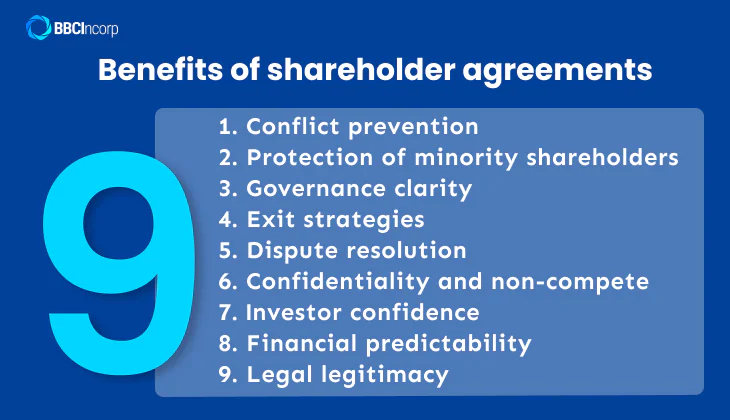
Benefits of shareholder agreements
- Conflict prevention: Defining procedures and standards for them helps reduce disputes among founders, investors, and minority shareholders.
- Protection of minority shareholders: Mechanisms like tag-along rights, pre-emption rights, and drag-along clauses safeguard smaller shareholders from unfair dilution or forced buyouts.
- Governance clarity: Defining management roles, voting thresholds, and decision-making processes facilitates smooth corporate governance.
- Exit strategies: Buy-sell clauses, pre-determined valuation formulas, and staged buyouts provide clear instructions for shareholder termination, retirement, or death.
- Dispute resolution: Arbitration, mediation, and shotgun clauses allow efficient resolution of deadlocks, avoiding prolonged litigation.
- Confidentiality and non-compete: Protects trade secrets, sensitive information, and competitive advantage.
- Investor confidence: Demonstrates professionalism, increasing trust from investors, lenders, and partners.
- Financial predictability: Dividend and profit-sharing provisions let shareholders anticipate returns and plan investments beforehand.
- Legal legitimacy: Creates a binding shareholder contract that protects both shareholders’ rights and company interests.
Considerations for shareholder agreements
- Cannot entirely eliminate disputes; enforcement may require legal action if parties breach the agreement.
- Minority protection mechanisms may slow decision-making or require extra approvals.
- Valuation formulas in exit clauses may become outdated as the business grows or market conditions change.
- Strict non-compete clauses could discourage potential investors or new shareholders.
- Drafting costs and legal fees can be high, particularly for complex agreements with multiple stakeholders.
Differences between a shareholder agreement and other corporate documents
While articles of association, bylaws, and operating agreements all play important roles, none provide the same level of protection, flexibility, or detail as a dedicated shareholding agreement.
Shareholder agreement vs Articles of Association
Articles of Association establish a company’s constitution and set out high-level rules for governance, director duties, and shareholder rights. They apply to all shareholders and must be filed publicly in most jurisdictions (e.g., the United States, the United Kingdom, and Hong Kong). Because they are public and statutory, articles are generally broad and difficult to amend.
A shareholder agreement, by contrast, is a private contract among shareholders that allows for tailored arrangements. Unlike articles, it can be customized and updated more easily as the business evolves.
This makes the shareholder agreement vs articles comparison particularly relevant for startups and closely held companies that require additional governance rule systems.
Shareholder agreement vs operating agreement for LLCs
Limited liability companies do not use articles of association. Instead, they rely on an operating agreement, which outlines ownership, management structure, and internal procedures. Many LLCs use an operating agreement as the functional equivalent of an LLC shareholder agreement, especially when members want to address rights and duties similar to those found in corporate shareholder agreements.
However, operating agreements often focus on management mechanics and profit distribution. In contrast, a comprehensive shareholding agreement may introduce additional protections such as buy-sell arrangements, termination provisions, enhanced minority safeguards, or confidentiality obligations.
When and how to create a shareholder agreement
Knowing the right time and approach for creating shareholder agreements is crucial to safeguard both the company and its shareholders.
When to draft or review the agreement
- During incorporation: It is ideal to draft a shareholder agreement at the company’s formation. Early agreements let you establish ownership, voting rights, and profit-sharing from the start.
- When new shareholders join: Adding investors or partners triggers a review or update of the agreement to integrate new rights, responsibilities, and governance provisions.
- After major funding rounds or structural changes: Major events such as venture capital investments, mergers, or equity restructuring require revisiting the share agreement process so that all parties are aligned, and legal protections are maintained.
Who should be involved in the drafting process?
- Founding shareholders: Provide input on ownership, voting, and operational priorities.
- Company directors: Ensure management roles, decision-making processes, and governance structures are accurately represented.
- Legal advisors: Professional guidance is recommended to make sure that the drafting of a shareholder contract meets both business and legal objectives.
Legal requirements by jurisdiction
Legal formalities for shareholder agreements vary across jurisdictions. In Hong Kong and Singapore, agreements are private contracts supplementing statutory requirements under the Companies Ordinance or Companies Act. In the U.K., agreements complement articles of association and are not filed publicly.
In the U.S., shareholder agreements are also private contracts between shareholders and are not filed publicly. They operate alongside state corporate laws (such as the Delaware General Corporation Law for Delaware-incorporated companies) and corporate bylaws.
Before signing any contract, you should always engage with legal experts for , so be sure to reach out to a provider with extensive experience, such as BBCIncorp.
Common mistakes and risks to avoid
Even well-intentioned companies can face challenges when drafting or managing a shareholder agreement. Being proactive will let you protect both the company and shareholder interests.
Using generic templates without legal advice
Relying on off-the-shelf agreements may seem convenient, but these templates often miss critical provisions or contain terms that are unenforceable under local law. This mistake can lead to ambiguities in shareholder rights, disputes over ownership, and increased legal risk, particularly for startups and closely held companies.
Vaguely drafting crucial clauses
If you fail to draft clear procedures for shareholder exits, share transfers, or valuation can create conflicts when a shareholder leaves or wishes to sell, potentially triggering litigation, operational disruption, and financial losses. Minority shareholders may be disadvantaged, and majority owners may face unexpected buyout obligations.
Lack of periodic review and updates
You must conduct regular reviews and updates of the critical terms. Not doing so in the case of ownership, business conditions, or laws changing can result in outdated clauses, gaps in protection, and misaligned rights or obligations. This will reduce investor confidence and increase the risk of internal conflicts.
Summary of common mistakes and potential consequences
| Mistake | Potential consequences |
| Using generic templates without legal advice | Missing essential provisions, unenforceable clauses, increased shareholder contract risk, and exposure to disputes. |
| Vaguely drafting crucial clauses | Conflicts over share transfers, disputes during shareholder exit, minority shareholder disadvantage, and potential litigation. |
| Lack of periodic review | Outdated clauses, gaps in protections, misaligned voting or dividend rights, and exposure to legal or financial risks. |
Simplify drafting shareholder agreements and compliance with BBCIncorp services
Creating a shareholder agreement requires careful planning to ensure compliance, clarity, and alignment with company goals. BBCIncorp assists businesses by providing expert guidance on shareholder contract services, helping founders and management teams navigate corporate governance in multiple jurisdictions.
Our services encompass:
- Compliance guidance: Guidance for businesses on local laws in over 18 jurisdictions, from the U.S., Hong Kong, Singapore, the BVI, and the Cayman Islands, etc.
- Business structuring expertise: Professional advice on ownership allocation, voting rights, legal requirements, and annual obligations of each entity type.
- Company formation: Full assistance in company incorporation throughout the complete process with the relevant authorities.
- Corporate secretary services: Support with company particulars’ changes, regulatory filings, share registry updates, and annual compliance obligations to keep the company in good standing at all times.
- Opening bank accounts, accounting, auditing, nominee director, nominee shareholder services, and more.
Every service comes with access to BBCIncorp secure Client Portal. This means clients can monitor the services’ progress, get in touch with our team, and keep track of compliance deadlines efficiently.
Discover how BBCIncorp streamlines your business needs by talking with our team through the chatbox, or send us an email at service@bbcincorp.com for more information.
Conclusion
A well-structured shareholder agreement is essential for any company, providing a clear framework for governance, ownership, decision-making, and dispute resolution. By stating critical clauses on share transfers, voting rights, profit distribution, exit strategies, and confidentiality, a shareholding agreement safeguards the interests of both majority and minority shareholders.
Take control of your company’s future by ensuring your shareholder agreements are clear, compliant, and strategically structured. Contact BBCIncorp today and let us help you determine the best course of action for your business.
Frequently Asked Questions
What is the difference between a shareholder agreement and a company’s constitution?
A shareholder agreement is a private contract between shareholders that sets out rights, obligations, decision-making processes, and dispute resolution. A company’s constitution (or articles of association) is a statutory document filed with the registry and governs the company’s fundamental rules.
While the constitution covers broad governance and compliance requirements, a shareholders agreement addresses practical arrangements. Both documents complement each other, but the shareholders agreement provides flexibility and detailed protections that are not available in the constitution.
Do I need a shareholder agreement if my company already has a constitution?
Yes. A constitution provides basic governance rules, but a shareholder agreement offers detailed protections and practical arrangements for shareholders. It can define voting rights, dividend policies, share transfers, exit strategies, and dispute resolution procedures, which the constitution may not fully cover.
Even for companies with existing constitutions, having a shareholder agreement ensures clarity, protects minority shareholders, and reduces potential conflicts.
How much does a shareholder agreement typically cost?
The cost of a shareholder agreement depends on company size, complexity, number of shareholders, and jurisdiction. Simple agreements for small or closely held companies cost less, but agreements for startups, multinational businesses, or companies with multiple classes of shares can be higher.
Costs usually reflect legal advice and time spent drafting or reviewing the agreement, so it’s advisable to get in touch with BBCIncorp for your specific situation.
Do I need to amend my shareholder agreement when new shareholders join?
Yes. When new shareholders join, you must update or amend the shareholder agreement to reflect changes in ownership, voting rights, profit distribution, and exit provisions. Failing to update the agreement may create ambiguities or disputes.
Amending the agreement ensures new shareholders are bound by existing terms and that protections for minority shareholders and governance standards remain consistent.
What happens if a shareholder breaches the agreement and how can I enforce it?
If a shareholder breaches the agreement, enforcement may involve legal remedies such as injunctions, damages, or specific performance through arbitration or court proceedings, depending on the dispute resolution clauses. Breaches may include unauthorized share transfers, failure to comply with voting obligations, or violation of confidentiality.
Professional legal advice is essential to implement the terms effectively. Furthermore, early action protects shareholder interests and avoids disputes from escalating.
How is a shareholder exit handled under the agreement?
A shareholder agreement generally defines exit procedures, pre-emption rights, buy-sell clauses, or valuation mechanisms. Exiting shareholders may be required to offer shares to existing shareholders first or follow agreed procedures for valuation and payment. Clear exit terms will reduce disputes, protect minority shareholders, and provide financial certainty.
Is a shareholder’s liability limited to the amount they invested in the company?
Yes, in most private companies and limited liability companies (LLCs), a shareholder’s liability is generally limited to their equity contribution. Shareholders are not personally responsible for company debts beyond their investment. Liability may extend in cases of fraud, wrongful trading, or statutory breaches by directors.
Disclaimer: While BBCIncorp strives to make the information on this website as timely and accurate as possible, the information itself is for reference purposes only. You should not substitute the information provided in this article for competent legal advice. Feel free to contact BBCIncorp’s customer services for advice on your specific cases.
Industry News & Insights
Get helpful tips and info from our newsletter!
Stay in the know and be empowered with our strategic how-tos, resources, and guidelines.