Hong Kong incorporation fee & Aspire
 cashback.


Table of Contents
Every successful business starts with a vision, but turning that vision into a lasting enterprise depends on choosing the right structure. The type of corporation a founder selects shapes how the company operates, raises capital, and protects its owners. Some structures prioritize control and simplicity, while others focus on scalability, investment, or tax efficiency.
Across the world, various types of corporations serve different purposes and growth strategies. Understanding these corporation types is essential to building a solid foundation that supports both compliance and long-term goals. Let’s explore the main types of company structures, their differences, and how to choose the one that fits your business best.
Key takeaways
A corporation is a separate legal entity from its owners, capable of owning assets, entering into contracts, suing or being sued, and continuing operations regardless of ownership changes.
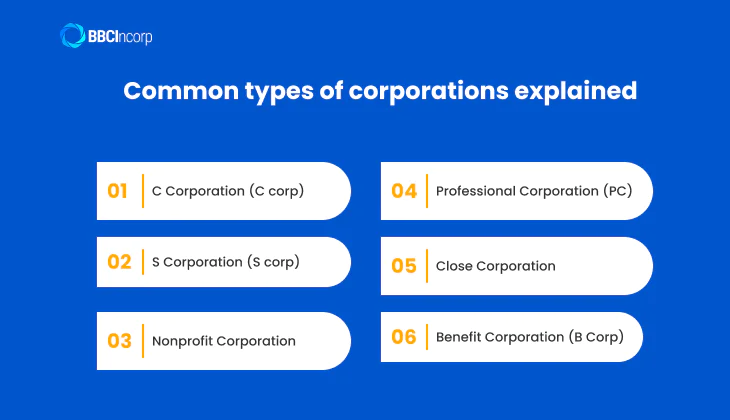
The major types of corporations include:
- C corporations: Unlimited shareholders, strong capital-raising, double taxation applies.
- S corporations: Pass-through taxation, limited shareholders, one class of stock.
- Nonprofit corporations: Public or charitable purpose, IRS tax exemptions.
- Professional corporations: For licensed professionals, ownership is restricted to qualified individuals.
- Close corporations: Small, privately held firms, simplified governance.
- Benefit corporations: Profit combined with social or environmental mission, annual impact reporting required.
What is a corporation?
A corporation is a legal entity that stands apart from its owners. It can enter into contracts, own assets, sue or be sued, and continue to operate even when ownership changes. The separation protects the personal assets of shareholders and allows the business to grow beyond individual founders. Among all types of corporations, this feature of independence forms the core of how companies function and expand.
Key features of a corporation
A corporation type of business has several defining characteristics that set it apart from other structures.
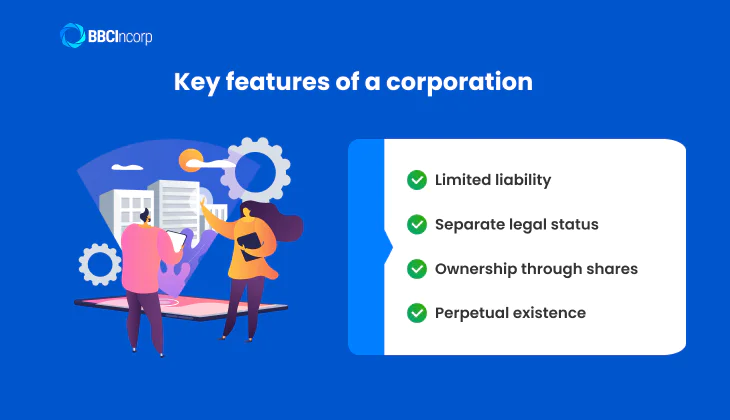
Limited liability
Shareholders are responsible only for the amount they invest in the company. Their personal assets remain protected from the company’s debts and legal obligations. Limited liability reduces risk and encourages entrepreneurship.
Separate legal status
A corporation operates under its own legal identity. It can own property, make contracts, and be held accountable separately from its shareholders or directors. The independence strengthens the company’s credibility in the eyes of clients and investors.
Ownership through shares
Ownership in a corporation is represented by shares, which makes it easier to raise capital through private investors or public markets. The structure supports growth and expansion, especially for businesses that need significant funding.
Perpetual existence
A corporation continues to exist regardless of changes in ownership or management. The continuity ensures stability and value, making it suitable for companies with lasting ambitions.
Why businesses incorporate as corporations
There are many corporation advantages and disadvantages, yet their benefits make them highly attractive for entrepreneurs. They provide liability protection that shields owners from personal financial exposure and enhances credibility, with investors and partners often viewing incorporated entities as more reliable.
Additionally, different corporation types offer flexibility in tax planning, enabling companies to select structures that align with their revenue models and optimize tax management, since corporations exist independently of their owners and can scale operations globally.
For example, in the United States, C corporations and S corporations differ mainly in how profits are taxed and distributed to shareholders.
In Hong Kong and Singapore, private limited companies are preferred for their flexibility and credibility among investors.
Meanwhile, in the British Virgin Islands, international business companies (IBCs) provide low-tax incentives and simplified compliance for global operations.
Common types of corporations explained
There is no single model that fits every business. Each type of corporation serves a different purpose: from attracting investors and raising capital to pursuing social goals or providing professional services.
Below are the most common types of corporations, their main features, and several examples.
C corporation
A C corporation (C corp), taxed under Subchapter C of the U.S. Internal Revenue Code, is the most traditional and widely used corporation type. It exists as a separate legal entity and pays corporate income tax on its profits. Shareholders then pay tax again on dividends they receive, a system known as “double taxation.” Despite this, the C-corp remains the preferred model for large companies and high-growth startups.
Advantages
C corporations can raise capital by issuing unlimited shares to an unrestricted number of investors. They provide strong liability protection, allowing shareholders to limit personal financial risk. They can also deduct a wide range of business expenses, including employee benefits, which helps manage taxable income.
Disadvantages
Double taxation can reduce net returns for shareholders. C corps also face more complex reporting, governance, and compliance requirements.
Example
Global enterprises such as Apple Inc., Microsoft Corporation, and Amazon.com, Inc. operate as C corporations. This structure is suited for businesses that aim to scale internationally and attract institutional investors.
S corporation (S corp)
An S corporation (S corp) offers similar liability protection to a C corporation, yet they diverge significantly in how they are taxed.
The primary difference between S corp and C corp lies in this tax treatment: S corps allow profits and losses to “pass through” directly to shareholders’ personal tax returns, effectively avoiding corporate income tax.
To qualify for these benefits, a company must first incorporate as a C corporation and then elect S status by filing Form 2553 with the IRS.
Advantages
One of the S corp benefits is that they let you avoid double taxation, making them one of the most efficient types of corporations for tax purposes. They combine limited liability with simplified tax reporting, making them attractive to small and mid-sized businesses.
Disadvantages
S corps face strict eligibility rules in the U.S.. They cannot have more than 100 shareholders, all of whom must be U.S. citizens or residents. They also cannot issue multiple classes of stock, which limits fundraising flexibility.
Example
Many professional service and family-owned companies, such as local law, accounting, and design firms, operate as S corporations to balance tax advantages with limited liability.
Nonprofit corporation
A nonprofit corporation exists to serve public or charitable purposes rather than to generate profits for shareholders. Common sectors include education, healthcare, and humanitarian aid. In the U.S., qualifying nonprofits can apply for tax exemption under Section 501(c)(3) of the Internal Revenue Code.
Advantages
Nonprofits benefit from an income tax exemption on activities related to their mission. They can also receive tax-deductible donations from individuals and corporations. Like other corporations, they offer limited liability protection to directors and officers.
Disadvantages
They must follow strict operational and reporting rules to retain tax-exempt status. Nonprofits cannot distribute profits to members and face restrictions on political activity.
Example
Notable examples of a corporation in this category include The Red Cross, World Wildlife Fund (WWF), and Doctors Without Borders. All of them are committed to public benefit rather than private profit.
Professional corporation (PC)
A professional corporation allows licensed professionals such as doctors, lawyers, engineers, or accountants to conduct business under a corporate entity. This example of a corporation business is subject to professional licensing laws that vary by jurisdiction. In some states, it may also be called a Professional Service Corporation (PSC).
Advantages
A PC limits liability for business debts and obligations while maintaining each professional’s personal responsibility for malpractice. It can also offer tax benefits such as income deferral or retirement plan contributions.
Disadvantages
Ownership is typically limited to licensed individuals in the same profession. PCs must also comply with strict industry regulations and ethical codes.
Example
Common professional corporation examples include law firms such as Baker McKenzie PC and medical groups organized under state professional corporation laws.
Close corporation
A close corporation suits small, privately held businesses where owners prefer direct control and limited disclosure. This structure allows fewer shareholders, typically no more than 35, and often eliminates the need for a formal board of directors.
Advantages
Close corporations enjoy flexibility in decision-making and reduced administrative burdens compared to publicly traded companies. They can also restrict share transfers, keeping control within a small group of owners.
Disadvantages
The limited number of shareholders can make capital raising more difficult. Internal disputes may also carry more weight due to the concentrated ownership structure.
Example
Family-owned manufacturing firms, real estate investment groups, and boutique consultancies are typical examples of corporations operating as close corporations.
Benefit corporation
A benefit corporation, or B corp, combines profit with purpose. Recognized in over 35 U.S. states and several international jurisdictions, this model requires directors to consider social and environmental impact alongside financial results. It differs from B corp certification, which is an independent credential granted by B Lab.
Advantages
Benefit corporations attract investors and customers who value transparency and social responsibility. They also enjoy stronger brand loyalty and a reputation for ethical governance.
Disadvantages
They face additional reporting obligations, including annual impact reports. Balancing financial goals with social commitments can also complicate corporate operations.
Example
Notable examples of the benefit model include Patagonia and Ben & Jerry’s, both legally structured or certified as B Corps to align profit with purpose.
From traditional profit-oriented C and S corporations to purpose-driven nonprofits and B corps, the structure a business chooses defines its flexibility, credibility, and long-term potential.
Comparing different corporation types
Knowing what are the different types of corporations’ distinctions helps business owners pick a structure that supports their financial and operational goals.
The following table highlights the key distinctions among common corporation types, including how they are taxed, governed, and owned.
| Corporation Type | Tax Treatment | Ownership Rules | Governance Structure | Ideal For |
| C corporation | Subject to double taxation (corporate and shareholder levels) | Unlimited shareholders, no citizenship restriction | Formal board of directors and officers required | Large or public companies seeking investment |
| S corporation | Pass-through taxation, profits taxed at individual level | Up to 100 shareholders, must be U.S. citizens or residents, one class of stock | Formal structure similar to C corp | Small to mid-sized U.S. businesses wanting tax efficiency |
| Nonprofit corporation | Exempt from income tax if approved under IRS 501(c)(3) | No private ownership or shareholders | Managed by a board of directors with strict reporting rules | Charitable, educational, or social mission organizations |
| Professional corporation (PC) | Typically taxed like a C corp, but income can be distributed as salaries | Ownership limited to licensed professionals | Formal board structure required by licensing laws | Doctors, lawyers, accountants, and similar professions |
| Close corporation | Can elect pass-through taxation in some states | Limited shareholders (often ≤35), not publicly traded | Simplified governance, fewer formalities | Small, family-owned, or privately held firms |
| Benefit corporation (B corp) | Taxed like a C corp, no federal tax benefit for social mission | Shareholders required to approve benefit goals | Must produce an annual impact report | Businesses balancing profit and social purpose |
Choosing the right type of corporation
The choice among different kinds of companies depends on long-term goals, industry characteristics, and compliance requirements. What types of companies are there for your business? Let’s delve into the steps.
Key questions to consider
Before incorporation, entrepreneurs should evaluate several key factors:
- Shareholder count: The number and type of shareholders influence eligibility. For instance, S corporations are limited to 100 shareholders, while C corporations have no such restriction.
- Capital and funding plans: Businesses that plan to raise capital or go public often prefer the C corporation for its flexible share structure.
- Growth ambitions: Companies with modest or local goals may choose close corporations for simplicity. On the other hand, those aiming for global expansion may need a more formal structure.
- Taxation preferences: The difference between double taxation (C corporation) and pass-through taxation (S corporation) affects how profits reach shareholders.
Common mistakes to avoid
Many entrepreneurs incorporate without a full grasp of legal or financial consequences. Hence, frequent mistakes include:
- Neglecting compliance duties such as annual reports, shareholder meetings, or accurate record keeping. These lapses can lead to fines or the loss of corporate status.
- Overlooking tax effects, which may create higher costs if profits exceed expectations.
- Following trends instead of strategy, as popular options like benefit corporations may not suit every business purpose.
Making your decision among these different corporation types requires considering balancing taxation, ownership flexibility, and governance expectations to create the foundation of building a company.
How BBCIncorp supports your corporation
At BBCIncorp, we guide entrepreneurs and international businesses through every stage of incorporation with clarity and confidence. Our offshore company incorporation services simplify complex legal, tax, and compliance requirements so clients can focus on growth.
Incorporation and structuring support
We set up global companies of all sizes, including C corporations, S corporations, and other types of companies across key markets such as the United States, Hong Kong, and Singapore.
Professional business guidance
Our specialists shall identify the most effective structure by assessing each client’s goals, ownership, and tax position to support sustainable performance.
Compliance and tax support
We manage ongoing obligations like registered agent representation, annual reports, bookkeeping, and tax filings, keeping every entity compliant and protected.
Digital management platform
Our secure online platform allows clients to view and manage their corporate information in one place, reducing manual work and improving oversight.
We combine global experience with local expertise to help businesses expand and operate with confidence. Visit our website or contact us today to make incorporation simpler and stress-free.
Conclusion
Corporations play a crucial role in safeguarding owners, attracting funding, and supporting sustainable expansion. Across the many types of corporations, each serves a specific purpose. The C corporation enables larger enterprises to raise capital. An S corporation offers more favorable taxation for smaller setups. Nonprofit corporations pursue public benefit, professional corporations cater to licensed experts, close corporations maintain tight ownership control, and benefit corporations align business success with social impact.
Selecting the most suitable corporation type of business depends on ownership structure, growth plan, and regulatory environment. The right choice strengthens financial flexibility and lasting credibility.
Expert guidance lets founders make these decisions with greater clarity. Connect with the BBCIncorp team at service@bbcincorp.com to explore different types of corporations and find the structure that best supports your goals!
Disclaimer: While BBCIncorp strives to make the information on this website as timely and accurate as possible, the information itself is for reference purposes only. You should not substitute the information provided in this article for competent legal advice. Feel free to contact BBCIncorp’s customer services for advice on your specific cases.
Industry News & Insights
Get helpful tips and info from our newsletter!
Stay in the know and be empowered with our strategic how-tos, resources, and guidelines.