Hong Kong incorporation fee & Aspire
 cashback.


Table of Contents
US company formation for non-residents is legal in 2026 and can be completed entirely online. Non-US citizens can establish a US LLC or C-Corporation without US citizenship, a visa, a Social Security Number (SSN), or a physical visit to the United States. As a result, entrepreneurs worldwide can access the US market more easily while benefiting from stronger business credibility, and a well-established legal framework.
If you’re considering US company formation, understanding the legal, tax, and compliance requirements is essential before getting started. This guide walks you through each step, including meeting ongoing compliance obligations and avoiding common mistakes.
Key Takeaways
- Non-residents can legally form a US LLC or C-Corp in 2026 without US citizenship, an SSN, or visiting the United States.
- LLCs are often a practical choice for many non-resident founders, while Delaware C-Corps are typically preferred by venture-backed startups.
- Beyond incorporation, founders should obtain an EIN, stay compliant with IRS and state requirements, and set up payment infrastructure.
- BBCIncorp, together with Payoneer, helps founders move from company formation to cross-border business operations through a streamlined, remote-first process.
Can a non-US citizen really own a US company?
Yes. US company formation for non-residents is legal, and foreign nationals can own a US company. In most cases, non-US citizens can establish either a Limited Liability Company (LLC) or a C Corporation (C-Corp) without becoming a US citizen or permanent resident.
They can also complete the incorporation process remotely, making the United States one of the most accessible jurisdictions for international founders.
However, S Corporations (S-Corps) cannot have a non-resident alien as a shareholder. As a result, foreign entrepreneurs typically choose either an LLC or a C-Corp, depending on their business goals and tax considerations.
Another common misconception is that foreigners must relocate to the United States before incorporating. In reality, incorporating as a non-resident generally does not require:
- US citizenship or permanent residency
- A US visa
- A Social Security Number (SSN)
- A physical visit to the United States
If you do not have an SSN or Individual Taxpayer Identification Number (ITIN), you can still apply for an Employer Identification Number (EIN). The IRS specifically allows applicants who are ineligible for an SSN or ITIN to indicate this on Form SS-4.
Most states do, however, require every company to maintain a registered agent with a physical address in the state of incorporation. The registered agent receives legal notices and official government correspondence on behalf of the business.
LLC vs. C-Corp for non-residents – Which structure in 2026?
For most entrepreneurs, an LLC is the preferred choice for non-residents due to its flexibility and relatively simple compliance requirements. However, a C Corporation (C-Corp) may be a better option if you plan to raise venture capital, issue shares, or eventually take your company public. The right structure is determined by your business model, funding plans, and long-term growth strategy.
| Factor | LLC | C Corporation (C-Corp) |
| Best for | Solo founders, SMEs, online businesses | VC-backed startups, high-growth companies |
| Legal status | Separate legal entity with limited liability | Separate legal entity with limited liability |
| US federal tax | Usually pass-through taxation* | Corporate tax + possible dividend tax (double taxation) |
| Ownership | Flexible ownership structure | Can issue multiple classes of stock |
| Fundraising | Limited appeal for institutional investors | Preferred by venture capital and angel investors |
| Compliance | Fewer corporate formalities | More governance and reporting requirements |
| Typical recommendation | Most non-resident entrepreneurs | Startups planning to raise external investment |

Expert Consulting
Choosing the right US state in 2026
Selecting the right state is one of the most important decisions when forming a US company as a non-resident. The best choice varies based on your business goals, budget, target customers, and long-term growth plans rather than simply choosing the state with the lowest fees.
Before deciding where to incorporate, consider the following factors:
- Business goals: Are you building a lifestyle business, an ecommerce store, or a venture-backed startup?
- Formation and maintenance costs: Compare state filing fees, annual reports, and recurring franchise taxes.
- State tax environment: Some states do not impose state income tax on businesses, while others have higher ongoing tax obligations.
- Privacy and compliance requirements: Filing and disclosure obligations vary by state and may affect administrative workload.
- Investor and banking preferences: Certain states, particularly Delaware, are widely recognized by venture capital firms and institutional investors.
Once you’ve identified your priorities, the following states are among the most popular options for non-resident founders. The examples below highlight three of the most common choices for non-resident founders, each offering different advantages suited to your goals.
| State | Formation fee | Annual fee/tax | Annual report required | State income tax | Best for |
| Wyoming | US$100 | US$60 minimum (license tax based on WY-located assets) | Yes – due 1st day of anniversary month | None | Cost-conscious founders wanting strong privacy and minimal compliance |
| Delaware | US$109 (Corp) / US$110 (LLC) | LLC: US$400 flat annual tax (effective Jan 1, 2026 per Delaware HB 400). Corp: franchise tax from US$175, plus US$50 annual report fee | LLC: No. Corp: Yes – due March 1 | None on income earned outside Delaware | Startups planning to raise venture capital; investor-familiar legal system |
| New Mexico | Approx. US$50 | US$0 | No annual report required | Progressive tax up to 5.9% (pass-through to owner) | Founders prioritizing the lowest possible ongoing compliance |
* Fee data verified as of July 16, 2026 against official state sources. State fees and filing requirements may change and can vary by entity type; always verify current figures with the official state authority before filing.
From formation to first payment – The BBCIncorp × Payoneer model
Forming a company is only the first step; making it operationally ready to invoice clients and collect payouts is the ultimate goal. BBCIncorp’s Delaware company formation packages, bundled with Payoneer account setup, are designed specifically to eliminate administrative friction for non-resident founders, bridging the gap between legal setup and global financial operations.
A streamlined incorporation process for international founders
Founded in 2017 and trusted by over 9,000 businesses worldwide, BBCIncorp offers an all-inclusive Delaware company formation package built around what matters most to non-resident founders:
- Core legal setup: Certificate of Formation (LLC) or Certificate of Incorporation (Corporation), one year of Registered Agent service, and a free 30-minute tax consultation with a CPA, with EIN application and banking support available depending on the package.
- Fast turnaround: Most Delaware entities are approved within a few business days, with 24-hour expedited filing available via the Premium Package.
- Transparent, flat-fee pricing: Every package fee is disclosed upfront, with no hidden costs added during or after formation.
As an end-to-end corporate service provider, BBCIncorp manages your ongoing compliance and administrative needs through a digital-first platform – including BSmart AI for automated client support and onboarding, and the BBCI Client Portal for tracking orders and filings in real time.
Activating your global payment infrastructure
Once the legal setup is complete, the next priority is ensuring the business can receive and manage payments efficiently.
Payoneer connects each newly formed Delaware entity with a multi-currency payment account as part of every BBCIncorp formation package. As a BBCIncorp client, you’ll enjoy free account opening and maintenance, zero fees on incoming payments, outgoing fees from just 0.5%, and a welcome reward of up to US$400.
Payoneer allows founders to receive USD payments, access multi-currency receiving accounts, and connect directly to ecommerce platforms such as Amazon, Shopify, and TikTok Shop — supporting businesses in more than 190 countries and territories.
Opening a Payoneer account through the BBCIncorp × Payoneer partnership adds practical advantages over a standalone signup:
- Priority processing and a higher approval rate – because BBCIncorp completes its own KYC screening during company formation, Payoneer’s account review moves faster and with fewer friction points.
- A dedicated Account Manager – clients are assigned a named AM to support onboarding and ongoing account needs, rather than a general support queue.
Beyond receiving customer payments, a Payoneer account gives a newly formed US company practical tools for day-to-day operations: paying international suppliers and contractors, converting between currencies at competitive rates, issuing virtual or physical cards for business expenses, and running mass payouts – useful for founders working with global teams, freelancers, or marketplace sellers.
A connected workflow from incorporation to first payment
BBCIncorp and Payoneer support different stages of the business setup journey, creating a more connected experience for international founders. While BBCIncorp focuses on establishing the legal and compliance foundation of a US business, Payoneer provides the financial infrastructure needed to receive and manage cross-border payments.
Together, BBCIncorp and Payoneer bridge the gap between legal incorporation and your first cross-border payment -100% remotely.
How to incorporate in the USA as a non-resident – Step by step
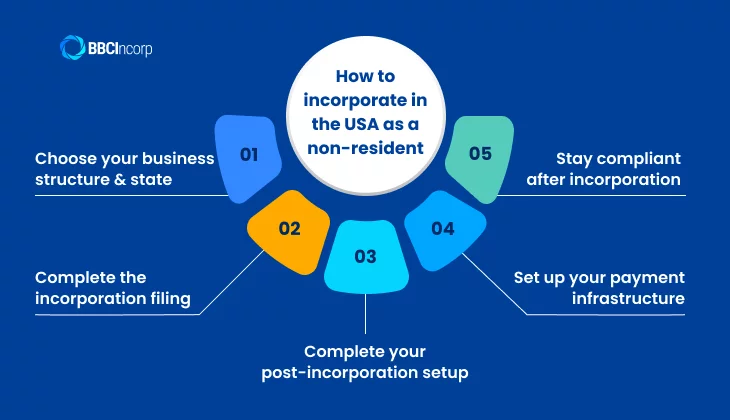
Incorporating in the US without being American is entirely possible, and in most cases, the process can be completed online. By leveraging the integrated ecosystem of BBCIncorp and Payoneer, international founders can navigate the following five steps seamlessly, moving from legal formation to first payment without leaving their home country.
Step 1. Choose your business structure and state
Decide between an LLC or C-Corp, and choose a business-friendly state like Delaware or Wyoming. Always verify your company name’s availability on the state’s official registry.
While multiple states are available, Delaware is the top choice for investors and international founders. BBCIncorp specializes specifically in Delaware company formation, offering tailored setups for both Delaware LLCs and Delaware C-Corps.

Note
Step 2. Complete the incorporation filing
Once you select a state, you must officially establish your company by filing the Articles of Organization (LLC) or Certificate of Incorporation (Corporation) with the state authority. You are also legally required to appoint a Registered Agent to receive official correspondence on behalf of your business.
BBCIncorp handles this entire state filing process for you and provides a premium Registered Agent service to ensure your legal foundation is established correctly
Step 3. Complete your post-incorporation setup
After your company is approved by the state, we help you complete the remaining essentials: applying for your Employer Identification Number (EIN) via IRS Form SS-4 even without an SSN, drafting a custom Operating Agreement, and confirming your Beneficial Ownership Information (BOI) reporting status under current FinCEN rules.
Step 4. Set up your payment infrastructure
Incorporation alone does not let your business process financial transactions, so activating payment infrastructure is the final step.
Depending on your business model, this may include a US business bank account, a payment gateway, marketplace integrations, or a cross-border platform such as Payoneer – which BBCIncorp can set up together as part of the same onboarding process.
Step 5. Stay compliant after incorporation
To keep your business in good standing, you’ll need to monitor ongoing filing and reporting obligations throughout the year. Create a compliance calendar that tracks important deadlines, including:
- Annual reports (where required by the state)
- Annual franchise taxes or state renewal fees
- IRS tax filings
- BOI reporting, if applicable under current FinCEN rules
- Registered Agent renewals and other corporate maintenance requirements
As your business grows, keeping track of filing deadlines and ongoing obligations can become more challenging. Our dedicated compliance team and the BBCI Client Portal help businesses stay compliant by managing recurring filings, statutory records, and key deadlines.
Tax and compliance obligations in 2026
Maintaining your company’s good standing requires strict adherence to ongoing compliance. At the federal level, foreign-owned single-member LLCs must typically file Form 5472 and a pro forma Form 1120 with the IRS to report transactions with related parties.
At the state level, companies must pay annual franchise taxes (such as Delaware’s $300 LLC tax) and may need to file an annual report, depending on the state.
BOI reporting is not currently required for most newly formed US entities, since FinCEN exempts domestic reporting companies under the Corporate Transparency Act — though this is a policy rule that could change, so founders should confirm their status periodically.
Final thought
US company formation for non-residents has become more accessible than ever in 2026. With no residency requirement, multiple business-friendly states, and a fully remote incorporation process, international founders can establish a US company as the foundation for serving global customers, accessing US financial infrastructure, and scaling internationally.
Through the strategic partnership with Payoneer, we help bridge this gap by combining company formation and ongoing compliance support with streamlined payment enablement. Instead of managing multiple providers separately, founders can move from incorporation to day-to-day operations with a more connected setup designed for international businesses.
Planning to form a US company? Chat with us to discuss your business goals and get guidance on the right incorporation and compliance setup for your US expansion.
Frequently Asked Questions
How long does it take to set up a US entity and become operationally active?
The incorporation timeline depends on the state, processing speed, and post-incorporation requirements. In many cases, a US company can be formed within a few business days, while obtaining an EIN and completing payment setup may take additional time.
How do I receive payments after forming a US LLC as a non-resident?
After your company is incorporated, you’ll need a payment solution before you can invoice customers or collect revenue. Depending on your business needs, this may include a US business bank account, a cross-border financial platform such as Payoneer. The right solution is contingent upon where your customers are located and how your business receives payments.
How do I receive Amazon and Shopify payouts as a non-resident LLC owner?
Most ecommerce platforms require a valid payment account before they can release your earnings. Many non-resident founders use cross-border payment platforms that provide USD receiving accounts and support marketplace integrations. These solutions can be linked to platforms such as Amazon and Shopify, making it easier to collect payouts and manage international sales.
How does BBCIncorp connect my new company to Payoneer?
The identity and company verification completed during formation with BBCIncorp is carried over into your Payoneer application, so you’re not starting eKYC from scratch. That’s what allows the two processes to move as one instead of two disconnected applications.
What makes Payoneer onboarding faster through BBCIncorp?
Because your KYC has already been pre-vetted, applications from BBCIncorp clients move through a prioritized review queue, and you’re assigned a dedicated Account Manager rather than a general support line.
Disclaimer: While BBCIncorp strives to make the information on this website as timely and accurate as possible, the information itself is for reference purposes only. You should not substitute the information provided in this article for competent legal advice. Feel free to contact BBCIncorp’s customer services for advice on your specific cases.
Industry News & Insights
Get helpful tips and info from our newsletter!
Stay in the know and be empowered with our strategic how-tos, resources, and guidelines.