Hong Kong incorporation fee & Aspire
 cashback.


Table of Contents
Corporate tax rates vary significantly across jurisdictions, making tax strategy a key consideration for businesses operating internationally. Many companies actively explore what country has the lowest taxes to reduce costs, improve profitability, and optimize global structures.
This is especially relevant for startups, digital entrepreneurs, and multinational businesses seeking flexible and tax-efficient environments.
However, choosing from low corporate tax countries is not simply about picking the lowest rate. Governments increasingly enforce strict compliance rules, economic substance requirements, and transparency standards.
Businesses must also evaluate factors such as legal stability, access to banking, talent availability, and overall infrastructure. In many cases, a slightly higher tax rate in a well-regulated jurisdiction may offer greater long-term benefits than a zero-tax environment with limited support.
Understanding the landscape of global corporate tax rates helps businesses make informed decisions when expanding internationally. In this guide, we highlight six countries with the lowest corporate tax rates that are widely recognized for their business-friendly frameworks and strong appeal to international companies.
Key Takeaways
- The lowest corporate tax rate doesn’t always mean the lowest actual tax bill — effective rates depend on incentives, compliance costs, and substance requirements.
- Top low-tax jurisdictions in 2026 include Hong Kong, Singapore, the UAE, Ireland, Hungary, and the Cayman Islands, each suited to different business models and expansion goals.
- Many low-tax regimes require genuine economic substance – such as local business activities, personnel, expenditure, or management – to qualify for preferential tax treatment.
- The OECD 15% global minimum tax is reshaping international tax planning for large multinationals, making jurisdiction selection more complex than ever.
- Always evaluate banking access, treaty networks, and regulatory stability alongside tax rates before deciding where to incorporate.
What is corporate tax and how does it work?
Corporate tax, also known as corporate income tax, is a direct tax levied by governments on a company’s net profits. Once a business deducts allowable expenses from its total revenue, the remaining taxable income is subject to this tax. It applies to incorporated entities: limited companies, corporations, and in many jurisdictions, certain partnerships.
How governments calculate it follows a consistent logic: multiply taxable income by the applicable corporate tax rate. However, “taxable income” isn’t simply revenue minus costs; it accounts for depreciation methods, tax deductions, loss carry-forwards, and jurisdiction-specific allowances that can significantly shift the final figure.
This is where two important distinctions come in:
- Statutory corporate tax rate: the official, legislated rate set by the government (for example, the US federal rate sits at 21%, while the UK charges 25% for profits above £250,000)
- Effective corporate tax rate: the rate a company actually pays after applying deductions, credits, and incentives, which is often considerably lower than the statutory rate
Beyond corporate income tax, businesses may also face withholding tax on cross-border payments like dividends and royalties, VAT or sales tax on goods and services, and local or municipal taxes that vary by region.
For businesses expanding internationally, understanding these layered tax obligations before incorporating is critical. Tax structures directly affect profitability, cash flow, and compliance risk, making corporate tax planning an essential part of any cross-border growth strategy.
What country has the lowest taxes for businesses?
Choosing where to incorporate is one of the most consequential decisions a business owner can make, and the corporate tax rate is often near the top of the criteria list. But the lowest headline rate doesn’t always mean the lowest actual tax bill. Effective rates, treaty networks, substance requirements, and broader business infrastructure all matter.
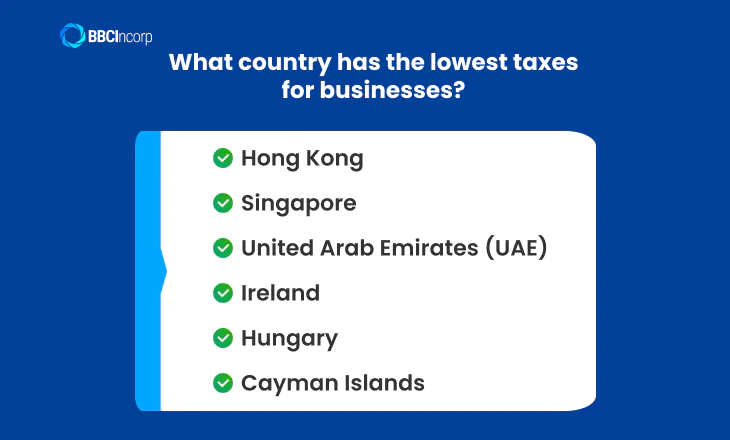
Here’s how the leading low-tax jurisdictions compare in 2026.
| Country | Corporate Tax Rate | Capital Gains Tax | Dividend WHT | VAT/GST |
| Hong Kong | 8.25% / 16.5% (two-tier) | 0% | 0% | None |
| Singapore | 17% flat | 0% | 0% | 9% |
| UAE | 0% up to AED 375,000; 9% above. Qualifying Free Zone Persons: 0% on qualifying income, 9% on non-qualifying income | 0% | 0% | 5% |
| Ireland | 12.5% trading / 25% non-trading | 33% | 25% standard; exemptions may apply | 23% |
| Hungary | 9% flat | 0% (qualifying) | 0% corporate | 27% |
| Cayman Islands | 0% | 0% | 0% | None |
1. Hong Kong
Hong Kong remains one of Asia’s most respected international business hubs, combining a straightforward two-tier profits tax system with a genuinely territorial approach to taxation.
According to the Hong Kong Inland Revenue Department (IRD), profits up to HK$2 million are taxed at 8.25%, with anything above that at 16.5%, while Hong Kong generally taxes profits arising in or derived from Hong Kong.
Certain foreign-sourced income may be exempt, subject to the applicable source rules and, for MNE entities, the conditions under the Foreign-sourced Income Exemption (FSIE) regime(1).
There’s no VAT, no capital gains tax, and no withholding tax on dividends, making it particularly attractive for international trading companies, holding structures, and Asia-Pacific operations. Setup is fully online with no local director required.
2. Singapore
According to the Inland Revenue Authority of Singapore (IRAS), Singapore’s headline rate of 17% sits higher than some peers, but the effective rate tells a different story. Qualifying startups receive a 75% tax exemption on the first SGD 100,000 of normal chargeable income and a further 50% exemption on the next SGD 100,000 for their first three consecutive Years of Assessment(2).
Combined with an extensive double taxation treaty network covering around 100 jurisdictions, generous R&D deductions of up to 400% on qualifying expenditure, and a highly stable regulatory environment, Singapore consistently ranks among the world’s premier business destinations for founders who want tax efficiency without reputational risk.
3. United Arab Emirates (UAE)
The UAE introduced a federal corporate tax of 9% on taxable profits above AED 375,000. However, businesses operating in designated Free Zones as Qualifying Free Zone Persons can still access a 0% rate on qualifying income, subject to genuine substance requirements.
There is no personal income tax, and no withholding tax on dividends, making the UAE a compelling hub for international trade, logistics, and Middle East operations. Substance expectations have risen considerably, so the 0% Free Zone rate requires real operational presence, not just a registered address.
4. Ireland
Ireland’s 12.5% corporate tax rate on active trading income has made it the jurisdiction of choice for multinational tech and pharmaceutical giants.
Access to the EU single market, a strong talent pool, an R&D Corporation Tax Credit of 30%, increasing to 35% generally for accounting periods ending 31 December 2026 or later, and a Knowledge Development Box reducing qualifying profits to an effective 10% tax rate make Ireland particularly powerful for IP-heavy and innovation-driven businesses.
It’s not the cheapest on this list, but it offers unmatched credibility within the European Union.
5. Hungary
At 9% flat, Hungary holds the title of the lowest statutory corporate tax rate in the EU — a significant draw for European holding structures and manufacturing operations. Zero withholding tax on dividends to corporate shareholders and tax-free capital gains on qualifying shareholdings add further appeal.
One caveat: a local business tax of up to 2% may apply depending on the municipality, and Hungary’s VAT rate of 27% is among the highest in the bloc.
6. Cayman Islands
The Cayman Islands impose zero corporate income tax, zero capital gains tax, and zero withholding tax, making it a pure tax-neutral jurisdiction frequently used for investment funds, holding companies, and special purpose vehicles. There is no VAT or GST.
However, the Cayman Islands offer limited substance for operational businesses and face increasing international scrutiny under OECD anti-avoidance frameworks, making them more suitable as a structural layer than a primary operating base.
Why do companies choose countries with low corporate tax rates?
The appeal of low-tax jurisdictions goes well beyond simply paying less to the government. For most businesses, it’s a strategic decision rooted in long-term financial efficiency and competitive positioning.
The most immediate driver is tax optimization and cost reduction. Lower corporate tax directly improves net profitability; funds that would otherwise go to tax can be reinvested into operations, product development, or talent. For businesses operating on thin margins or scaling aggressively, this difference is material.
Low-tax environments also play a significant role in attracting foreign direct investment (FDI). Governments use competitive tax rates as deliberate policy levers, signaling to international businesses that they are open, investment-friendly, and commercially pragmatic.
Ireland’s success in drawing tech multinationals and Singapore’s dominance as a regional headquarters hub are direct results of this approach.
For companies expanding internationally, tax-efficient jurisdictions offer a natural home for global or regional headquarters, centralizing management, intellectual property, and treasury functions in a single, low-cost structure.
Special economic zones and free zones (common in the UAE, Qatar, and Singapore) layer additional incentives on top of headline rates, offering targeted exemptions for qualifying activities.
That said, the smartest international tax planning doesn’t chase the lowest rate in isolation. Regulatory stability, treaty access, banking infrastructure, and compliance requirements all affect the real cost of operating in any jurisdiction.
A 0% rate in an unstable or poorly recognized jurisdiction can cost more in practice than a 12.5% rate in a well-governed, treaty-rich country like Ireland.
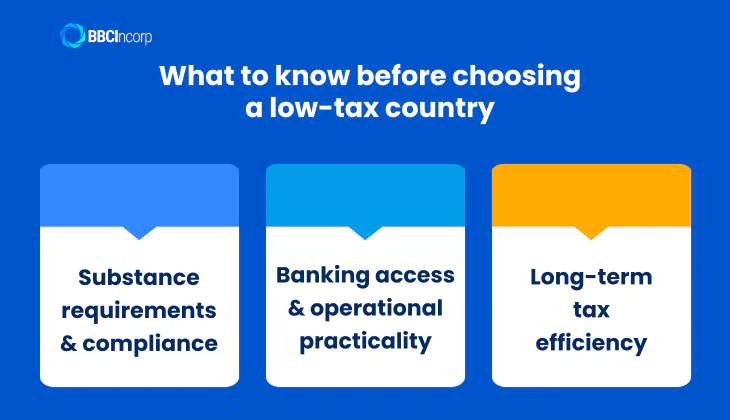
What to know before choosing a low-tax country
A low headline rate is only the starting point. Before committing to any jurisdiction, founders need to understand what’s required to actually maintain that tax treatment, and how the global regulatory environment is shifting.
Substance requirements and compliance
Most legitimate low-tax regimes require genuine economic activity in the jurisdiction to qualify for preferential rates. This typically means a real registered address, locally based directors or employees, board decisions made within the country, and annual compliance filings.
A company without adequate substance risks losing its tax status and attracting scrutiny from home-country tax authorities.
The OECD Pillar Two global minimum tax framework sets a 15% minimum effective tax rate for in-scope multinational groups with consolidated annual revenues of at least EUR 750 million in at least two of the four preceding fiscal years.
For these groups, low-tax regimes in jurisdictions such as Hungary or Ireland may offer less tax benefit where top-up tax applies.

Note
For SMEs, Pillar Two does not directly apply, but the broader regulatory direction is clear: international pressure on tax avoidance and profit shifting is intensifying, and structures without real substance face growing exposure.
To better understand how these international tax rules may influence cross-border structuring and compliance, explore our guide to pillar two OECD summary
Banking access and operational practicality
A jurisdiction’s tax rate means little if your company can’t open a functional bank account. Zero-tax jurisdictions like the Cayman Islands or BVI may face additional banking scrutiny depending on the financial institution, business activities, ownership structure, and AML/KYC risk profile.
Credible hubs like Singapore, Hong Kong, and Ireland offer far stronger banking ecosystems, smoother KYC processes, and more predictable ongoing compliance requirements.
Ease of company setup, local regulatory transparency, and the quality of professional services infrastructure also affect the real cost of operating in any given location, factors that don’t appear in a tax rate comparison table but matter considerably in practice.
Long-term tax efficiency
Effective tax planning looks beyond the statutory rate to the actual rate paid after incentives, deductions, and compliance costs. A double taxation treaty (DTA) network is often the difference between a jurisdiction that works globally and one that creates friction on every cross-border transaction.
Singapore’s 90+ treaty network and Ireland’s EU alignment, for example, give businesses far more flexibility in managing cross-border income than a zero-tax jurisdiction with limited treaty coverage.
The most sustainable structures balance a competitive, effective tax rate with regulatory credibility, banking access, and the substance required to defend the arrangement under scrutiny, not just today, but as global tax rules continue to evolve.
How to choose the right low corporate tax jurisdiction
Selecting a low-tax jurisdiction isn’t simply a matter of finding the lowest rate on a comparison table. The right choice depends on your business model, where value is genuinely created, and the level of credibility your structure needs to hold up, with banks, investors, and regulators alike.
Legitimacy and reputation
Jurisdiction reputation has direct, practical consequences. Companies registered in well-recognized hubs like Singapore, Ireland, or Hong Kong face far fewer obstacles when opening bank accounts, attracting investors, or entering commercial partnerships.
By contrast, structures in controversial zero-tax havens (Cayman Islands, BVI, Bahamas) routinely face declined banking applications, heightened due diligence from counterparties, and scrutiny from home-country tax authorities. A credible jurisdiction with a 12.5% rate will often outperform a tax haven at 0% once the full operational picture is accounted for.
Business environment and ease of setup
Beyond tax, consider company formation procedures, ongoing compliance requirements, access to professional services, banking infrastructure, and the availability of local talent.
Some jurisdictions, such as Hong Kong and Singapore, allow non-residents to incorporate without a local director, although a Hong Kong registered office and company secretary are still required.
Singapore also offers an online incorporation process, but foreign founders must engage a Corporate Service Provider (CSP), and the company must have at least one ordinarily resident director.
Other jurisdictions may require local directors, physical offices, or resident employees to qualify for or maintain certain tax benefits. These requirements carry real cost and should factor into your total calculation.
Strategic tax planning
The most effective corporate structures align jurisdiction choice with genuine business activity and long-term expansion goals. A SaaS company scaling across Asia-Pacific sits naturally in Singapore. An IP-driven business entering European markets finds a stronger footing in Ireland.
A trading operation focused on the Middle East may be best served by the UAE. If you plan to relocate your business to Asia, weighing hubs such as Singapore and Hong Kong against your substance, banking, and setup needs can help you choose the most suitable regional base.
Professional advice from qualified international tax advisors is essential before committing, particularly for Net CFC Tested Income (NCTI, formerly GILTI) exposure or any business operating across multiple treaty jurisdictions.
Corporate services and tax advisory support with BBCIncorp
Navigating international corporate tax regimes is rarely straightforward. Choosing the wrong jurisdiction, misunderstanding substance requirements, or overlooking compliance obligations can cost far more than the tax savings you were aiming for. That’s where professional guidance makes the difference.
Working with experienced corporate advisors helps businesses move from comparison to decision with confidence. The right experts don’t just present a rate table; they assess your business model, income structure, and expansion goals to identify which jurisdiction genuinely fits, then map out the compliance requirements you’ll need to sustain that structure long-term.
BBCIncorp supports entrepreneurs and businesses at every stage of international expansion. Whether you’re exploring your first offshore structure or optimizing an existing global setup, BBCIncorp’s services are built to simplify the process and reduce risk:
- International company incorporation – streamlined incorporation across leading jurisdictions, including Hong Kong, Singapore, and beyond, with full remote setup where available
- Corporate tax advisory – practical guidance on comparing tax regimes, understanding effective rates, and structuring your business for long-term efficiency
- Accounting and compliance services – ongoing support to meet local filing requirements, maintain good standing, and stay ahead of evolving regulatory obligations
With BBCIncorp’s offshore company formation service, businesses can move from incorporation to ongoing compliance through a more connected, technology-enabled experience.
Conclusion
For businesses asking what country has the lowest taxes, this guide has explored six jurisdictions that stand out for their competitive corporate tax environments: Hong Kong, Singapore, the UAE, Ireland, Hungary, and the Cayman Islands. Each country offers distinct advantages depending on your business model and expansion goals.
However, corporate tax rates should not be considered in isolation. The right jurisdiction should also provide regulatory credibility, reliable banking access, manageable substance requirements, and a compliance framework your business can sustain over the long term.
Whether you’re setting up a new company or restructuring an international business, professional guidance can help you evaluate these factors and choose a structure that supports both tax efficiency and long-term growth.
Chat with our team for guidance on incorporation, tax, and compliance.
References:
- (1): IRD – Two-tiered Profits Tax Rates Regime: https://www.ird.gov.hk/eng/faq/2tr.htm
- (2): IRAS – Corporate Income Tax Rate, Rebates & Tax Exemption Schemes: https://www.iras.gov.sg/taxes/corporate-income-tax/basics-of-corporate-income-tax/corporate-income-tax-rate-rebates-and-tax-exemption-schemes
Frequently Asked Questions
Which country has the lowest tax rate?
Several jurisdictions offer very low or zero corporate tax rates, including the Cayman Islands, UAE Free Zones, and certain other offshore financial centers.
However, the effective tax rate a business actually pays depends heavily on local regulations, substance requirements, and the nature of business activities. A 0% headline rate rarely means 0% in practice.
Why do some countries have very low corporate tax rates?
Governments use low corporate tax rates as deliberate policy tools to attract foreign direct investment, stimulate economic growth, and position themselves as competitive international business hubs. Lower rates can generate broader economic activity, such as jobs, infrastructure spending, and ancillary tax revenue, that offsets the reduction in corporate tax collected directly.
Are low corporate tax countries legal for businesses?
Yes. Incorporating and operating in low-tax jurisdictions is entirely legal, provided companies comply with local regulations, meet substance requirements, and adhere to international tax rules, including OECD frameworks and applicable reporting obligations.
The key distinction is between legitimate tax planning and aggressive avoidance structures that lack genuine economic substance.
What factors matter besides corporate tax rates?
Businesses should carefully evaluate regulatory stability, banking access, double taxation treaty networks, infrastructure quality, ease of company formation, and ongoing compliance requirements.
For US-based founders, additional considerations around NCTI and Subpart F exposure are also critical. The jurisdiction that scores best across all these factors, not just on tax rate, is typically the right choice.
Disclaimer: While BBCIncorp strives to make the information on this website as timely and accurate as possible, the information itself is for reference purposes only. You should not substitute the information provided in this article for competent legal advice. Feel free to contact BBCIncorp’s customer services for advice on your specific cases.
Industry News & Insights
Get helpful tips and info from our newsletter!
Stay in the know and be empowered with our strategic how-tos, resources, and guidelines.