Hong Kong incorporation fee & Aspire
 cashback.


Table of Contents
Many people still ask, What is an account number? and why every bank requires it. The confusion is common because a bank account number looks simple, yet it performs one of the most important functions in modern finance. It identifies your financial account with precision, so that every payment you send or receive reaches the right place without delay.
Banks and global payment networks rely on account numbers to support secure transfers, digital payments, and the entire online banking experience.
As digital transactions increase worldwide, knowing what a bank account number is becomes essential for both business owners and everyday users.
In this article, we will explain the meaning of a financial account number, clear up common misconceptions, and show you how to find yours easily and confidently.
Understanding all about the business bank account number
Although the definition of a bank account number might seem simple, this identifier plays a central role in how banks process payments and maintain secure records.
What is an account number?
An account number is the unique code a bank assigns to a specific customer account. It applies to both a corporate bank account and a private bank account and ensures that every transaction reaches the correct destination. When you define an account number in banking, it represents the exact identifier for one financial account within the institution.
It differs from a customer ID, which identifies the account holder, and from a bank code, which identifies the financial institution. Additional identifiers often work alongside a bank account number to support secure and accurate transfers.
Typical format and number of digits
Bank account numbers vary by country, institution, and payment requirements. In the United States, a bank account number usually ranges from eight to twelve digits. The United Kingdom typically uses eight digits. In several European markets, IBAN structures can extend the number of account digits to more than twenty.
Banks may assign digits to represent different information, such as branch details, account types, or customer-specific sequences.
Regardless of the structure, the bank account number remains the element that pinpoints the specific financial account involved in a transaction. The sequence helps banks and payment networks identify the right account to credit or debit, reducing the risk of errors in domestic or international transfers.
Understanding bank account number format becomes even more important for companies that manage multiple accounts or send payments to global partners.
Clear knowledge of how many numbers in bank account number fields shall minimise the chances of these mistakes and facilitate financial operations.
What is a corporate bank account number?
A corporate account number, also called a business bank account number, is the unique banking account number assigned to an account registered under a company. It acts as the bank account identifier that links each transaction directly to the business entity.
Unlike a private account used for personal finances, a corporate account handles vendor payments, payroll, customer receipts, and other business operations. Corporate accounts separate business funds from personal funds and provide clear financial records.
The corporate account number functions like any bank account number. It identifies the specific financial account within the institution so that payment systems process transfers accurately and securely.
When customers or partners send funds, the banking number directs the money to the correct business account. A corporate account number allows companies to track transactions, comply with regulations, and process digital payments with accuracy.
Where to find your business bank account number
The bank account number identifies the business account for payments, payroll, and vendor transactions. It appears in multiple secure locations, both on paper and digitally.
Common places to locate it
Business bank account numbers can be found in several standard locations:
- Paper checks: Printed at the bottom, usually next to the routing number. Checks may also include the branch code, depending on the country.
- Bank statements and passbooks: Typically displayed under account details or the account summary section. Statements list both the account number and the branch or bank code for reference.
- Online and mobile banking platforms: Most banks provide a dedicated section for account information where corporate clients can view their full account number. For instance, BBCIncorp Client Portal platforms enable secure download of account details for internal bookkeeping or audits.
Access to these sources allows companies to process transactions accurately and reduces delays when transferring funds domestically or internationally.
Finding the account number on a debit or credit card
Kindly note that the number printed on a debit or credit card is often not the same as the bank account number. Key points include:
- Some cards display only a partial account number or a reference code for security reasons.
- Corporate debit cards linked to a business account may show a unique card number separate from the actual bank account identifier.
- When the full account number is required, such as for wire transfers or vendor payments, verification with the bank is the most reliable option.
Banks can provide precise guidance on how to locate the business account number across statements, digital platforms, or associated cards, so that all corporate transactions are directed to the accurate account.
Additional tips for corporate clients
- Use secure channels when retrieving account numbers to prevent fraud.
- Keep a record of all business account numbers for different accounts separately to avoid confusion during transactions.
- For international transfers, combine the account number with other identifiers like IBAN or SWIFT codes, depending on the recipient country.
- Review account details periodically to confirm accuracy before making high-value transfers.
Accessing and verifying the business bank account number is a critical step for smooth financial operations, accurate vendor payments, and secure online transactions.
Examples and uses of account numbers
Bank account numbers are structured sequences that identify individual accounts within financial institutions. They vary by country and bank, but all serve the same purpose: to direct transactions accurately to the intended account.
Sample of a bank account number and its breakdown
To illustrate, a U.S. bank account number example is 123456789012. In this 12-digit sequence:
- The first three digits may indicate the branch or routing designation.
- The middle six digits often identify the specific account type or internal bank coding.
The last three digits are typically unique to the customer’s account, providing precise identification for transactions.
Other countries use slightly different structures.
In the United Kingdom, a bank account number usually consists of 8 digits, paired with a 6-digit sort code to identify the branch. Singapore uses a 9 to 12-digit account number format, while Australian accounts combine a 6-digit BSB code with a 9-digit account number.
These examples demonstrate how account numbers work alongside other identifiers to form a complete banking profile for each customer.
Role of account numbers in financial transactions
Deposit account numbers and banking account numbers are essential for processing a wide range of financial transactions. Banks use them to direct deposits, withdrawals, and internal transfers with precision. And each account number acts as a routing tool.
Businesses rely on banking account numbers for operational purposes such as payroll, billing, and vendor payments. Corporate clients can assign specific account numbers for different departments or projects, which simplifies internal management and accounting.
Banks also require account numbers when processing loan applications or setting up recurring payments, linking the financial activity directly to the company’s accounts.
For international transactions, complete bank account numbers tend to integrate with systems like IBAN and SWIFT codes. These identifiers allow businesses to receive payments from global partners, execute cross-border transfers, and reconcile transactions accurately across multiple currencies and jurisdictions.
Using a bank account number correctly enables each financial operation, whether domestic or international, is executed reliably. Corporate clients can then manage their accounts efficiently, reduce errors, and streamline transaction workflows by referencing accurate banking account numbers.
A bank account number is one of the most sensitive pieces of financial information a business can hold. Corporate clients need to treat it carefully to prevent unauthorized access or misuse.
Security and privacy of your bank account number
Why account numbers are sensitive information
Exposing a bank account number can create serious risks, including fraud, phishing attacks, and unauthorized transactions. Criminals may attempt to withdraw funds, initiate fake payments, or use the information for identity theft.
It is vital to distinguish between sharing your account number for legitimate purposes, such as payroll, vendor payments, or verified client transfers, and unsafe sharing through unverified emails, phone calls, or public platforms. Businesses should know what a bank account number looks like and which is the account number that must remain confidential.
Common scams targeting corporate accounts include:
- Fake vendor invoices requesting payment to fraudulent accounts.
- Phishing emails posing as banks asking for account verification.
- Unauthorized access attempts via unsecured devices or public Wi-Fi networks.
How to protect your banking details
Corporate clients can adopt several measures to safeguard account numbers and bank account details:
- Access banking platforms only on secure devices and networks; avoid public Wi-Fi for financial transactions.
- Enable two-factor authentication to add an extra layer of protection.
- Share bank account numbers only through verified and encrypted channels such as secure banking portals or verified emails.
- Review transaction history regularly to detect unusual activity promptly.
- Follow bank policies on digital protection, including encryption and tokenization, which safeguard banking account numbers during online transactions.
Following these practices allows businesses to use their bank account number safely for payroll, vendor payments, and other corporate transactions. Proper handling of bank account details reduces risk, keeps transactions accurate, and preserves the integrity of financial operations.
How to open a business bank account
Before starting the process, corporate clients should select a bank that matches their business needs. Consider factors such as account fees, online banking features, international payment capabilities, and customer support.
Choosing the right bank first can save time and simplify operations once the account is opened.
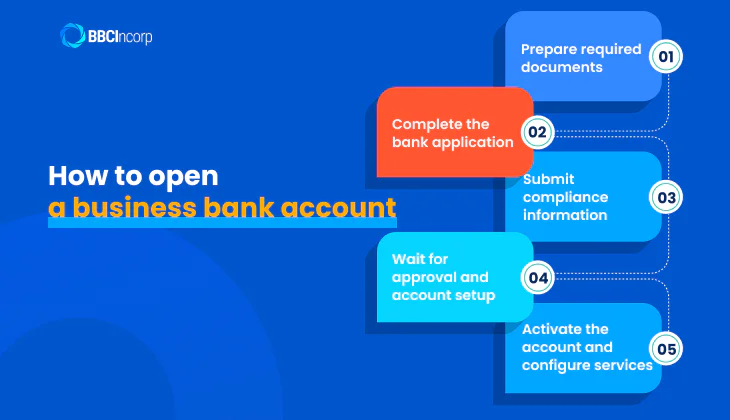
Step 1: Prepare required documents
Most banks require proof of business registration, legal company documents, and identification for owners or authorized signatories. Typical documents include articles of incorporation, a business license, and valid personal identification for each director or signatory.
For example, in the U.S., banks such as Chase or Bank of America require a federal Employer Identification Number (EIN) along with corporate formation documents for LLCs or corporations.
Step 2: Complete the bank application
The business completes the bank’s corporate account application form. This usually requests company details such as name, address, tax identification number, and information for authorized signatories.
Accurate completion of the form reduces errors.
Step 3: Submit compliance information
Banks must follow anti‑money‑laundering (AML) and know-your-customer (KYC) regulations. Businesses may need to provide information on the nature of operations, source of funds, and expected account activity.
U.S. banks often require a brief description of the business model, anticipated transaction volumes, and key clients or suppliers.
Step 4: Wait for approval and account setup
After review, the bank assigns a business bank account number and provides account details. Depending on the country, this may include a routing number, sort code, IBAN, or access to online banking platforms.
In the U.S., once approved, the account includes a 9-to 12-digit account number and a 9-digit routing number for domestic payments. Approval times vary by institution.
Step 5: Activate the account and configure services
Once approved, businesses can deposit funds, link payment systems, set up payroll and vendor payments, and enable debit or corporate card access. The account becomes fully operational and ready for financial management.
Opening a business bank account requires preparation and documentation, but following these steps allows corporate clients to complete the process efficiently.
With a U.S. business bank account number in place, companies can process transactions, manage cash flow, and maintain accurate financial records.
BBCIncorp’s global banking support for seamless account setup
BBCIncorp provides specialized banking services to help entrepreneurs and companies open U.S. business accounts or offshore accounts in strategic jurisdictions efficiently.
Our services cover domestic U.S. accounts, multi-currency accounts, and offshore banking solutions, giving corporate clients secure and compliant access to global financial operations.
Our packages include:
- Opening a corporate bank account: U.S. business account setup for startups, SMEs, and established corporations
- Opening a business account with EMIs/ global payment platforms (e.g., Payoneer, Wise, Airwallex, etc.)
- Offshore account opening in high-potential jurisdictions such as Singapore, Hong Kong, the British Virgin Islands, Cayman Islands, the UAE, etc.
- KYC documentation preparation customized to meet each bank’s regulatory requirements
- Liaison with banks and fintech providers to coordinate approvals and minimize delays, automated notifications for compliance deadlines
- Digital banking configuration, including access to online platforms and secure access for corporate transactions
All services are carried out in compliance with anti-money laundering and regulatory standards, ensuring a smooth and secure account opening process.
Over the years, aspiring entrepreneurs and global businesses have chosen BBCIncorp because our extensive banking network reduces the risk of application rejection and accelerates approval times.
Additional guidance is provided on selecting the most suitable jurisdictions, managing cross-border transactions, and integrating company formation with account setup. Our approach allows businesses to establish fully operational accounts efficiently, whether in the U.S. or offshore.
With BBCIncorp’s global banking solutions, companies gain access to U.S. and offshore business accounts, multi-currency banking, and digital banking platforms seamlessly.
To start opening a U.S. business account or for any corporate service needs, please visit our site or contact us via email at service@bbcincorp.com for more details.
Conclusion
A bank account number is the unique identifier for a business account, playing a vital role in accurate, secure, and efficient financial transactions.
Corporate clients can locate it on checks, bank statements, passbooks, or online banking platforms, while debit and credit cards may display only partial numbers. Because this information is sensitive, careful handling is essential to prevent fraud, unauthorized access, or errors in payments.
By working with experts from BBCIncorp, clients can navigate complex requirements, prepare KYC documentation, and coordinate directly with banks to streamline approvals.
This approach not only simplifies the account setup process but also supports secure cross-border transactions and smooth day-to-day operations.
Get in touch with BBCIncorp to open a bank account confidently and maintain reliable financial management today.
Frequently Asked Questions
What’s the difference between a checking and a savings account number?
A bank account number identifies a specific account, but checking and savings accounts often have separate numbers even if held at the same bank. A checking account number is used for everyday transactions such as payments, transfers, and payroll, while a savings account number is associated with deposits, interest accumulation, and longer-term funds storage.
Although both account numbers serve the same fundamental purpose, uniquely identifying a financial account, they link to accounts with different functionalities.
How to retrieve a lost or forgotten account number?
If a bank account number is lost or forgotten, it can usually be retrieved through secure channels.
- Start by checking online banking or mobile apps, as account details are often listed under account information.
- Paper statements, checkbooks, or account opening documents also contain the number.
- If unavailable, contact the bank directly, verifying identity through official documentation. The bank service provider may provide the number in person, via secure email, or within their digital banking portal.
Understanding what is your bank account number and what is your account number for a bank is essential to ensure transactions are processed correctly and securely.
Disclaimer: While BBCIncorp strives to make the information on this website as timely and accurate as possible, the information itself is for reference purposes only. You should not substitute the information provided in this article for competent legal advice. Feel free to contact BBCIncorp’s customer services for advice on your specific cases.
Industry News & Insights
Get helpful tips and info from our newsletter!
Stay in the know and be empowered with our strategic how-tos, resources, and guidelines.