Hong Kong incorporation fee & Aspire
 cashback.


Table of Contents
A Public Company Limited (PLC) holds a distinct position within Singapore’s corporate landscape, representing a structure designed for scale, transparency, and access to public capital. As Singapore continues to strengthen its role as a regional financial hub, PLCs serve as essential vehicles for businesses seeking wider investor participation and long-term growth.
For investors, entrepreneurs, and regulatory stakeholders, understanding how a Public Company functions is fundamental to evaluating governance quality, financial disclosure standards, and investment potential.
Unlike Private Companies, which face strict limitations on share transfer and fundraising, a PLC in Singapore can offer shares to the public and may be listed on the Singapore Exchange (SGX). This expanded access comes with heightened regulatory oversight, creating both opportunities and obligations for all parties involved.
This guide provides a comprehensive overview of PLC Singapore requirements, operational characteristics, and the strategic implications decision-makers should consider.
Key Takeaways
- A Public Company Limited in Singapore enables businesses to raise capital from the public while operating under strict governance and disclosure standards.
- Shareholder liability is limited, and investor protection is reinforced through robust regulatory oversight.
- Compared to private companies, public companies face significantly higher compliance, reporting, and transparency obligations.
- The choice between public company structures depends on business objectives, growth strategy, and funding needs.
- BBCIncorp helps businesses establish and manage Public Companies Limited by providing structured incorporation and ongoing compliance support.
What is a public company limited?
A Public Company Limited (PLC) is a corporate structure designed for businesses seeking broader access to capital markets and operating under a higher degree of transparency and governance. Understanding what a Public Limited Company is becomes essential for investors and founders evaluating expansion strategies, as PLCs allow public participation in ownership while maintaining a strict regulatory framework.

A PLC is typically established to raise capital through the issuance of shares to the public. This concept is consistent with the Public Limited Company meaning described by Investopedia, where PLCs enable investors to purchase shares through public markets. For instance, an investor might acquire shares during a public offering or through an exchange, becoming a partial owner without taking on personal liability for the company’s debts. This example reflects how PLCs promote both liquidity and diversified ownership.
To understand the characteristics of a PLC more clearly, it is helpful to examine its defining attributes. Key structural features of a Public Company Limited include:
- Limited liability, under which shareholders are responsible only for the value of their subscribed shares.
- Ability to issue shares to the public, distinguishing PLCs from Private Companies that are prohibited from making public offers.
- Wider investor accessibility, allowing institutional and retail investors to participate in the company’s growth.
These attributes make the PLC Singapore model an effective vehicle for companies planning large-scale expansion, regional growth, or capital-intensive projects.
Because PLCs raise capital from the public, they are subject to a comprehensive regulatory regime designed to ensure investor protection and maintain market integrity.
The regulatory framework governing Public Companies in Singapore includes:
- Incorporation under the Companies Act 1967 and oversight by the Accounting and Corporate Regulatory Authority (ACRA).
- Compliance with Singapore Exchange (SGX) Listing Rules if the PLC is listed on the market.
- Requirements under the Securities and Futures Act (SFA), which mandate a MAS-approved prospectus for public offerings unless exemptions apply.
- Mandatory audits, continuous disclosure obligations, and adherence to financial reporting standards.
In summary, a Public Company Limited combines limited liability, the ability to raise capital publicly, and strong governance standards, making it a strategically powerful structure within Singapore’s corporate ecosystem.
How does a public limited company operate?
The way a Public Company operates is shaped by its purpose: to raise capital from the public while maintaining a high level of transparency, accountability, and regulatory discipline. Most businesses do not begin in this structure; they typically evolve from private entities once they reach financial maturity. This transition becomes meaningful when a company demonstrates consistent revenue and earnings growth, traits that build investor confidence and justify public fundraising.
Public investors purchase shares based on expectations of future value creation. Buying a share is effectively a claim on a portion of the company’s future cash flows, which is why predictable financial performance is essential. Mature companies are better positioned to meet these expectations, making them suitable candidates for becoming PLCs.
Daily operations are anchored in a governance system that balances strategic oversight and shareholder participation. The Board steers long-term direction, ensures regulatory compliance, and oversees executive management. Shareholders, on the other hand, influence major decisions through voting rights and participation in general meetings. Ahead of going public, many companies reinforce their governance by appointing directors experienced in public-company reporting and compliance.
Regulatory transparency is another core element of how a public limited company operates. Unlike Private Companies, which only submit accounts to tax authorities, public entities must make their financial information publicly accessible. This includes quarterly updates, annual audited statements, and market disclosures that inform investors of material developments.
To clarify how this plays out in practice, PLCs in Singapore follow several key operational obligations:
- Regular financial reporting, including audited annual statements and periodic market announcements.
- Immediate disclosure of significant corporate events, ensuring investors receive timely and accurate information.
- Compliance with SGX Listing Rules for listed entities, governing corporate conduct, governance standards, and investor communications.
These expectations create an environment where transparency and disciplined governance are not optional but integral to the company’s functioning. Strong reporting standards also place higher demands on finance, treasury, tax, legal, and operational teams.
Ultimately, a Public Company operates as a transparent, investor-oriented organisation whose internal processes are shaped by regulatory expectations and market discipline. This operating model strengthens investor trust and enables PLCs in Singapore to raise capital efficiently and sustain long-term growth.
Types of public companies limited in Singapore
Singapore recognises two distinct forms of Public Companies under the Companies Act, each created to accommodate different organisational purposes, funding requirements, and governance expectations. Understanding these categories is essential for investors, founders, and stakeholders evaluating how public entities function within Singapore’s corporate environment.
While both structures fall under the “public” classification, their legal features, financing mechanisms, and typical use cases vary widely, shaping how they contribute to the broader economic landscape.
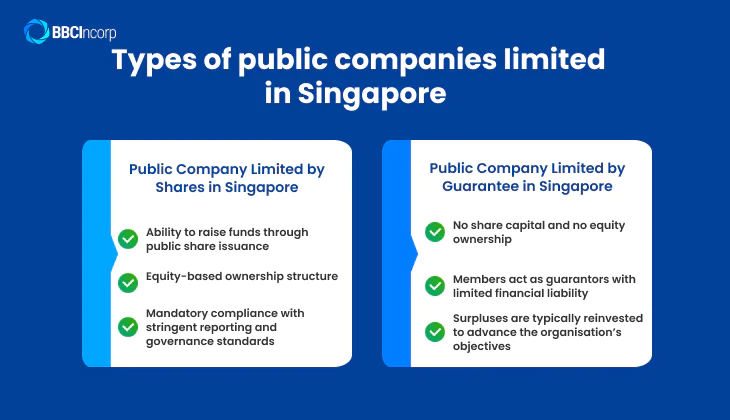
Public Company Limited by Shares in Singapore
A Public Company Limited by Shares is the model most commonly associated with public fundraising and large-scale commercial operations. In this structure, shareholder liability is limited to the amount unpaid on their shares, and the company is permitted to issue shares to the general public. Companies in this category may be listed on the Singapore Exchange (SGX), although listing is optional.
Key characteristics of a public company limited by shares Singapore include:
- Ability to raise funds through public share issuance.
- Equity-based ownership structure.
- Mandatory compliance with stringent reporting and governance standards.
In Singapore, this structure is generally chosen by medium-to-large enterprises seeking expansion capital, preparing for an IPO, or building a long-term growth platform. Because it fosters broader investor participation and access to capital markets, the public company limited by shares Singapore framework plays a significant role in supporting high-growth, scalable businesses.
Public Company Limited by Guarantee in Singapore
A Public Company Limited by Guarantee (CLG) differs significantly from the share-based model. It does not have share capital and does not issue shares. Instead of shareholders, it has members who agree to contribute a predetermined guarantee amount if the company is wound up. Liability is therefore minimal and symbolic, making CLGs suitable for non-profit or community-focused purposes.
Core characteristics of CLGs include:
- No share capital and no equity ownership.
- Members act as guarantors with limited financial liability.
- Surpluses are typically reinvested to advance the organisation’s objectives.
In Singapore, this model is commonly used by charities, professional associations, foundations, religious organisations, and non-profit entities that require a formal legal structure without relying on equity financing. It is especially suitable for organisations seeking strong governance, public accountability, and long-term mission continuity.
Advantages and disadvantages of a public company limited
Public companies occupy a unique space in Singapore’s corporate landscape, offering substantial growth opportunities while imposing demanding governance expectations.
Understanding the public limited company meaning requires evaluating both the strategic advantages and the operational burdens that come with being publicly accountable. The balance between these two dimensions often determines whether a business is suited for public-company status.
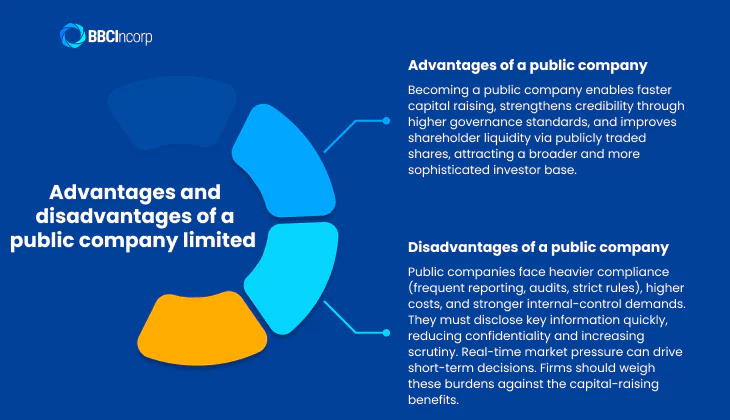
Key advantages of a public company
The most widely recognised benefit of becoming a public company is the ability to raise capital efficiently. Access to public share issuance enables organisations to fund large-scale expansion, invest in new markets, or support long-term development plans. This ability to mobilise substantial financial resources distinguishes public entities from private firms that rely more heavily on limited shareholder contributions or private fundraising.
Beyond financing, public status enhances a company’s corporate image. Listing on an exchange or operating as a public entity signals maturity, stability, and compliance with high governance standards, qualities that strengthen credibility with customers, partners, lenders, and institutional investors.
Public companies also offer greater liquidity for shareholders. Shares can be traded on the open market, allowing investors to enter or exit positions more easily, which broadens the investor base and increases market confidence. Liquidity is a strategic advantage for companies aiming to attract sophisticated or large-scale investors.
Major disadvantages of a public company
Despite the opportunities, operating as a public company introduces significant challenges. Compliance requirements intensify as organisations must produce quarterly and annual reports, maintain audited financial statements, and adhere to detailed regulatory guidelines. These obligations increase operational costs and require robust internal controls.
Public companies must also operate under extensive transparency rules. Information about financial performance, governance decisions, and material developments must be disclosed promptly. While essential for investor protection, this level of openness may limit strategic confidentiality and expose the company to greater public scrutiny.
Another disadvantage is the pressure from market expectations and shareholder interests. Share prices reflect sentiment in real time, which can drive short-term decision-making or place strain on leadership during periods of volatility.
Ultimately, the advantages and disadvantages of a public company coexist, and organisations must assess whether the benefits of access to capital outweigh the regulatory and market pressures inherent in public-company status.
Public Company vs Private Company in Singapore
Public and private companies in Singapore share the same foundational legal structure but operate under very different expectations, funding options, and governance models. For business owners and investors comparing alternatives, understanding these distinctions is essential to determining which structure best aligns with long-term strategic goals.
This comparison highlights the Public Limited Company meaning in practice, particularly in terms of capital access, shareholder structure, and regulatory intensity.
Ownership and control differences
The most fundamental distinction lies in ownership rules. A private company is restricted to a maximum of 50 shareholders, while a public company can have an unlimited number of shareholders. This difference directly influences how control is exercised.
In terms of decision-making, private companies typically maintain tighter control among founders or a small investor group. Public companies, by contrast, distribute voting power across a broader shareholder base, which can shift influence toward institutional investors. As a result, governance becomes more structured and formalised.
Capital raising and funding differences
The ability to raise capital is another major point of divergence. Public companies can access public capital markets, undertake an IPO, and issue shares to a large pool of investors. This is a key component of what a public limited company offers, scalability through wider participation.
Private companies rely primarily on internal funds, private placements, or venture capital. While this allows founders more control, it limits the scale and speed of fundraising. Public listing advantages such as liquidity, visibility, and access to institutional investors are generally not available to private entities.
Regulatory obligations comparison
Regulatory expectations intensify significantly for public companies. They must comply with ongoing disclosure requirements, publish quarterly and annual reports, and adhere to stringent governance standards. Private companies face fewer reporting obligations and greater operational flexibility.
These additional requirements ensure transparency for shareholders but also increase compliance costs and administrative workload.
Overall, the public company structure offers broader capital access and higher visibility, while private companies retain flexibility and concentrated control. Choosing between them depends on an organisation’s growth ambitions and appetite for regulatory responsibility.
How to incorporate a public company limited in Singapore
Before beginning the incorporation process, it is important to clarify what is a Public Limited Company under Singapore law, as the regulatory expectations differ significantly from those of private entities.
Incorporating a Public Company Limited in Singapore requires a structured and compliance-driven approach, reflecting the higher level of accountability expected from companies that may raise capital from the public.
Compared to private entities, the process involves additional regulatory considerations, particularly around governance, disclosure, and investor protection. Businesses considering PLC Singapore incorporation must therefore prepare not only the required filings but also the internal frameworks needed to operate as a public entity.
Registration and regulatory requirements
The incorporation process begins with meeting the statutory requirements set out under the Companies Act. A Public Company Limited must have at least one shareholder, one locally resident director, and a qualified company secretary appointed within six months of incorporation. These requirements ensure that the company has adequate local oversight and governance from the outset.
Registration is carried out through the Accounting and Corporate Regulatory Authority (ACRA) via its BizFile+ system. Before filing, the proposed company name must be approved, and the intended business activities must comply with any sector-specific regulations. During registration, the company submits key documents, including identification details of officers and the company constitution.
The constitution plays a central role in incorporation. It defines the company’s governance framework, shareholder rights, voting mechanisms, and share transfer rules. For entities formed as a public company limited by shares Singapore, the constitution must also anticipate future capital raising, including provisions that support public share issuance and potential listing requirements.
Share capital and prospectus requirements
Singapore does not impose a statutory minimum paid-up capital for incorporating a Public Company Limited, meaning incorporation can technically occur with as little as SGD 1. In practice, however, companies intending to raise funds publicly or pursue listing usually adopt a more substantial capital structure to meet commercial expectations and regulatory scrutiny.
When a company offers shares to the public, it must prepare a prospectus in accordance with the Securities and Futures Act (SFA). The prospectus must be lodged with and registered by MAS (unless an exemption applies). MAS’s registration does not imply endorsement or responsibility for the prospectus contents. This document provides potential investors with detailed information on the company’s financial position, business model, governance structure, and risk factors, forming a cornerstone of investor protection.
Ongoing compliance obligations
Incorporation marks the beginning, not the end, of regulatory responsibilities. A public company limited must hold Annual General Meetings (AGMs), file annual returns with ACRA, and prepare financial statements in accordance with Singapore Financial Reporting Standards. These obligations apply regardless of whether the company is listed.
Where the company is listed, compliance requirements increase further. Continuous disclosure obligations and adherence to Singapore Exchange (SGX) Listing Rules become mandatory, shaping how the company communicates with shareholders and the market.
Ultimately, incorporating a Public Company Limited in Singapore demands careful planning, robust governance, and long-term compliance readiness, laying the foundation for sustainable participation in the public capital market.
Investing in public companies limited in Singapore
For investors, public companies limited in Singapore offer access to regulated capital markets supported by strong governance standards. Investing in a public company limited allows individuals and institutions to participate in corporate growth while relying on a legal framework designed to promote transparency and investor protection. Understanding both the rights granted and the risks involved is essential when evaluating opportunities in the plc Singapore market.
Shareholder rights and responsibilities
Shareholders in a public company hold defined legal rights that enable participation in key corporate decisions. Voting rights allow shareholders to approve matters such as director appointments and major corporate actions. Investors may also benefit financially through dividends declared from distributable profits and potential capital gains arising from share price appreciation.
At the same time, shareholders are expected to act within the boundaries of corporate governance rules. While day-to-day management rests with the board, informed voting and engagement at general meetings contribute to accountability and long-term value creation.
Risks and protections for investors
Despite regulatory safeguards, investing in public companies involves inherent risks. Market volatility can affect share prices due to economic conditions, sector performance, or company-specific developments. Short-term price movements may not always reflect underlying business fundamentals.
To mitigate these risks, Singapore maintains a robust regulatory environment. Corporate governance requirements, continuous disclosure obligations, and financial reporting standards help ensure that investors receive timely and accurate information. Listed public companies must also comply with Singapore Exchange rules, reinforcing market discipline and transparency.
Overall, investing in public companies limited in Singapore combines growth potential with structured investor protections, making informed analysis and risk awareness essential components of successful participation in the public market.
BBCIncorp solutions for managing public company obligations
Managing the obligations of a public company limited requires consistent regulatory awareness, accurate documentation, and disciplined corporate governance. As public entities face heightened scrutiny and ongoing disclosure requirements, businesses often benefit from professional support that ensures compliance without disrupting strategic priorities.
BBCIncorp provides structured solutions to help companies navigate these responsibilities across the lifecycle of a plc Singapore.

Incorporation services for public companies
When forming a public company limited, early-stage decisions can significantly affect long-term compliance and governance. BBCIncorp offers step-by-step guidance to support businesses through the incorporation process, from initial structuring considerations to formal registration.
This support typically includes assistance with preparing and reviewing incorporation documents, drafting a compliant company constitution, and aligning the share structure with public fundraising objectives. For companies forming a public company limited by shares Singapore, particular attention is given to provisions that accommodate future capital raising and potential listing requirements. By addressing these elements at the outset, businesses can reduce regulatory friction as they grow.
Compliance and ongoing support
Beyond incorporation, public companies must meet recurring statutory and governance obligations. BBCIncorp provides ongoing support designed to help companies remain compliant as regulatory requirements evolve.
Services commonly cover core areas such as annual filings with ACRA, preparation and coordination of Annual General Meetings (AGMs), and maintenance of statutory registers, including share registry management. By supporting these functions, businesses can maintain accurate records, meet statutory deadlines, and ensure transparency for shareholders and regulators alike.
Through structured incorporation and compliance support, BBCIncorp helps public companies manage regulatory responsibilities efficiently, allowing management teams to focus on growth while maintaining strong governance standards.
Conclusion
Public companies limited play an important role in Singapore’s business environment by enabling companies to access public capital while operating under a strong regulatory and governance framework. Understanding the public limited company meaning is essential for businesses and investors, as this structure prioritises transparency, shareholder protection, and market accountability.
At the same time, the strategic benefits of a public company limited, such as capital scalability, enhanced credibility, and shareholder liquidity, come with increased compliance and reporting responsibilities. Successfully managing these obligations requires careful planning and a clear understanding of regulatory expectations.
For businesses considering incorporation or ongoing management of a public company in Singapore, professional support can help ensure compliance and operational efficiency. To receive tailored guidance, you may contact BBCIncorp’s advisory team at service@bbcincorp.com for detailed consultation.
Frequently Asked Questions
Can a public company limited be converted into a private company in Singapore?
Yes. A public company limited may be converted into a private company by passing the required shareholders’ resolutions and filing the relevant conversion documents with ACRA, subject to meeting statutory conditions under the Companies Act.
Does every public company limited in Singapore have to be listed on the Singapore Exchange (SGX)?
No. A public company limited may be listed or unlisted. Only companies that choose to list and meet SGX’s listing requirements will become listed companies.
What is the minimum number of shareholders for a public company limited in Singapore?
A public company limited must have at least one shareholder and no maximum limit on the number of shareholders. In contrast, a private company is restricted to a maximum of 50 shareholders.
Do you need a company secretary and local director for a public company limited in Singapore?
Yes. A public company limited must appoint at least one locally resident director and at least one qualified company secretary in accordance with the Companies Act.
Disclaimer: While BBCIncorp strives to make the information on this website as timely and accurate as possible, the information itself is for reference purposes only. You should not substitute the information provided in this article for competent legal advice. Feel free to contact BBCIncorp’s customer services for advice on your specific cases.
Industry News & Insights
Get helpful tips and info from our newsletter!
Stay in the know and be empowered with our strategic how-tos, resources, and guidelines.