Hong Kong incorporation fee & Aspire
 cashback.


Table of Contents
A public limited company is a recognised business structure in Hong Kong and many major markets, defined by its ability to offer shares to the public and raise capital at scale.
Understanding PLC meaning gives entrepreneurs a clear view of what is required to grow beyond private ownership. In Hong Kong, a public limited company operates under the Companies Ordinance (Cap. 622), which sets clear rules on governance, disclosure, and shareholder protection. As of the end of 2024, there were 2,631 listed companies on the Hong Kong Stock Exchange, highlighting the opportunity of PLCs.(1)
In today’s article, let’s explore what is a public limited company and how a PLC Hong Kong structure supports sustainable expansion.
What is a public limited company?
Definition and legal structure of a PLC
A public limited company (PLC) is a legal entity whose ownership is divided among multiple shareholders, with shares that can be publicly traded.
In Hong Kong, the Companies Ordinance (Cap. 622) defines a PLC as a company limited by shares, meaning that each shareholder’s liability is restricted to the unpaid amount on their shares. Its built-in features allow founders, institutional investors, and retail shareholders to participate without exposing personal assets beyond their investment.
Legal structure and ownership model
A PLC raises capital by issuing tradable shares, including through initial public offerings (IPOs). Compared with private companies, a PLC faces stricter regulatory requirements, which promote business integrity and attract investor confidence. Its ownership can expand indefinitely, providing flexibility for scaling operations.
Key features of a public limited company
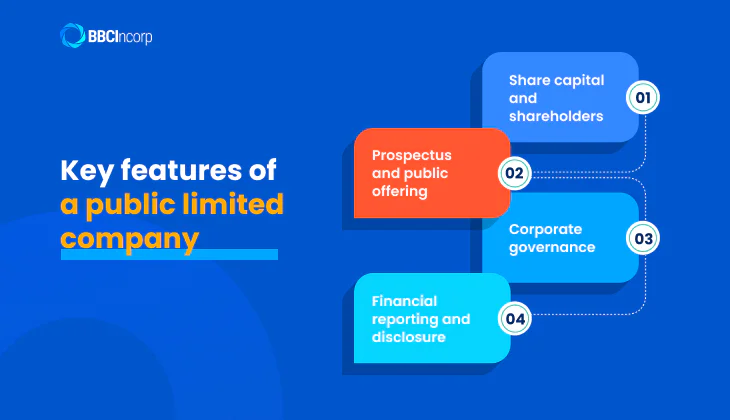
Public limited companies are governed by specific rules and practices. The key features of a PLC in Hong Kong include:
Share capital and shareholders
Hong Kong PLCs can have an unlimited number of shareholders. The introduction of no-par-value shares removes a fixed minimum capital requirement, although sufficient funds are usually needed to support business and ongoing compliance.
Prospectus and public offering
Before offering shares publicly, a PLC must prepare and register a prospectus with the Companies Registry. This ensures accurate disclosure, with directors held liable for any misleading information.
Corporate governance
A board of directors and a company secretary are required. In Hong Kong, the secretary must be a resident locally or operate through a Hong Kong-based entity, supporting compliance with governance standards.
Financial reporting and disclosure
PLCs must publish audited financial statements and report key information to shareholders, including directors’ reports, principal risks, and business plans. These requirements strengthen transparency and investor protection.
These elements set a public company limited by shares apart from private companies. Thus, for global entrepreneurs, the PLC Hong Kong structure creates a clear path to global growth, funding, and public investment.
Benefits of a public limited company
Forming a public limited company (PLC) offers powerful advantages for entrepreneurs, especially when based in a dynamic environment like Hong Kong. These benefits combine access to capital, enhanced market credibility, strategic flexibility, and strong legal protection.
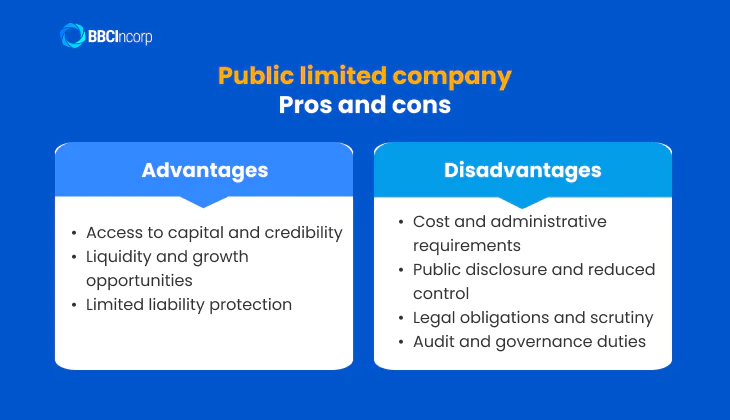
Access to capital and credibility
One of the most compelling benefits of a public limited company is the ability to raise substantial funds through a public offering. By selling shares to a broad investor base, a PLC can tap into both institutional and retail capital.
In 2024, for example, Hong Kong’s IPO market saw 71 new listings that raised approximately HK$87.5 billion, representing a year-on-year increase of 89%.
Beyond capital, being listed enhances a company’s credibility. The rigorous disclosure, mandatory audited financial statements, and annual regulatory oversight promote trust among investors, partners, and customers. As a publicly traded company, a PLC signals transparency and stability.
Liquidity and growth opportunities
Publicly traded shares give shareholders significant liquidity. Investors can buy, hold, or sell shares more easily in secondary markets. The liquidity makes the company more attractive to investors and supports a strong, engaged shareholder base.
Moreover, a PLC enjoys flexibility in pursuing growth. Through mergers, acquisitions, or joint ventures, it can utilize its shares as a form of currency. Being publicly listed also provides a powerful platform to rapidly and effectively expand into new markets or sectors.
Limited liability protection
A core advantage of the public limited company structure is limited liability. Shareholders’ financial exposure is confined to their investment in the company’s shares.
They do not bear personal liability for the company’s debts or liabilities. This protection encourages broader participation from both institutional and retail investors, as it limits the downside risk of equity investment while preserving the upside potential.
In sum, the benefits of a public limited company include stronger access to capital, enhanced reputation, liquidity for shareholders, and the protection of limited liability.
In the case of global entrepreneurs, establishing a public company in Hong Kong creates a robust foundation for scaling, attracting serious investors, and building a credible, high-growth enterprise.
Disadvantages and obligations of a public limited company
A public limited company (PLC) fosters growth potential but carries notable responsibilities that entrepreneurs must consider.
Cost and administrative requirements
Establishing and running a PLC in Hong Kong involves significant expenses. Businesses will require professional services such as auditors, company secretaries, and legal advisors to meet their statutory obligations. Regular filings, annual general meetings, and submission of audited accounts create ongoing administrative work and operational costs.
Public disclosure and reduced control
Public companies are required to release detailed financial statements, directors’ reports, and other shareholder information. As a result, it can limit privacy for founders and executives. In addition, widely held ownership increases the risk of takeovers or activist shareholder influence, potentially reducing management’s control.
Legal obligations and scrutiny
As mentioned earlier, Hong Kong PLCs must comply with the Companies Ordinance and the Securities and Futures Commission rules.
Companies are required to provide disclosure of material information, maintain corporate governance standards, and file annual returns on schedule. Non-compliance can result in penalties or legal action, with directors and officers potentially held personally accountable.
Audit and governance duties
A PLC must produce audited financial statements each year and hold shareholder meetings to approve reports and corporate plans. These obligations demand careful financial oversight and governance attention.
Overall, while the advantages of a public limited company are considerable, operating one requires substantial investment, transparency, and compliance. Entrepreneurs should balance these responsibilities with growth objectives before choosing this corporate structure.
Types of public limited companies in Hong Kong
Hong Kong law recognises two main forms of public limited companies under the Companies Ordinance (Cap. 622). Each serves distinct purposes, helping entrepreneurs select the structure that fits their goals.
Public company limited by shares
A public company limited by shares issues tradable shares, allowing it to raise capital from the public investors. It is particularly suited for large enterprises aiming to list on the Hong Kong Stock Exchange, offering access to a broad range of funding sources and enhancing corporate credibility.
Key points include:
- Shareholders’ liability is limited to the unpaid portion of their shares.
- Suitable for multinational corporations, listed holding companies, and large industrial or technology firms.
- Enables liquidity, strategic growth, mergers, and acquisitions.
- Requires disclosure of audited financial statements and adherence to corporate governance standards.
Public company limited by guarantee
A public company limited by guarantee does not issue shares and is typically adopted by non-profit, charitable, or professional organizations. The members commit to a nominal guarantee in the event of winding up.
Below are several key features:
- Members’ liability is limited to the agreed guarantee amount.
- Focuses on social, educational, or professional objectives rather than profit.
- Requires transparent governance and reporting to members and regulators.
- Commonly used by charities, clubs, and professional associations.
Therefore, determining the most suitable structure should be based on whether the intended Hong Kong operation is a commercial, profit-oriented business or a non-profit organization focused on public benefit, or a specific cause.
What is the difference between Pvt Ltd and Public Ltd?
Entrepreneurs in Hong Kong must decide between establishing a private limited company and a public limited company, depending on growth objectives, capital needs, and regulatory preferences.
While both offer limited liability, they differ significantly in ownership, fundraising, and compliance requirements.
Ownership and share transferability
Private limited companies restrict the transfer of shares, which requires approval from existing shareholders.
In contrast, a public company listed company allows shares to be freely traded on the stock exchange, enabling a diverse shareholder base. It’s important to note that this decision may dilute founders’ control over major decisions.
Capital structure and fundraising
Funding for private companies usually comes from internal resources, angel investors, or venture capital. They cannot solicit public investment, which may limit their ability to expand. Public limited companies, however, can raise capital by issuing shares to the public, providing access to substantial funds for growth, acquisitions, or research and development.
This is why many Hong Kong firms begin privately and later convert to a PLC in Hong Kong.
Compliance, transparency, and regulation
Private companies benefit from simpler reporting and lower administrative burdens.
Public companies are required to comply with stricter governance standards, publish audited financial statements, and submit annual reports to regulators and shareholders. These requirements increase structural complexity but also enhance credibility and investor confidence.
Examples and suitability
Startups and small enterprises often begin as private limited companies to retain control and reduce costs. As businesses grow, attract institutional investors, or plan a stock exchange listing, converting to a PLC Hong Kong becomes the right choice.
To better help you navigate these differences, here’s a comparison table:
| Feature | Private Limited Company | Public Limited Company (PLC) |
|---|---|---|
| Ownership | Share transfers restricted; control remains with founders or selected investors | Shares freely tradable on the stock exchange; ownership widely dispersed |
| Capital raising | Relies on internal funds, angel investors, or venture capital | Can raise capital publicly through share issuance, IPOs, and secondary offerings |
| Compliance | Simplified reporting, lower administrative burden | Strict audit, governance, and disclosure requirements; annual reports and filings are mandatory |
| Investor perception | Limited external credibility; suitable for early-stage growth | Enhanced credibility; attracts institutional and retail investors |
| Suitability | Startups and small to medium enterprises seeking control and cost efficiency | Large enterprises planning to scale, access public funding, or list on a stock exchange |
Incorporating a public limited company in Hong Kong
If you’re a global entrepreneur looking to grow your business and get investment, setting up a Public Limited Company brings both credibility and flexibility.
The process can be divided into three main stages: pre‑incorporation planning, incorporation application, and post‑incorporation compliance.
Pre‑incorporation planning & setup
Before submitting your application, it is essential to prepare the company structure and required documents:
Directors and the company secretary
- A public limited company must have at least two directors, who can be individuals but not corporate bodies.
- The company secretary must ordinarily reside in Hong Kong if an individual, or be a Hong Kong-registered corporate entity.
Shareholders and capital
- At least one shareholder is required, which can be an individual or a corporate entity. The issued share capital represents the value of shares actually issued to shareholders at the time of incorporation.
- Hong Kong no longer requires authorised capital, but the company must specify the number, value, and class of issued shares in the Articles of Association, including any special rights.
- Shareholders’ liability is generally limited to the amount unpaid on their shares, protecting personal assets. The company can later issue new shares to raise additional funds, subject to shareholder approval.
Statutory documents: Prepare the Articles of Association to clearly define governance rules, shareholder rights, and company procedures.
Incorporation application
To move from planning to formal registration, follow these steps:
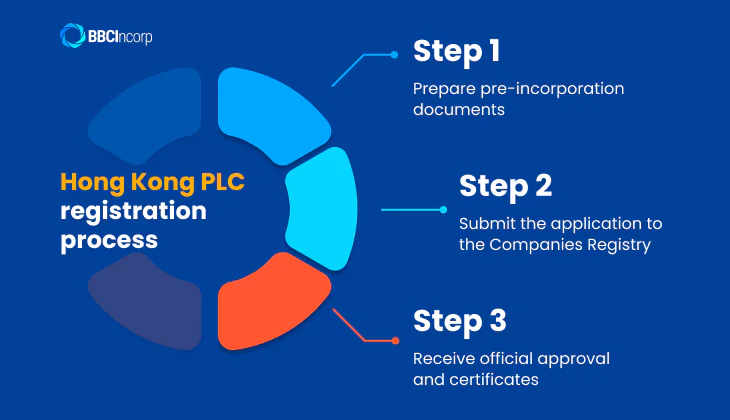
Step 1: Prepare pre-incorporation documents
The first step is to gather and prepare all necessary pre-incorporation documents. Start by completing the NNC1 form (or equivalent) with accurate details of the directors, shareholders, and company secretary. Then, you must draft the Articles of Association.
Next, prepare any required statutory declarations or supporting documents, and carefully review everything before applying.
Step 2: Submit the application to the Companies Registry
Once the documents are ready, submit them to the Companies Registry. During this process, the Registrar will review your application and may request clarifications or additional information.
Therefore, it is important to respond promptly to any requests, which helps avoid unnecessary delays and smooths the approval process.
Step 3: Receive official approval and certificates
After the Companies Registry approves your submission, you will receive the Certificate of Incorporation, officially confirming your company’s legal existence.
Additionally, you will obtain the Business Registration Certificate under the Business Registration Ordinance.
These certificates are essential for opening corporate bank accounts, signing contracts, and fulfilling statutory compliance obligations. They must be safely stored for future reference.
Post‑incorporation compliance
After incorporation, maintaining compliance is essential to ensure your PLC Hong Kong operates legally and efficiently:
- Annual returns: File within 42 days after the return date, which is six months after the end of the accounting reference period. Returns must include audited financial statements, the directors’ report (including a business review if required), and the auditor’s report.
- Statutory filings and changes: Update the Companies Registry within 15 days for any changes in directors, company secretary, or other officeholders.
- Fees and penalties: On-time filing incurs a base fee of HK$140, while late submissions carry higher fines, up to HK$4,800.
- Corporate governance: Conduct regular board and shareholder meetings, maintain statutory registers, conduct annual audits, and implement financial control systems.
By carefully following these stages, entrepreneurs can establish a compliant and credible public limited company in Hong Kong.
Expert support from BBCIncorp for your public limited company registration
Setting up a public limited company in Hong Kong can be complex, particularly for businesses planning to go public or expand internationally. BBCIncorp provides professional corporate services that simplify the process with full compliance.
With extensive experience in company formation in Hong Kong, we assist entrepreneurs with company incorporation, bank account opening, preparation and filing of statutory documents, annual reporting, and more.
By working with us, clients can gain expert step-by-step guidance, monitor the process through our online Client Portal at any time, and save valuable resources for your venture.
In addition, we offer customized solutions to support capital raising, scale expansion, and international growth across over 18 jurisdictions.
Start your journey with a trusted global company service provider. Register a company in HK with BBCIncorp today and take the first step toward building your Hong Kong limited company.
Conclusion
In conclusion, a public limited company gives entrepreneurs a solid platform for expansion by enabling access to broader investment, greater market presence, and a structure designed for long-term growth.
Understanding the PLC meaning, its ownership framework, disclosure duties, and its distinction from private companies helps entrepreneurs evaluate whether this model aligns with their strategy. And in Hong Kong, favourable regulations for PLCs make the jurisdiction an attractive environment for business development.
With complex compliance requirements involved, BBCIncorp delivers the expert support needed to move from concept to full incorporation with confidence. Our team positions your PLC Hong Kong for credibility and future success.
Reach out to us at service@bbcincorp.com with your needs and receive timely support now.
Reference:
(1) https://www.hkex.com.hk/-/media/HKEX-Market/Market-Data/Statistics/Consolidated-Reports/Annual-Market-Statistics/2024FY-Ann-Mkt-Stat_eng.pdf
Frequently Asked Questions
What’s the difference between a PLC and an LTD?
A public limited company (PLC) can offer shares to the public and may list on a stock exchange, giving it access to broader capital.
A private limited company (LTD) restricts share transfers to a smaller group and cannot trade publicly. PLCs require at least two directors, have stricter reporting rules, and often a minimum share capital, while LTDs have simpler governance and lower regulatory obligations.
Both structures limit shareholders’ liability, but PLCs face higher transparency and disclosure standards. Hence, PLCs are more suitable for businesses aiming to scale or raise public investment.
How do public limited companies get their funding?
Public limited companies raise capital primarily through an Initial Public Offering (IPO), issuing shares to public investors.
After listing, they can conduct secondary share offerings or private placements to institutional investors. Some PLCs also issue bonds or debt securities to raise additional funds. These methods provide access to large-scale capital for growth, mergers, or acquisitions.
Can a PLC turn into a Private LTD?
Yes, a PLC can convert to a private limited company. This involves passing a special shareholder resolution, reducing issued share capital if required, and updating the company’s constitution. The company must then submit the appropriate forms to the corporate regulator (e.g., Form RR02 in the UK) to re-register as an LTD.
After conversion, share transfers become restricted, regulatory obligations are simplified, and the company operates as a private entity, while maintaining limited liability for its shareholders.
Disclaimer: While BBCIncorp strives to make the information on this website as timely and accurate as possible, the information itself is for reference purposes only. You should not substitute the information provided in this article for competent legal advice. Feel free to contact BBCIncorp’s customer services for advice on your specific cases.
Industry News & Insights
Get helpful tips and info from our newsletter!
Stay in the know and be empowered with our strategic how-tos, resources, and guidelines.