Hong Kong incorporation fee & Aspire
 cashback.



Table of Contents
Choosing the best jurisdictions for offshore company formation in 2026 depends on your business purpose, target market, banking needs, tax position, and compliance capacity.
Hong Kong and Singapore suit Asia-facing businesses, BVI and Cayman remain popular for holding and investment structures, while UAE/RAK, Cyprus, Seychelles, Belize, and Panama serve different strategic needs.
This guide compares the top 9 offshore jurisdictions to help you choose a structure that fits your business goals.
Key Takeaways
- The best offshore jurisdiction depends on business purpose, banking needs, tax position, compliance capacity, and target market.
- This guide compares 9 offshore jurisdictions: Hong Kong, Singapore, British Virgin Islands, Seychelles, Cayman Islands, Belize, Panama, RAK/UAE, and Cyprus.
- Hong Kong and Singapore are strong options for Asia-facing trading, ecommerce, fintech, and regional business expansion.
- BVI, Cayman Islands, Seychelles, Belize, and Panama are commonly considered for holding, asset protection, private wealth, investment, and international structuring.
- RAK/UAE and Cyprus may suit businesses seeking Middle East or EU market access, but tax and compliance rules should be reviewed carefully.
- Before incorporation, compare tax treatment, banking feasibility, setup cost, maintenance obligations, reputation, and economic substance requirements.
Factors to consider when choosing your offshore jurisdiction
There are many things to consider before determining the best place for your offshore company. Below are some helpful questions for your self-check:
| Key factor | What to check before choosing an offshore jurisdiction |
| Business purpose | What are your expected benefits? Does the offshore location meet your needs? How to form the best offshore in the world? |
| Jurisdiction reputation | Does that offshore location have a stable economy, politics, legislative system, and corporate laws? Is it included in the “blacklist” or “grey list” by the EU Council? |
| Taxation | Are there any special taxes or exempted status imposed on offshore companies? Under what circumstances may your company be liable to tax? |
| Entity structure | How many structures are available? Can you choose that business structure (e.g. IBC, LLC, Pte, or Ltd) in that jurisdiction? |
| Setup and maintenance cost | How much is the incorporation cost? Which countries offer the lowest incorporation cost? Are there additional fees? |
| Compliance requirements | How much is the incorporation cost? Which countries offer the lowest incorporation cost? Are there additional fees? |
| Banking and payment access | Do you need a corporate bank account to run your business in that jurisdiction? What are the options available? Does the country’s banking system allow the opening of offshore debit or credit cards, merchant accounts, or cryptocurrency accounts? |
| Processing time and local requirements | How long does it take to incorporate your company in that offshore jurisdiction? When moving offshore, are there any residency requirements for your company directors, shareholders, or company secretary? |
| Tax treaty access | Does that offshore country have any signed double taxation agreements or tax treaties that can apply to your corporation? Based on these inquiries, which countries are the top choices for establishing an offshore company? Let’s move on to the next section! |

Start your offshore business with ease!
Reach out to our team now for more support on setting up an offshore business.
Types of offshore jurisdictions by tax profile
Tax is often one of the first factors entrepreneurs consider when choosing where to incorporate an offshore company. However, offshore jurisdictions should not be assessed by tax rate alone. Businesses also need to review compliance requirements, accounting records, beneficial ownership rules, economic substance obligations, banking access, and treaty availability.
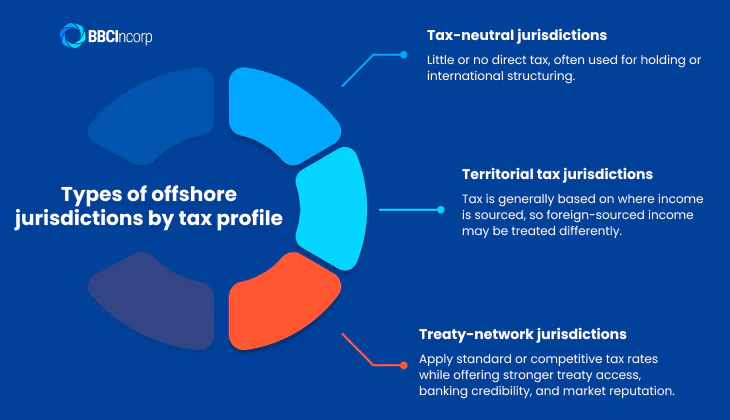
Tax-neutral jurisdictions
Some offshore jurisdictions do not impose conventional corporate income tax, capital gains tax, or withholding tax on certain types of companies or income. These jurisdictions are often used for holding, asset protection, investment, or international structuring purposes.
However, tax-neutral does not mean compliance-free. Companies may still need to maintain accounting records, pay annual government or registered agent fees, file annual returns or financial information, and comply with beneficial ownership, KYC, and economic substance requirements where applicable.
Territorial tax jurisdictions
Some jurisdictions tax companies based on where income is sourced. In these jurisdictions, foreign-sourced income may be treated differently from locally sourced income, but the exact tax outcome depends on the company’s activities, source of income, substance, and local tax rules.
Treaty-network jurisdictions
Other jurisdictions apply standard or competitive corporate tax rates while offering stronger treaty access, banking credibility, and market reputation. Examples may include Switzerland, Luxembourg, Ireland, and the Netherlands. These jurisdictions are often selected not only for tax efficiency, but also for double taxation treaty access, commercial reputation, and cross-border business planning.
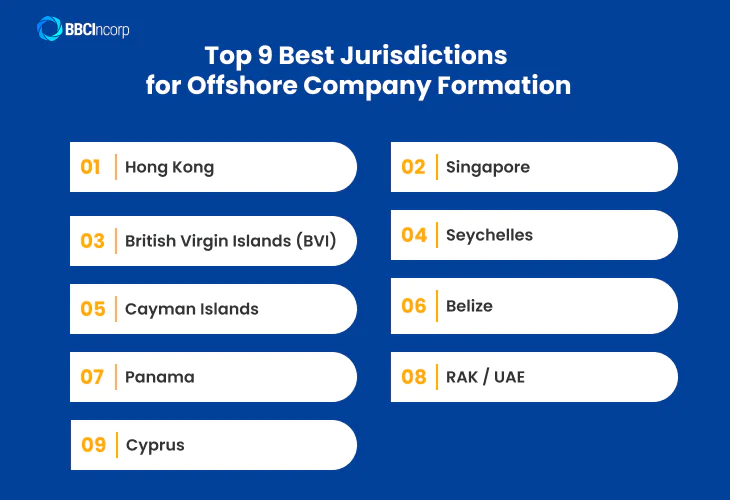
Top 9 best jurisdictions for offshore company formation
The best offshore jurisdiction depends on the company’s commercial purpose. A trading company may prioritize banking access, while a holding company may value flexible corporate law.
A fund structure may need Cayman, while an Asia-focused business may prefer Hong Kong or Singapore.
| Jurisdiction | Company Type | Corp. Tax | Setup Cost (USD) | Banking Access | Incorporation Speed | Best For |
| Hong Kong | Private Limited Company | 8.25% / 16.5%; offshore profits may be non-taxable | From US$ 899 | Excellent | 3–5 business days | APAC trading, ecommerce, China gateway, banking hub |
| Singapore | Private Limited Company | 17%; exemptions may reduce effective tax | From US$ 2,199 | Excellent | 1–3 business days | APAC credibility, fintech, treaty access, regional HQ |
| British Virgin Islands (BVI) | Business Company (BC) | 0% | From US$1799 | Moderate | 2–3 business days | Holding, asset protection, investment structures |
| Seychelles | IBC | Territorial; foreign-source income generally not taxable | From US$999 | Limited–Improving | 24–48 hours | Budget holding, e-commerce, consultancy |
| Cayman Islands | Exempted Company / LLC | 0% direct tax | From US$2999 | Moderate–High | 2–3 business days | Funds, SPVs, private equity, institutional investors |
| Belize | Business Company (BC) / LLC | Case-specific; review tax and substance position | From US$1059 | Improving | 24–48 hours | Asset holding, private wealth, selected international structures |
| Panama | Corporation (S.A.) | Territorial; foreign-source income generally not taxed | From US$1699 | Moderate | 3–5 business days | Latin America gateway, holding, international structuring |
| RAK / UAE | RAK ICC / Free Zone Company | 0% only for qualifying free zone income; 9% may apply | From US$2999 | Good | 3–7 business days | Middle East access, trading, consultancy, holding |
| Cyprus | Private Company Limited by Shares | 15% from 2026 | From US$2999 | Moderate | Few working days | EU access, trading, holding, professional services |

Disclaimer
This article is published by BBCIncorp, which offers company formation services across the jurisdictions listed above.
Hong Kong
Hong Kong is listed among the most ideal countries for offshore company formation because of its strong international reputation and beneficial business schemes, including:
- 100% of foreign ownership
- Business-friendly tax regime: Qualifying foreign-sourced profits may be exempt from Hong Kong profits tax, subject to the applicable rules, low tax rate from 8.25% to 16.5%(1) .
- No VAT/GST, no capital gains tax in the ordinary sense, and generally no withholding tax on dividends
- No exchange controls
- Open trade policy, competitive economy, the independent legal system
- Financial hub with 75 out of the 100 largest banks in the world
- Ease of access and entry point to mainland China
Among many choices, a Private Limited Company is the most common entity type in Hong Kong among start-ups, entrepreneurs, and those looking to form international trading businesses.
Advantages
- Shareholder’s liability is limited to the number of shares
- Any change in the company’s shareholders does not impact the existence of the company
- The company can enter contracts, acquire assets, sue or be sued under its name
- Transfer of ownership can be done wholly or partially by selling or releasing the shares
Disadvantages
- The company needs to fulfill compliance requirements on an annual basis with CR and IRD
- The identity information of shareholders and directors must be disclosed to the public
- Maintenance and dissolution for Hong Kong limited company are quite complicated
Planning to set up an offshore business in Hong Kong?
Contact us today for tailored guidance.
Singapore
Singapore is another fast-growing commercial center in Asia. It is also known as the promised land for start-ups, entrepreneurs, and investors in terms of commodity trading and wealth management.
Some key highlights of Singapore’s business nature are:
- Transparent tax scheme: Singapore generally taxes income accruing in or derived from Singapore, as well as certain foreign-sourced income received in Singapore, subject to applicable exemptions and tax rules; the corporate income tax is capped at a rate of 17%(2) .
- Singapore has DTAs, limited DTAs and EOI arrangements with around 100 jurisdictions.
- Partial tax exemption schemes and various incentives for startups and investors, especially in fintech and technological innovation industries
- Top-notch banking systems
- High-skilled workforce, beneficial visa schemes for foreigners
A Private Limited Company is the most popular option here. Either individuals or body corporate can be shareholders of a Singapore private limited company.
Advantages
- Shareholder’s liability is limited only to their shares
- The company can own property, enter contracts under its name
- Any change of members does not impact the existence of the company
- The ownership can be transferred completely or partly by transferring to another
- The company can enjoy many tax schemes for tax reduction
Disadvantages
- Follow annual compliance requirements with ACRA and IRAS
- Maintain accounting and other relevant documents
Looking to establish an offshore business in Singapore?
Get in touch with us today!


British Virgin Islands (BVI)
The British Virgin Islands (BVI) is a well-known offshore jurisdiction, often chosen for its straightforward company setup, cost efficiency, and flexible business environment. It is commonly used by foreign investors for offshore investments, international trading, holding purposes, savings, and other cross-border business activities.
The BVI Business Company (BVI BC) remains one of the most popular structures for international entrepreneurs seeking favorable tax treatment and relatively reduced compliance requirements.
Advantages
BVI offers several benefits for offshore company formation, including:
- Generally no corporate income tax on ordinary BVI business company profits, subject to applicable rules
- Relatively simple company setup and administration
- USD used as an official currency
- No currency exchange control
- No general annual meeting requirement
- No general public filing of audited financial statements for ordinary BVI Business Companies
- High level of confidentiality compared with jurisdictions such as Hong Kong and Singapore
- Beneficial owner, director, and shareholder information is generally disclosed only to the Registrar, registered agent, or competent authorities where required
Disadvantages
Although BVI companies benefit from a relatively flexible regime, they are not free from compliance obligations. Companies must maintain proper accounting records and generally file an annual financial return with their registered agent unless an exemption applies.
In addition, banking can require detailed due diligence, including information on business activities, ownership structure, source of funds, and expected transaction flows. BVI companies may also need to review economic substance obligations depending on their activities.
Seychelles
Seychelles is a well-known offshore jurisdiction, commonly used for international business, asset holding, investment structuring, and cost-efficient offshore company formation. The most common structure for foreign entrepreneurs is the International Business Company (IBC).
However, Seychelles should no longer be described as a purely “tax-exempt IBC” jurisdiction. The tax exemption clause under the IBC Act has been removed, and Seychelles has moved toward a territorial tax system. Only IBCs deriving “Assessable Income” in Seychelles are required to submit annual returns and audited accounts to the FSA.
Advantages
- Suitable for international trading, holding, asset management, and simple offshore structures.
- Seychelles follows a territorial tax approach, where only Seychelles-sourced income is generally taxable.
- IBCs may be used for international business activities, subject to compliance with the International Business Companies Act.
- Formation and maintenance costs are often more accessible than higher-cost offshore financial centres.
- Seychelles has a dedicated Financial Services Authority overseeing IBCs and offshore service providers.
- Only IBCs with Seychelles assessable income are required to submit annual returns and audited accounts to the FSA.
Disadvantages
- Seychelles IBCs must maintain accounting records; the FSA has emphasized that accounting information must be available to competent authorities upon request.
- Beneficial ownership information must be maintained under Seychelles’ beneficial ownership framework.
- Seychelles should not be described as a fully tax-free or no-compliance jurisdiction.
- Banking may require detailed KYC, source-of-funds evidence, and proof of business activity.
- Regulated activities such as financial services, securities, insurance, gambling, or virtual asset services may require additional licensing.
- IBCs deriving assessable income in Seychelles may face annual return and audited account obligations.
Cayman Islands
The Cayman Islands is one of the best country to set up an offshore company, especially for investment funds, private equity structures, securitization vehicles, asset holding, and cross-border investment arrangements.
Known as a leading offshore financial hub, the Cayman Islands offers a stable legal environment, strong professional services ecosystem, and tax-neutral framework. A Limited Liability Company (LLC) is one commonly used structure, although exempted companies and exempted limited partnerships are also widely selected depending on the business purpose.
Advantages
- No conventional direct corporate income tax, capital gains tax, withholding tax, or income tax.
- No general foreign exchange controls.
- Strong reputation in offshore fund formation, private equity, and institutional investment structures.
- Flexible entity options, including LLCs, exempted companies, and exempted limited partnerships.
- Well-established legal and financial services infrastructure.
- Suitable for asset protection, investment holding, securitization, fund structuring, and international commercial arrangements.
Disadvantages
- Cayman entities are still subject to government registration and annual renewal fees, which vary by entity type and share capital.
- Ongoing compliance may include annual filings, economic substance notification, CRS/FATCA reporting, and record-keeping obligations.
- Regulated funds, financial entities, and investment vehicles may face additional licensing, reporting, or regulatory requirements.
- Banking and investor onboarding may require detailed KYC, source-of-funds documents, and business activity evidence.
- Tax exposure may still arise in the company owner’s country of residence, investor jurisdictions, or operating markets.
Belize
Belize remains a notable offshore jurisdiction for overseas businesses, high-net-worth individuals, and international investors seeking a cost-effective and efficient place to establish an international structure.
The jurisdiction is known for its relatively competitive formation costs, straightforward incorporation process, and business-friendly legal environment. However, Belize should no longer be described purely as a traditional IBC jurisdiction.
Following the Belize Companies Act 2022(3) , former International Business Companies and local companies are now recognized under one unified legal status as “Belize companies,” with the same rights and obligations.
For foreign entrepreneurs, a Belize company may still be suitable for selected offshore structures. An LLC can also be considered as an alternative, especially where the business wants a different structure from the standard company model.
Advantages
- Straightforward and relatively fast incorporation process.
- Competitive company formation costs compared with some offshore jurisdictions.
- Stable legal and judicial framework.
- Privacy-oriented corporate environment for directors and shareholders.
- English-speaking business environment.
- Banking sector that may support remote account opening and lower deposit requirements, depending on the bank and applicant profile.
- Suitable for international investors, private wealth planning, and selected offshore business structures.
Disadvantages
- Belize should no longer be positioned simply as a classic IBC jurisdiction after the Belize Companies Act 2022.
- Former IBCs and local companies now share a single legal status as Belize companies, which may require clearer explanation for readers.
- Tax treatment, compliance obligations, banking feasibility, and economic substance exposure should be reviewed before incorporation.
- Privacy and banking access are not automatic, as banks and service providers may still require KYC, source-of-funds documents, and business activity details.
- LLCs may be an alternative, but their suitability should still be assessed based on the company’s activities and long-term structure.
Panama
Panama remains a relevant jurisdiction for offshore company formation, particularly for entrepreneurs and investors seeking a territorial tax system and a flexible corporate structure. Under Panama’s tax regime, income generated outside Panama is generally not subject to Panamanian corporate income tax.
A Panama corporation is commonly used for international trading, holding activities, asset management, and cross-border business structuring. However, it should not be presented as a maintenance-free offshore option, as companies must still meet local corporate and record-keeping obligations.
Advantages
- Territorial tax system, where foreign-source income is generally not subject to Panama corporate income tax.
- Suitable for international business, asset holding, and offshore structuring.
- Directors may generally be of any nationality and do not need to reside in Panama.
- No universal audit requirement for all Panama corporations.
- Flexible corporate framework for foreign investors.
Disadvantages
- A Panama corporation typically requires at least three directors.
- Companies must maintain accounting records and supporting documents.
- Compliance obligations may apply even if the company does not conduct business in Panama.
- Banking and onboarding may require KYC, source-of-funds documents, and business activity evidence.
- Panama’s offshore reputation may require careful positioning for banking, investors, and partners.
RAK/UAE
Ras Al Khaimah, commonly known as RAK, is one of the seven emirates of the United Arab Emirates and is recognized as a fast-growing destination for foreign investors and business owners.
With a strong industrial base and access to the UAE business environment, RAK is often considered for holding companies, consultancy businesses, financial service structures, investment activities, and international trading.
For foreign entrepreneurs, an International Business Company can be a suitable structure in RAK, especially for those seeking flexible ownership, international operations, and a relatively fast incorporation process.
Advantages
RAK company formation offers several benefits for international business owners, including:
- 100% foreign ownership
- Potential tax neutrality for foreign-sourced earnings, subject to applicable UAE tax rules
- No requirement to use a specific currency as company capital
- No general restriction on bank transfers and share capital deposits
- Confidentiality regarding the register of company members
- Limited public filing requirements may apply
- Fast incorporation, often within 1 to 2 working days, subject to approval and documentation
Disadvantages
RAK companies should not be viewed as entirely free from compliance obligations. Although public filing requirements may be limited, companies must still maintain proper accounting records and comply with applicable annual renewal, annual return, KYC/UBO, Economic Substance, and UAE Corporate Tax obligations where relevant.
In addition, activities such as financial services, mainland UAE trading, or regulated business operations may require further licensing, review, or approval before the company can operate.
Notice of Economic Substance Requirements
Effective from 1 January 2019, several offshore countries including the Cayman Islands, the BVI, Belize, and RAK have enacted Economic Substance Rules.
If your incorporated company (e.g. IBCs, LLCs, LLP, other than a domestic company, under the respective laws) falls under the in-scope entities of Economic Substance in those jurisdictions, your company must comply with reporting requirements and tax obligations (if applicable).
Cyprus
Cyprus is a suitable jurisdiction for businesses seeking access to the European Union, especially for companies involved in regional trading, holding structures, professional services, and cross-border operations. It has been an EU member since 2004 and part of the Eurozone since 2008.
Cyprus has traditionally been known for its competitive corporate tax environment. From 1 January 2026, the standard corporate income tax rate increased from 12.5% to 15%(4) , which remains competitive within the EU context but should be presented accurately.
Advantages
- EU and Eurozone access for companies planning to operate or trade in Europe.
- Competitive corporate tax rate of 15% from 2026.
- Suitable for holding, trading, consulting, and international service structures.
- VAT registration and VIES access may support intra-EU business where applicable.
- No broad minimum capital requirement for common private company structures.
Disadvantages
- Cyprus is not excluded from AEOI; it participates in CRS and automatic exchange of financial account information.
- Banks and financial institutions apply KYC, tax residency checks, and reporting obligations.
- VAT registration is not automatic and depends on the company’s activities and applicable thresholds.
- EU compliance, accounting, tax filing, and substance expectations should be reviewed before incorporation.
- Certain regulated activities or business models may require licensing or additional capital requirements.
Conclusion
The best jurisdictions for offshore company formation in 2026 are not chosen by tax rate alone. Hong Kong and Singapore work well for Asia-facing businesses, BVI and Cayman remain useful for holding and investment structures, UAE/RAK supports Middle East operations, and Cyprus can serve EU-facing companies.
Before incorporating, compare the jurisdiction’s tax rules, compliance burden, banking feasibility, reputation, and substance requirements. BBCIncorp can help you choose the right jurisdiction, form the company, prepare KYC documents, and support ongoing compliance through a single advisory process.
Contact BBCIncorp via service@bbcincorp.com to start your offshore company formation with a structure that fits your business goals and compliance obligations.
————————————————————————-
References:
- (1) Fstb.gov.hk – On the Treasury Front: https://www.fstb.gov.hk/en/treasury/general/prevailing-tax-policy.htm
- (2) Iras.gov.sg – List of DTAs, Limited DTAs and EOI Arrangements: https://www.iras.gov.sg/taxes/international-tax/international-tax-agreements-concluded-by-singapore/list-of-dtas-limited-dtas-and-eoi-arrangements?pg=1&indexCategories=all
- (3) Belizefsc.org.bz – Enactment of the Belize Companies Act, 2022: https://www.belizefsc.org.bz/wp-content/uploads/2022/08/05AUG22newcompaniesact_FINAL-1.pdf
- (4) Gov.cy – Cyprus annual progress report 2026: https://www.gov.cy/media/sites/11/2025/05/CY-APR-2026-Final.pdf
Frequently Asked Questions
What is the best jurisdiction for offshore company formation in 2026?
The best jurisdiction depends on your business purpose. Hong Kong and Singapore are strong for Asia-facing businesses, BVI and Cayman are common for holding and investment structures, UAE/RAK supports Middle East operations, and Cyprus is suitable for EU-facing companies.
The right choice should balance tax, banking, compliance, reputation, and market access.
Is BVI still a good jurisdiction for offshore companies?
Yes, BVI can still be suitable for holding, investment, and asset structuring. However, it should not be treated as a no-maintenance jurisdiction. Companies should review annual financial return requirements, registered agent obligations, beneficial ownership rules, and economic substance classification before choosing BVI.
Is Singapore considered an offshore jurisdiction?
Singapore is not a classic offshore tax haven, but it is often used by foreign founders for international business structuring. It offers strong banking credibility, a 17% corporate tax rate, tax exemption schemes for eligible companies, and a trusted legal environment.
It is usually best for real operations, regional headquarters, startups, and trading companies.
Is UAE / RAK tax-free for offshore companies?
Not automatically. UAE Corporate Tax now applies under the federal regime, and a 0% result for free zone companies depends on qualifying conditions. A company must review its income type, business activity, substance, audited accounts, and compliance status before assuming any tax benefit.
Which offshore jurisdiction is best for investment funds?
Cayman Islands is often preferred for investment funds, private equity, and sophisticated investment vehicles because investors and professional advisers are familiar with its legal framework.
BVI can also be used for certain holding or investment structures, but Cayman is generally stronger for fund-specific use cases.
Should I choose the cheapest offshore jurisdiction?
No. The cheapest jurisdiction is not always the best. Low setup cost can be offset by banking delays, compliance risks, tax uncertainty, or poor reputation with counterparties. A better approach is to compare total maintenance cost, banking feasibility, legal certainty, compliance obligations, and business purpose.
Do offshore companies need economic substance?
Some offshore companies need to assess economic substance requirements, especially if they conduct relevant activities such as holding, headquarters, distribution, service center, finance, leasing, fund management, or intellectual property activities. Rules differ by jurisdiction, so the company should be assessed before and after incorporation.
Disclaimer: While BBCIncorp strives to make the information on this website as timely and accurate as possible, the information itself is for reference purposes only. You should not substitute the information provided in this article for competent legal advice. Feel free to contact BBCIncorp’s customer services for advice on your specific cases.
Industry News & Insights
Get helpful tips and info from our newsletter!
Stay in the know and be empowered with our strategic how-tos, resources, and guidelines.