Hong Kong incorporation fee & Aspire
 cashback.


Table of Contents
If you aim to set up a prominent business in Asia, business registration and company registration in Hong Kong can provide a solid foundation. By registering your company with the Companies Registry and obtaining a Business Registration Certificate, you gain formal legal status under Hong Kong law, allowing you to operate in and from the vibrant jurisdiction. In fact, as of March 31, 2025, over 1.47 million local companies have been established in Hong Kong.
Understanding the registration process and requirements is crucial for founders and investors to grow, attract partners, and expand across borders. It ensures that business operations follow clear rules and stand on firm legal ground. Read on below to see how the process works and the benefits it offers.
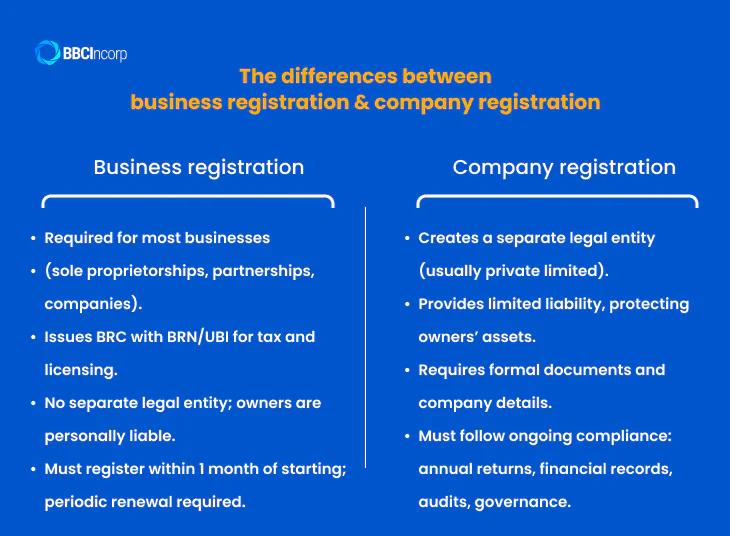
The differences between business registration and company registration
In Hong Kong, business registration and company registration serve distinct purposes, follow different procedures, and carry different legal implications. With the right path, your business will be on a smooth journey to legal compliance, credibility, and satisfying regulatory requirements.
Business registration
Business registration is mandatory for most businesses and is handled by the Business Registration Office under the Inland Revenue Department. It applies to sole proprietorships, partnerships, and companies. The main purpose is to obtain a Business Registration Certificate (BRC), which comes with a Business Registration Number (BRN).
Since December 2023, the Business Registration Number (BRN) also serves as the Unique Business Identifier (UBI) for companies, replacing the older Certificate of Incorporation Number (CRN) for most practical purposes.
It’s important to note that registration must occur within one month of starting operations. Although it grants legal recognition for tax and licensing purposes, the business itself is not a separate legal entity. The owners remain personally liable for debts.
As a further safeguard, compliance also requires BRC renewal every year or periodically in order to continue operations legally.
Company registration
Company registration, or incorporation, is conducted through the Companies Registry under the Companies Ordinance. The incorporation establishes a separate legal entity, typically a private limited company, which protects owners’ personal assets through limited liability.
Legal distinction is a must for entrepreneurs planning to grow, attract investors, or enter into contracts in Hong Kong and internationally while protecting their personal assets.
The Hong Kong company incorporation process requires several formal documents, including the Articles of Association, the memorandum of association, and other statutory forms. Companies must also provide basic details such as registered office address, director and shareholder information, and share capital.
Once incorporated, companies must adhere to ongoing compliance obligations under the Companies Ordinance. This includes submitting annual returns, maintaining proper financial records, conducting statutory audits if required, and following corporate governance standards.
Comparison table between business registration and company registration:
| Aspect | Business registration | Company registration |
| Authority | IRD Business Registration Office | Companies Registry |
| Purpose | Obtain BRC for tax and operations | Form a separate legal entity with limited liability |
| Applicable to | Sole proprietorships, partnerships, companies | Only companies (private limited companies) |
| Legal status | Not separate; owners liable | Separate legal entity; limited liability |
| Timeline | Within one month of starting | Any time during incorporation |
| Documentation | Basic business info + fee | Incorporation documents, including Articles of Association |
| Compliance | Annual or periodic BRC renewal | Annual filings under the Companies Ordinance |
| Identifier | BRN/UBI | BRN/UBI |
As an entrepreneur, it is essential to know these differences to decide whether to simply register a business for operations or incorporate a company to gain legal protection and credibility.
In the next sections, we will delve further into the key features and requirements of business registration of a Hong Kong venture.
What is business registration in Hong Kong?
Business registration in Hong Kong is the formal process of registering a business with the government.
Purpose of the process
Business registration is an official certification of your venture with the Inland Revenue Department (IRD). It is a necessary step to comply with Hong Kong taxation and regulatory requirements, granting recognition that allows legal operation, access to administrative services, and eligibility for financial and commercial transactions.
Information required for registration
Applicants must submit a prescribed application form and pay the applicable fee and levy. The necessary information generally includes:
- The business name
- The official registered address
- Nature of the business
In the case of sole proprietors or partners, you must submit valid identity documents. For partnerships, the details of all partners are required. For companies, you can register your business and submit incorporation documents as part of a one-stop process. Most importantly, business owners must maintain accuracy in all fields to prevent delays or administrative issues.
Compliance requirements
After registration, you will receive a Business Registration Certificate, which must be displayed at the registered address. The certificate allows:
- Opening bank accounts
- Signing contracts under the business name
- Applying for trade licences if needed
- Annual or periodic renewal of the certificate
Credibility, legal compliance, and long-term stability can only be assured with proper registration. Therefore, seeking detailed guidance from local experts right from the start is highly recommended.
What is company registration in Hong Kong?
As mentioned, company registration in Hong Kong is the process of forming a separate legal entity through the Companies Registry.
Purpose of the process
Unlike business registration, which records a business for tax and administrative purposes, company registration creates a distinct structure that can own assets, sign contracts, and carry liabilities in its own name.
This legal foundation is governed by the Companies Ordinance and is the preferred route for entrepreneurs who seek credibility, protection, and long-term growth potential.
Information required for registration
The incorporation process requires several key documents and details. First, applicants must provide:
- The proposed company name
- A registered office address in Hong Kong
- Identification information for all directors and shareholders
- The Articles of Association
- Details of the share capital structure
- Information on the appointed company secretary
Once the Companies Registry approves the application, the company receives a Certificate of Incorporation, which serves as official proof of its establishment and legal status. Notably, the certificate of incorporation document is required for opening corporate bank accounts, applying for licences, and maintaining compliance.
Advantages of company registration
Registering a company offers several advantages that support long-term growth and operational stability. Limited liability protects the owners’ personal assets, giving entrepreneurs confidence to pursue opportunities without exposing themselves to unnecessary risk. The separate legal entity structure also strengthens credibility, helping the company build trust with banks, clients, suppliers, and potential investors.
A registered company can hire employees, make contracts under its own name, and open corporate bank accounts for managing finances professionally. It can also participate in government programs, tender for larger projects, and access a broader range of business services that are not available to unregistered entities.
In addition, Hong Kong companies benefit from strong international recognition, which makes cross-border operations, partnership development, and fundraising more accessible.
What is the difference between BRN and CRN Hong Kong?
Understanding the difference between a BRN (Business Registration Number) and a CRN (Company Registration Number) is a must for anyone starting or managing a business in Hong Kong. Although both are unique registration numbers, they serve different purposes and are issued by different authorities.
Hong Kong Business Registration Number (BRN)
The BRN is issued by the Business Registration Office under the Inland Revenue Department and is linked to the business registration certificate. It applies to sole proprietorships, partnerships, and companies. The BRN primarily acts as proof that a business is registered for tax and administrative purposes.
Businesses use the BRN for tax filings, issuing invoices, and opening bank accounts. Additionally, the validity of the BRN is tied to the business registration period, which requires renewal annually or periodically.
Hong Kong Company Registration Number (CRN)
The CRN is issued by the Companies Registry and is associated with the certificate of incorporation for limited companies only. It serves as proof of a company’s legal incorporation and existence.
A CRN is used for a wider range of purposes, including tax filings, invoicing, banking, and official legal documents. The CRN remains valid throughout the company’s existence and is an essential identifier for regulatory and compliance matters.
Latest update: Unified Business Identifier (UBI):
In December 2023, Hong Kong introduced the Unique Business Identifier (UBI) system, effectively replacing the CRN for most practical purposes. Today, the BRN also serves as the primary identifier for companies, unifying business and company registration numbers.
To summarize the differences between the current BRN, or UBI, and the CRN, please see the detailed table below:
| Feature | BRN / UBI (current) | CRN / former Company No. |
| Issued by | Business Registration Office / Companies Registry (post‑Dec 2023) | Companies Registry (pre‑Dec 2023) |
| Associated with | Business registration certificate, Certificate of Incorporation | Certificate of Incorporation (historical) |
| Applicable to | All entities – sole proprietorships, partnerships, limited companies | Limited companies only |
| Purpose | Unified identifier for regulatory, tax, banking, legal documents | Proof of company incorporation (legacy) |
| Usage | Tax filings, licences, banking, legal documents, public records | Historical reference, legacy documents |
| Validity | Linked to business existence under UBI system | Replaced by BRN/UBI for new filings |
Introduction of UBI (Unique Business Identifier) in Hong Kong
As stated above, the Hong Kong Companies Registry launched the Unique Business Identifier (UBI) system, marking a major update in business registration and company registration from 27 December 2023.
Since then, the UBI has served as a unified, standardized identifier for companies and other registered entities, simplifying regulatory processes and improving clarity in government and commercial interactions.
What is the UBI?
The UBI is derived from the Business Registration Number (BRN), specifically the first eight digits of the number assigned by the Business Registration Office. This means that for all practical purposes, the BRN now functions as the primary identifier for both business registration and company registration.
Previously, the Company Registration Number (CRN) served as the unique identifier for incorporated companies, but under the new system, it has been effectively replaced by the UBI.
Does UBI replace CRN?
Yes. The UBI now replaces the CRN for entities under the Companies Registry. All companies, whether local or non-Hong Kong entities, will use the UBI as the primary reference in official documentation.
For companies incorporated on or after 27 December 2023, the BRN/UBI will also appear as the “No.” on the Certificate of Incorporation or Certificate of Registration of Non-Hong Kong Company.
Applications and usage of the UBI
The UBI is widely applied across regulatory, administrative, and commercial activities, including:
- Communication with government agencies and business partners
- Filing statutory forms and documents with the Companies Registry
- Searching and verifying company/entity details through the Registry’s Electronic Search Services
- Appearing as the primary identifier on Certificates of Incorporation or Registration
This unified approach reduces confusion between previous identifiers like the BRN and CRN, streamlines compliance, and record keeping for both authorities and businesses. As a result, entrepreneurs, investors, and service providers now have a consistent and reliable reference number that consolidates tax, legal, and corporate information under a single identifier.
The introduction of the UBI reflects Hong Kong’s commitment to modernizing its business registry system, providing a clearer, more efficient, and internationally recognizable framework for all companies and entities operating in the region.
Simplify your business registration with BBCIncorp’s support
At BBCIncorp, we provide comprehensive services to help entrepreneurs and businesses navigate business registration and company registration in Hong Kong effortlessly and efficiently. Our expert team combines years of experience assisting clients in setting up, managing, and maintaining a company in Hong Kong.
We offer a full suite of services to cover all aspects of business operations:
- Business registration and company incorporation: We support clients through these processes, which include choosing the right business structure, obtaining the necessary certificates (e.g., BR CI), ensuring that all filings are completed efficiently to open a company in Hong Kong.
- Business banking account: Open an account with a reputable bank/EMI to make international transactions with minimal fees and enjoy exclusive promotions from us.
- Company secretary services: Our experienced team acts as your Hong Kong company secretary, maintaining corporate records, statutory registers, and filings to meet all legal obligations.
- Compliance support: Stay compliant with the Companies Ordinance and other regulatory requirements, including annual filings, BRC/UBI updates, accounting, and audit preparations.
BBCIncorp team offers customized advice based on your individual business situation, guiding you through every stage of the registration process. Thus, with our secure Client Portal, you can track deadlines, receive automated notifications, and manage tasks at all times, giving full visibility and control over your operations.
Partner with BBCIncorp to simplify your Hong Kong business journey. Contact us today at service@bbcincorp.com or visit our website for more information!
Conclusion
Successfully navigating business registration and company registration lays the foundation for operating confidently in Hong Kong. While a Business Registration Certificate enables tax compliance and smooth day-to-day operations, a Certificate of Incorporation establishes a separate legal entity, providing limited liability, credibility, and broader business opportunities.
By completing the right registration, businesses can remain fully compliant with ease, be recognized by banks, clients, and partners, and be ready to grow without unnecessary obstacles.
At BBCIncorp, we provide hands-on guidance for obtaining both the certificate of incorporation and business registration. Don’t hesitate to talk with our team for timely assistance on any questions you may have on doing business in Hong Kong.
Frequently Asked Questions
Can a single person register a company in Hong Kong?
Yes, a single person can register a company in Hong Kong. A private limited company can be incorporated with just one shareholder and one director. The sole director can also be the sole shareholder. However, the company must appoint a company secretary. This role can be an individual or a corporate service provider. A registered office address in Hong Kong is also required.
What are the requirements for a sole director and sole shareholder in Hong Kong?
A sole director and sole shareholder in Hong Kong must be at least 18 years old and can be the same person. Directors and shareholders can be of any nationality and do not need to reside in Hong Kong. The company must appoint a company secretary and have a local registered office address. Proper identification and company incorporation documents, including the Articles of Association and relevant statutory forms, are also required.
How long does the Hong Kong company registration process take?
The company registration process in Hong Kong is typically fast.
- Online incorporation through the Companies Registry can be completed within 1–2 working days after submission of all required documents, including the Articles of Association, identification of directors and shareholders, and the registered office address.
- Paper applications may take longer, usually 5–7 working days.
The Business Registration Certificate (BR) can be issued alongside the Certificate of Incorporation.
Timelines for obtaining a Business Registration Certificate (BR) and Certificate of Incorporation (CR)
In Hong Kong, the Certificate of Incorporation (CR) is issued by the Companies Registry immediately upon successful company registration.
The Business Registration Certificate (BR) is issued by the Inland Revenue Department, usually at the same time for newly incorporated companies. Online applications can result in same-day or next-day issuance, but paper applications may take up to a week.
For sole proprietorships or partnerships, the BR is typically issued within one month of filing.
When should I use the BR number vs. the CR number in Hong Kong?
The BR number identifies your business for tax, banking, and licensing purposes. On the other hand, the CR number historically served as the unique company identifier for legal and incorporation documents.
Since 27 December 2023, the UBI system has used the BR number as the primary identifier for most filings. You may use the BR number for tax filings, invoicing, and official correspondence. The CR number (for older companies) may still appear on incorporation documents, but is gradually replaced by the BR/UBI in practical usage.
Can the BR number replace the CR number for legal filings in Hong Kong?
Yes, under the new UBI system, the first eight digits of the BR number serve as the primary identifier for companies and registered entities. This means the BR number can now replace the CR number for most legal filings, statutory submissions, and interactions with government agencies.
Companies incorporated after 27 December 2023 will use the BR/UBI as their main identifier, while older companies will gradually adopt the BR as the primary reference for regulatory and legal purposes.
Which businesses are exempt from BR or CR number requirements in Hong Kong?
Certain businesses in Hong Kong are exempt from obtaining a Business Registration Certificate (BR) or Certificate of Incorporation (CR). These include government entities, statutory bodies, and specific non-profit organizations. Sole proprietorships or partnerships with very limited operations may qualify for simplified registration under local regulations.
Exemptions depend on business type, structure, and operations. You should consult the Inland Revenue Department or BBCIncorp, the professional service provider, to confirm eligibility before filing.
Disclaimer: While BBCIncorp strives to make the information on this website as timely and accurate as possible, the information itself is for reference purposes only. You should not substitute the information provided in this article for competent legal advice. Feel free to contact BBCIncorp’s customer services for advice on your specific cases.
Industry News & Insights
Get helpful tips and info from our newsletter!
Stay in the know and be empowered with our strategic how-tos, resources, and guidelines.